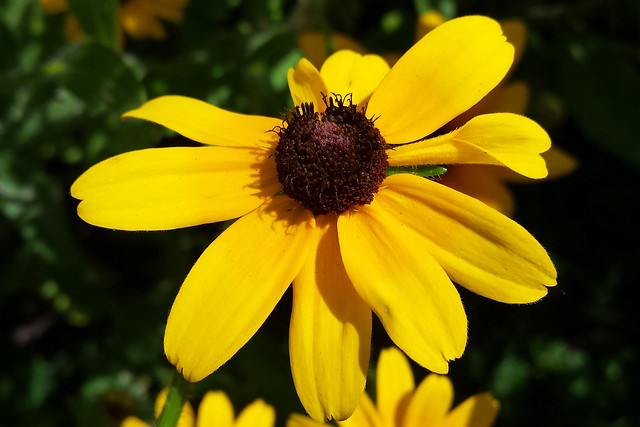
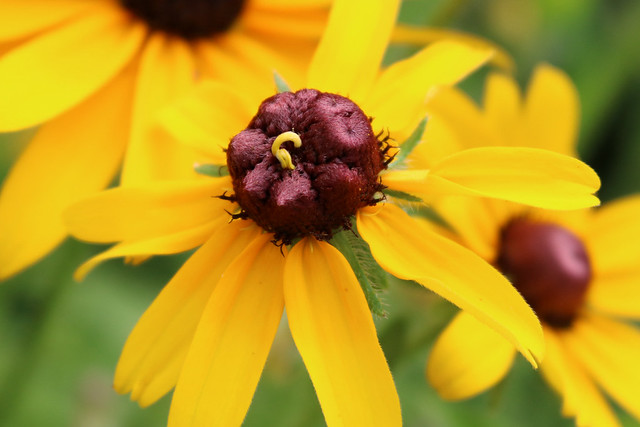
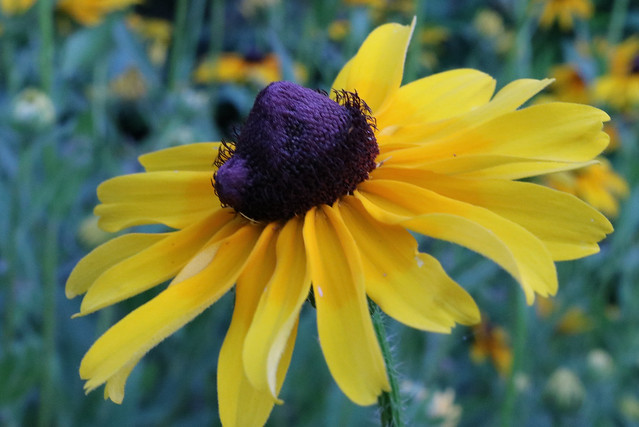
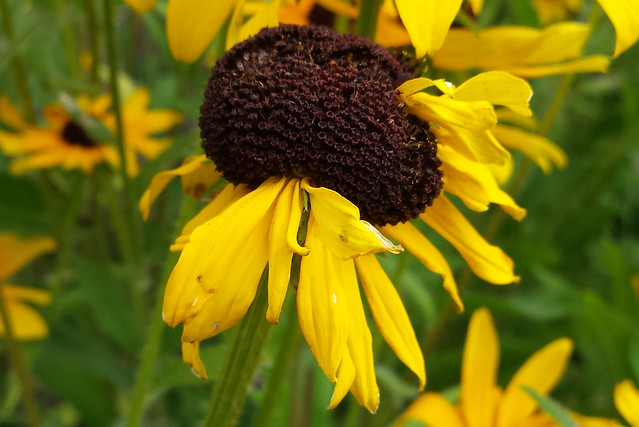
With so many dozens of black-eyed susans in our garden, we were bound to spot some flowers that didn’t grow quite perfectly. Here are some examples.
One petal that remained fused:
Irregular center disks:
Another type of irregular center, a condition called fasciation that causes elongated growth that’s usually in the stem, which causes the flower to be elongated too:
(I left this flower in the garden, since fasciation is not contagious.)
Aster yellows, an incurable condition caused by a bacteria that’s spread by leafhoppers:
(These affected sections of flowers were removed, because aster yellows is contagious.)
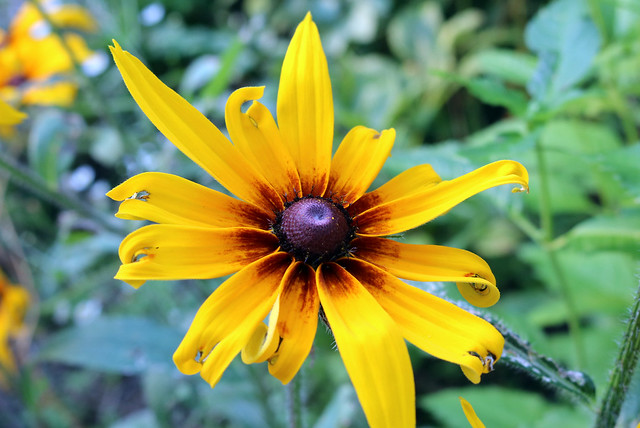
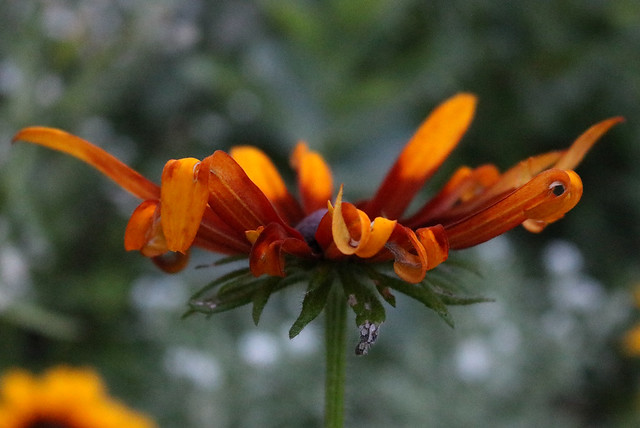
Curled petals that seem to be caused by the tear / hole near the tips:
It’s a pretty effect, but it happened to many flowers, so I’m curious whether it’s something to be concerned about. I haven’t been able to find any information about this yet.
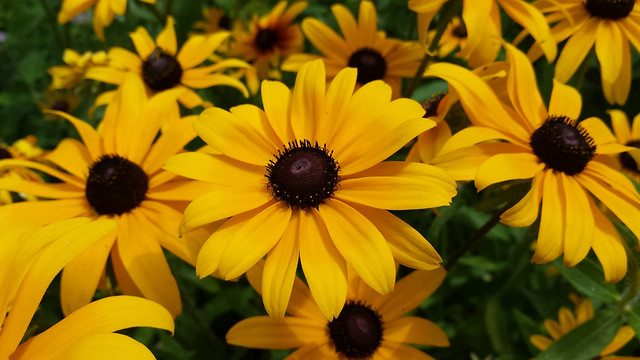
Long petals, short petals. Skinny petals, wide petals. Single color, bicolor. You name it, we saw it somewhere in the garden this year.
The red ones likely came from a seed mix a few years ago. They started in a flower box and are now spreading on their own and may be intermingling with the native, solid-yellow, rudbeckia hirta. I think they’re called “gloriosa daisy” though which specific variety, I’m not sure; perhaps there are more than one, which is why there’s such variation.
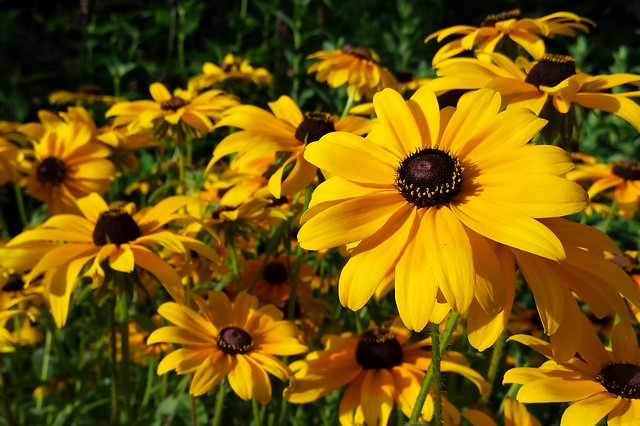
This was a banner season for the native black-eyed susans — especially after such a lackluster year in 2016. While last year there were only a few flowers, and not any until September 19, this year they started opening up on June 20, and dozens and dozens of them kept going for weeks.
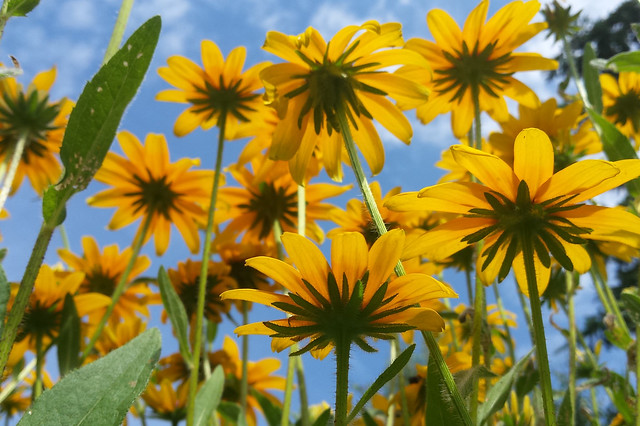
One gorgeous Sunday afternoon, I waded in close to the cluster and crouched near the ground to look up at the blue sky.
Side-by-side comparison of one flower:
Here’s one more photo of the whole bunch for good measure, from the side.
I thought that the Japanese beetle outbreak wasn’t so bad this year (compared to previous years).
I was wrong.
They started out slowly, with just one or two showing up seemingly randomly on basically every kind of plant in the yard — no surprise, since there is a list of about 300 plants that they like. But then they found the grapevine
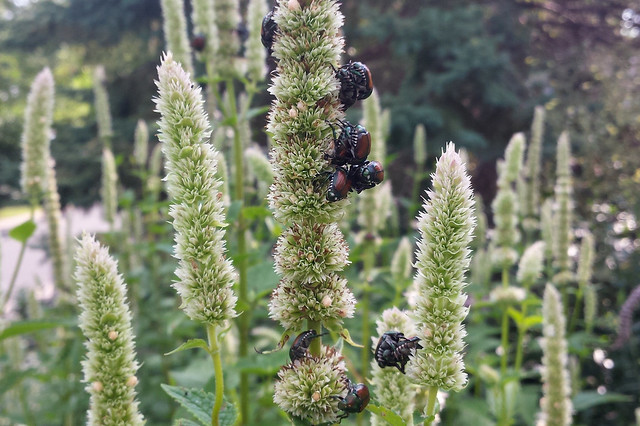
and the purple giant hyssop
and on both of those plants, they really cluster.
Japanese beetles are an invasive species that arrived on the east coast of the United States just over 100 years ago, and they’ve been moving westward ever since.
They are considered a major agricultural pest, destroying turf grass (which, sorry, I don’t care for anyway) and defoliating shrubs and trees.
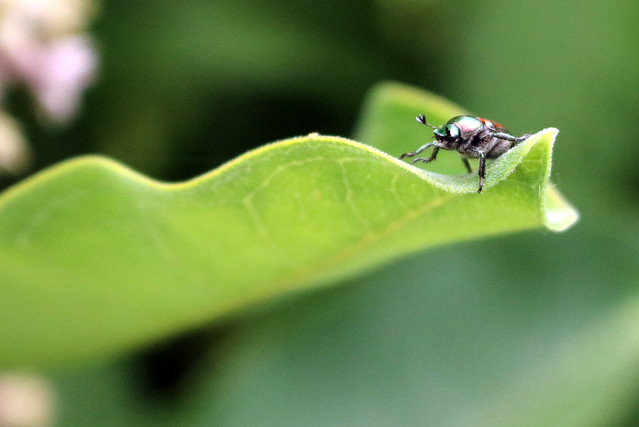
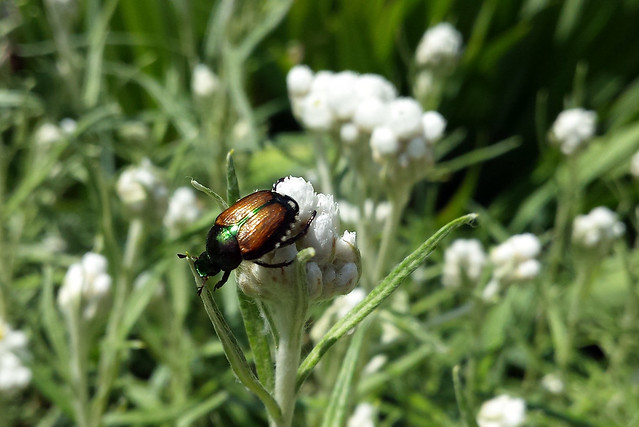
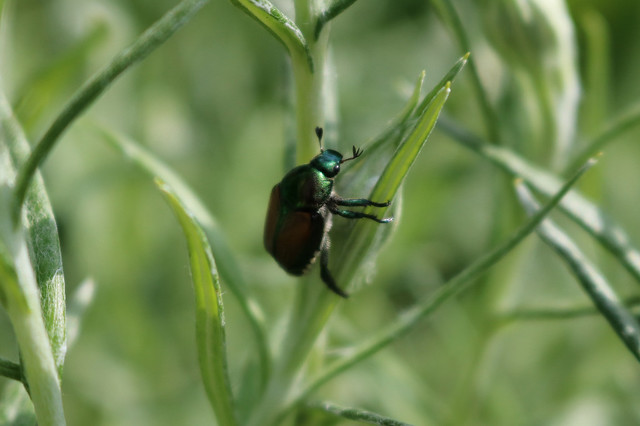
They’re actually quite attractive bugs, with their metallic coloring…
and maybe they’re even a little cute, with their “eyelashes.”
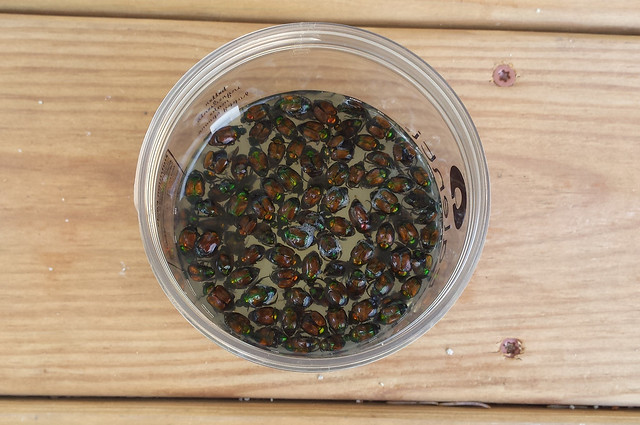
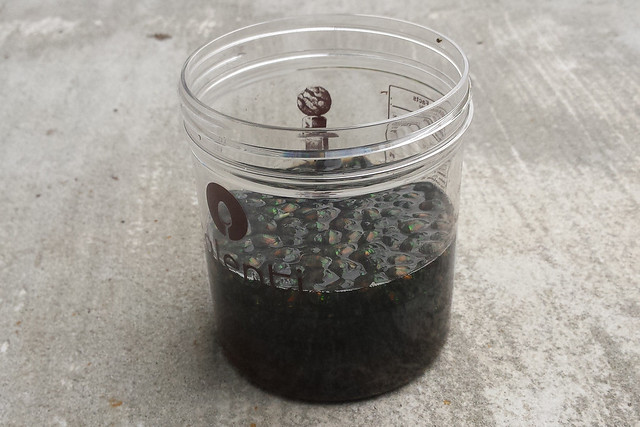
My current method of control is to walk around the garden with a small container of soapy water and to knock the beetles into the container, where they drown. This is mostly but not completely effective because some will fly away, and it is even a little bit fun (but only because it’s an invasive species) as long as the beetles don’t end up in my hair, which happens at least once a night. I sometimes find them there hours later, which is rarely a happy event.
With the large size of my garden, this collecting activity leads to some pretty full, and pretty yucky, containers.
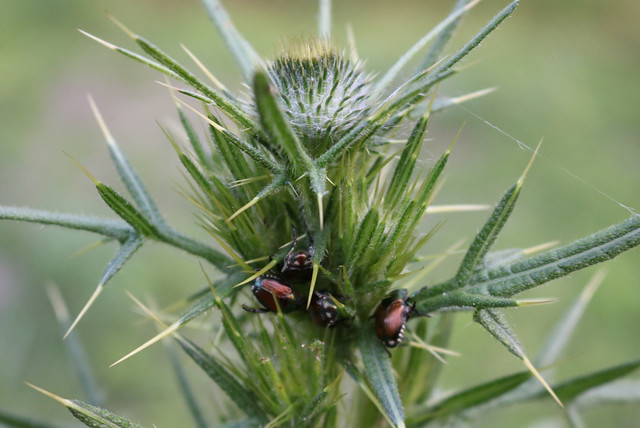
These ones were pretty smart in picking a super-sharp thistle, where I’m not about to go after them.
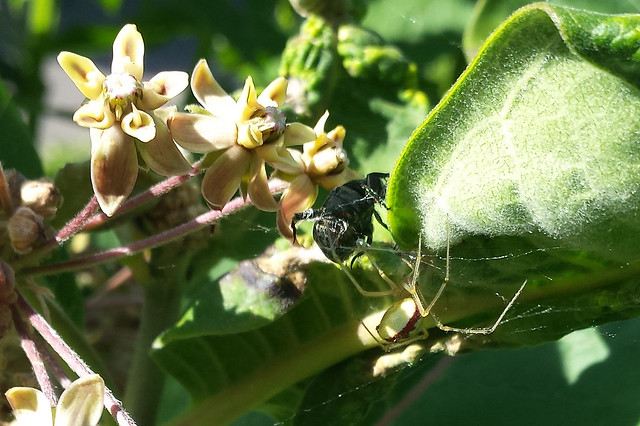
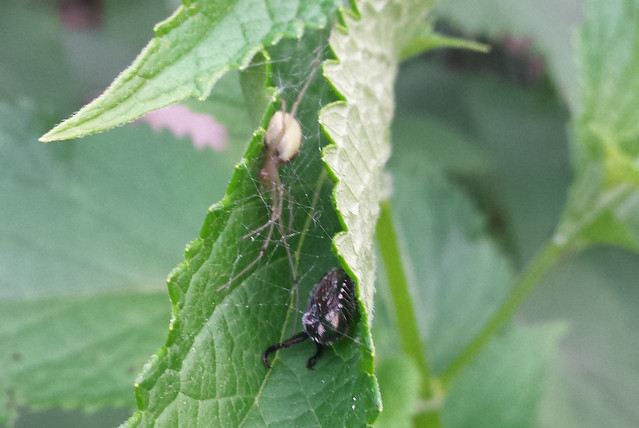
I have heard from a couple of in-person and Instagram friends that chickens love these beetles, but unfortunately I do not have access to chickens. And Japanese beetles don’t have enough natural predators to really control their numbers in Minnesota — though I did catch this interesting altercation between a candy-stripe spider and a Japanese beetle on a common milkweed plant last year. The beetle put up a really good fight, but the spider eventually won.
The end of a Japanese beetle at the hands of a candy-stripe spider, the same night — possibly the same pair, though on a joe-pye weed 10 feet away:
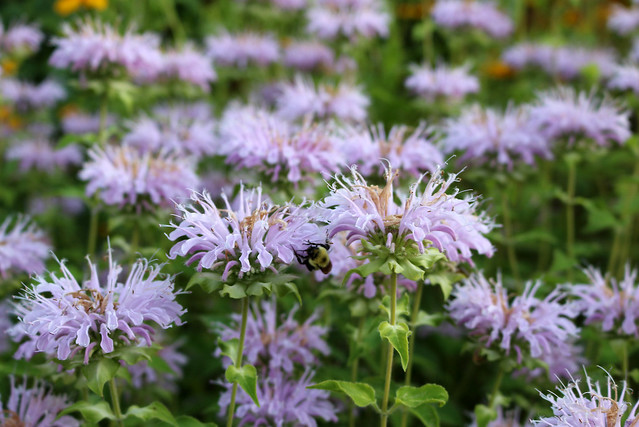
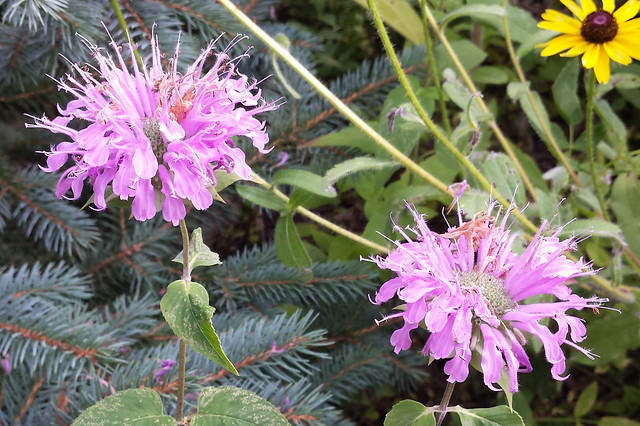
We’ve been growing bee balm (or wild bergamot, or monarda) for many years. It started as one large clump, and then we divided it into two sections. Each year it’s been the same pale purple color.
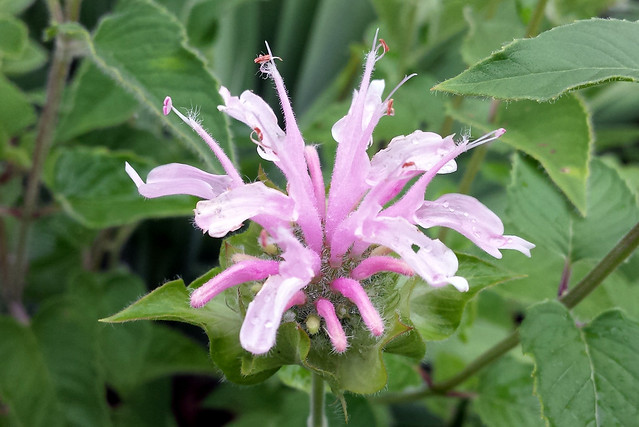
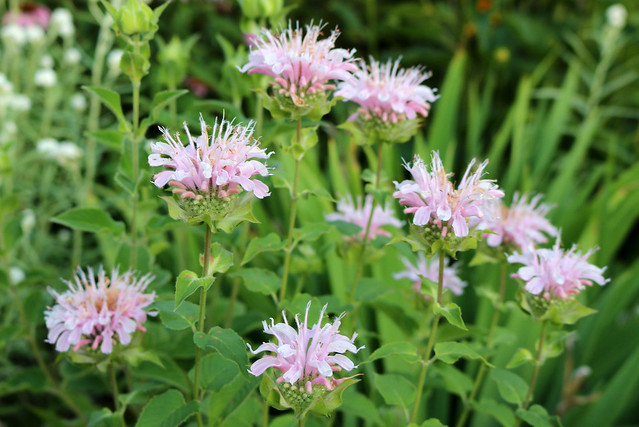
Last year there were a couple of volunteer blossoms, but this summer new growth is popping up all over. The first new plants were purple, too, but then I noticed a pink flower…
…which turned into a pink patch.
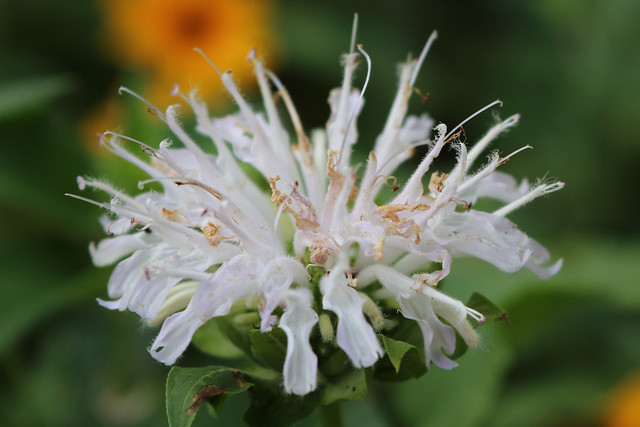
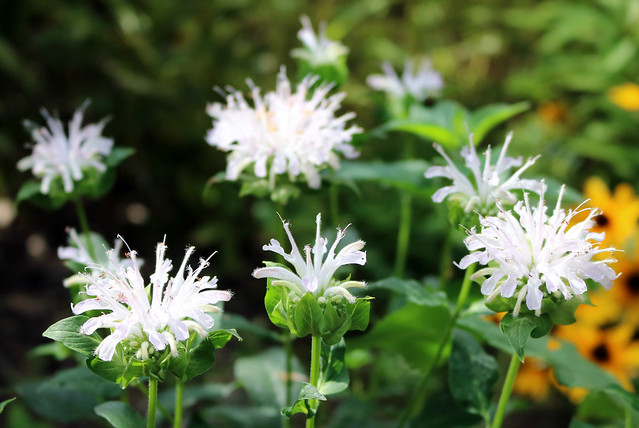
Later I found a nearly white patch, then several more clusters like this.
And finally, I found a couple of blossoms that were a darker purple.















 crystallofolia