The last flower to start blooming this year was one solitary goldenrod. Almost immediately, dozens of little bees found it.

more than a dozen little bees on goldenrod

I saw more types of insects on the goldenrod than I saw on any of our other flowers. Someday I hope to be able to identify bees, but for now I’ll just say there were a lot of bees. A big yellow-and-black beetle hung out for one afternoon, and several mosquitoes even stopped by frequently.

goldenrod with a bee, mosquito, and beetle

This video shows how busy the goldenrod was on a late-summer afternoon:

I spent a lot of time watching the insect activity in the flower garden this year. Some of the plants seemed to be bee magnets, like this catmint that has grown in our yard for years:

bee pollinating catmint

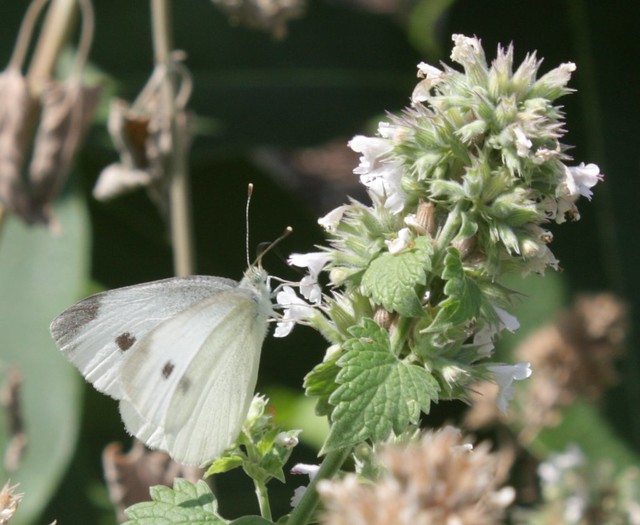
Though bees aren’t the only insects that are attracted to the mint plants. Here’s a cabbage butterfly on catmint:

butterfly on purple giant hyssop

Last year, a new plant sprouted but didn’t flower before winter. This year it got an earlier start and we discovered it was a motherwort. It didn’t take long for the bees to find it. A few bumblebees, in particular, spent lots of time visiting the little pink blossoms:

bumblebee pollinating motherwort

And then there’s the purple giant hyssop. We got this plant last year, but it tipped over in a windstorm and didn’t grow very tall. This year, it was huge, and the bumblebees seemed to go crazy fluttering up and down the flower spikes. There are three bumblebees in this photo, though it wasn’t uncommon to see at least a dozen at a time:

bumblebees on purple giant hyssop

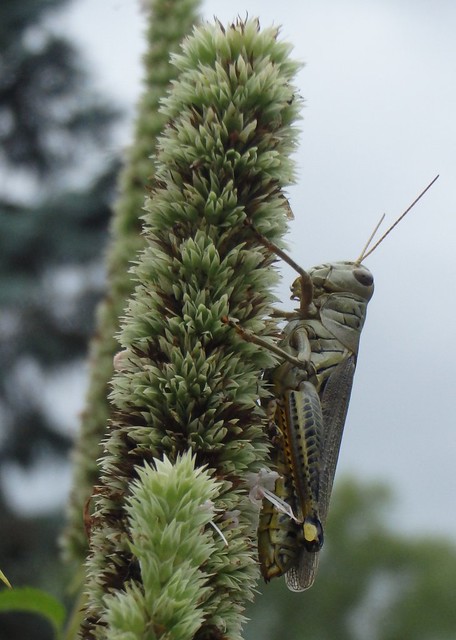
This grasshopper was always on the hyssop, no matter when I looked:

grasshopper on purple giant hyssop

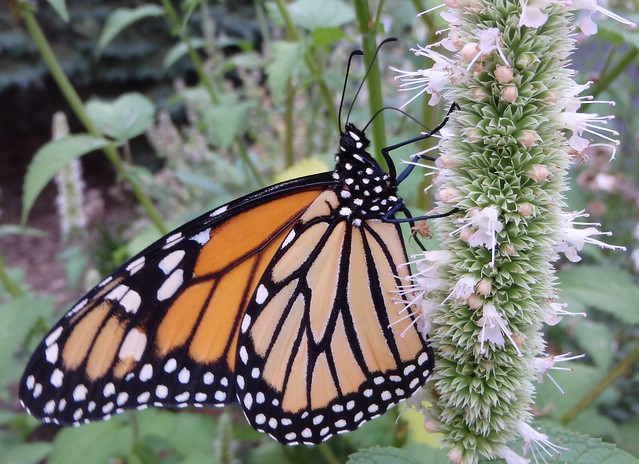
This monarch was so patient as I took dozens of photos:

monarch feeding on purple giant hyssop

…and video. Bumblebees also make an appearance, along with one Japanese beetle:

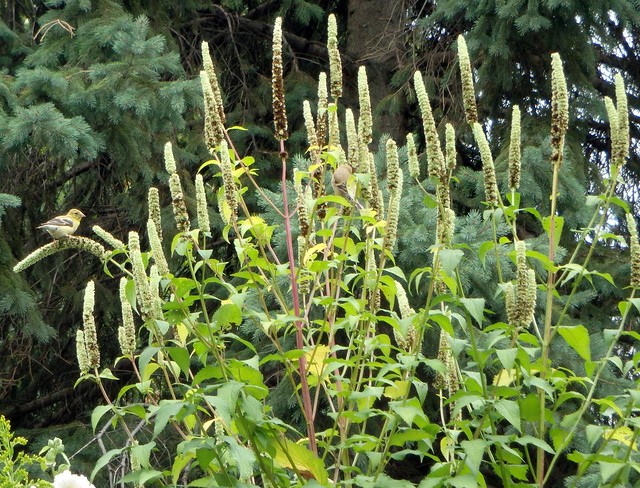
And once the plant was finished flowering, the goldfinches moved in to eat the seeds. There are two in this photo, one hiding in the middle:

goldfinches on purple giant hyssop

Plant sources:

  • Motherwort: Arrived in our yard in 2013 (first flowered and identified in 2014)
  • Mint: Came with the house
  • Purple giant hyssop: Friends School Plant Sale, 2013

I’ve been studying and studying the list of sunflowers on MinnesotaWildflowers.info, trying to identify a very tall sunflower that grew in our yard this year.

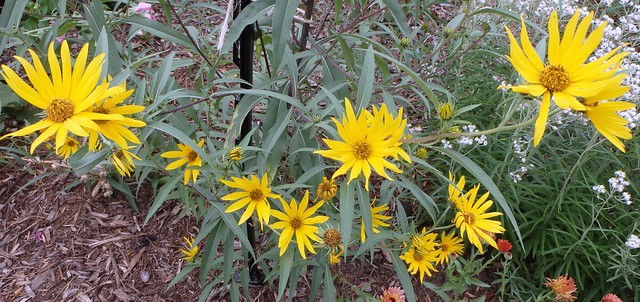
Looking up at many medium-sized yellow sunflowers against a blue sky

I don’t remember buying it, and there is no tag, which suggests I didn’t. It it could be a volunteer plant, like so many others in our garden, though there are at least six stems, so that seems unlikely. Last fall I collected seeds while on a hike, and this plant may have been from a packet that I labeled “giant sunflower.”

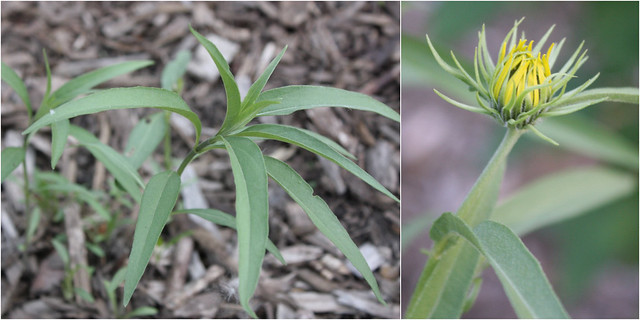
green shoots and a sunflower bud

It has leaves like Maximilian sunflower

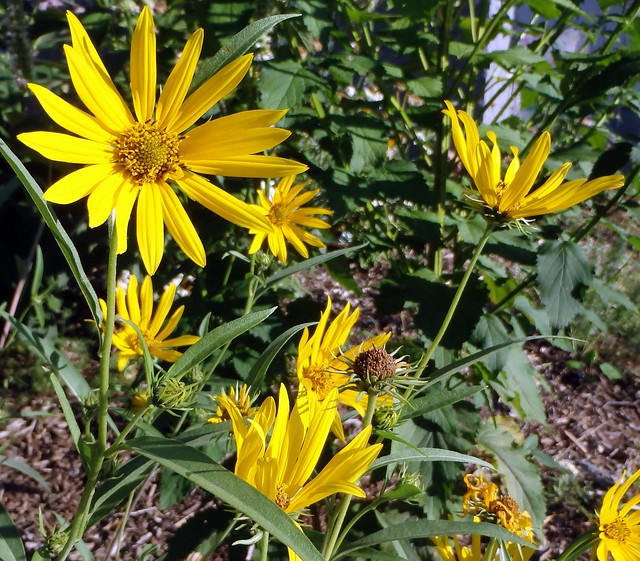
Looking down at several open sunflower blossoms close to the ground

…but petals more like Jerusalem artichoke.

One medium-sized sunflower blossom, fully open

I’ve been calling it “giant sunflower” all summer – but that is the common name of an actual plant, and this one does not have the characteristic hairy stem or toothed leaves.

Many sunflower blossoms in sunshine, from several angles

This is as close as I got to taking a photo of the flower’s bract:

Closeup of two open blossoms against a blue sky

I’m not exactly tall, but even still, this plant towers over me:

A woman standing next to a very tall sunflower

Well, whatever its name, I enjoyed watching it grow and bloom. And so did the bees and bugs.

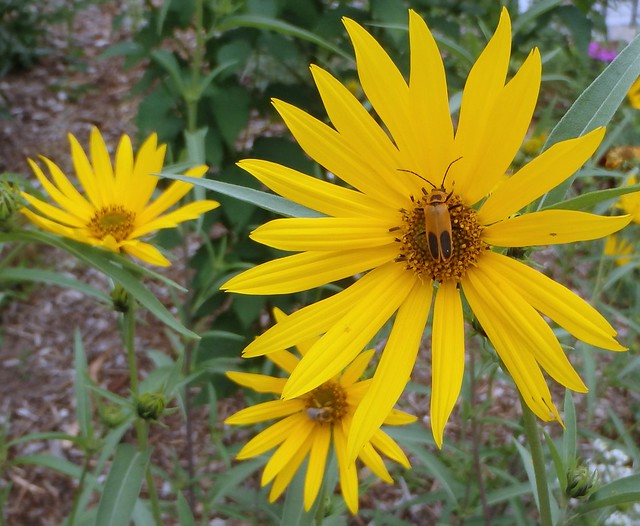
three open sunflowers, one with an orange beetle and one with a bee

Now, it’s time to collect seeds (this time, to make sure it doesn’t take over the entire garden).

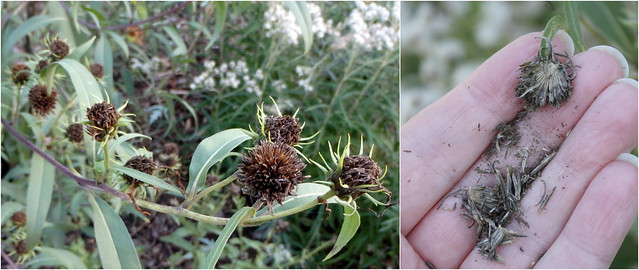
a stalk of many seed heads, and a hand with seeds and half a seed head

I’m going with Maximilian sunflower, with petals that grew thinner than normal, until I learn otherwise.

a bumblebee in a sunflower

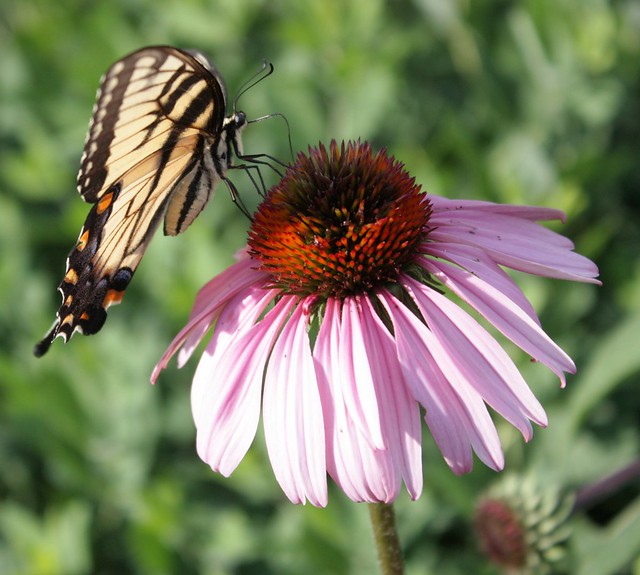
The purple coneflower attracted many butterflies this summer.

Eastern tiger swallowtail butterfly from the right side

I am certainly not a butterfly expert, but I’ve done my best to identify them. Let me know if I’ve made a mistake!

Eastern tiger swallowtail, female and male:

two pictures: female and male Eastern tiger swallowtail butterflies

Red admiral:

red admiral butterfly on top of a flower

White admiral:

two pictures: white admiral butterflies, one from the left side and one from the top

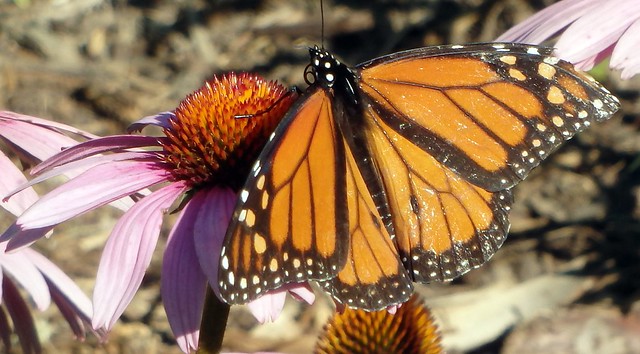
And, of course, monarch:

monarch

We’ve never exactly appreciated the squirrels that live in our neighborhood, but this year they seem especially mean.

This sunflower already had its top bitten off, and the rest didn’t last long after this photo.

sunflower sprout

An entire evening primrose was pulled out of the ground, stem by stem.
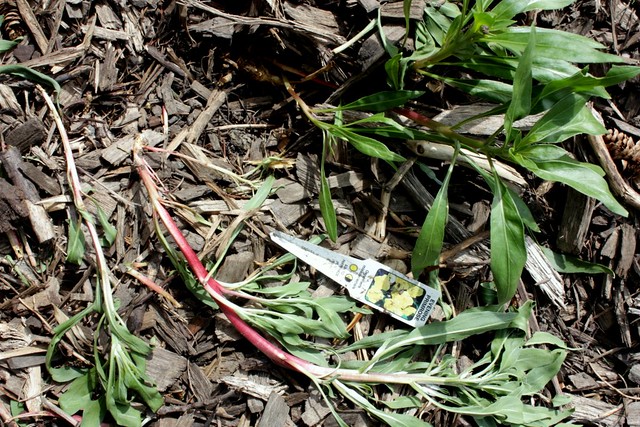
four evening primrose stems lying on the ground

This white coneflower, which bloomed this year for the first time, was snipped off near the ground.
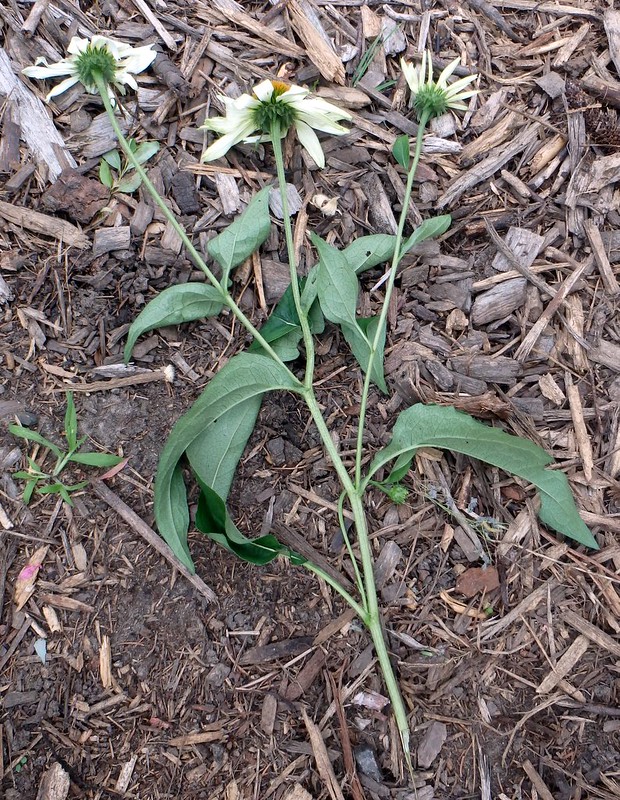
a wilting white coneflower with three blossoms lying on the ground

I was especially annoyed that the squirrels were damaging our flowers for no good reason: they weren’t even eating them. But then they turned to the vegetables, and I wasn’t any less upset even though the food was being eaten.

A chicken-wire fence, which stopped the rabbits, wasn’t enough to deter the squirrels from picking the tomatoes. So we had to add another fence to the top to the garden, which makes it a challenge for the humans to harvest the tomatoes and kale.

half of a green tomato, and a whole green tomato lying on the ground

Earlier this summer, when the squirrels were ripping up the squash and gourd flowers, we fenced them all in, which stopped the damage – but we eventually had to remove the fence because the vines were too constrained.

At one point, we had two acorn squashes. One disappeared completely, and the other ended up with a good chunk eaten off the top.
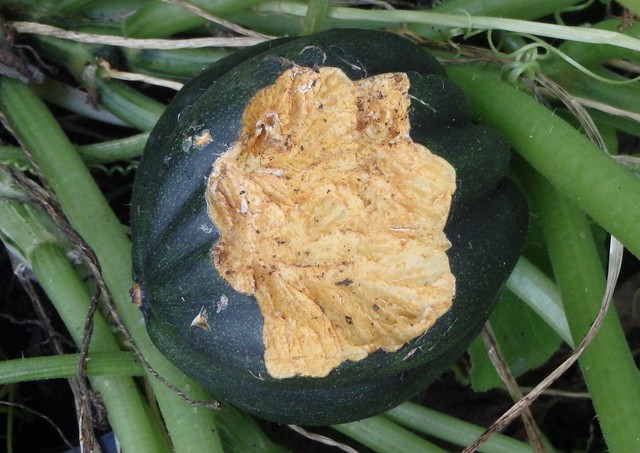
acorn squash with lots of little bite marks on the top

Same thing with this yellow squash. They also got two zucchini, but I don’t have the photo evidence because I was too busy rescuing the untouched zucchini to document it.

summer squash with a hole eaten out of the top, with chunks of the rind lying nearby

There were at least five gourds at one point, each distinctly different in appearance.
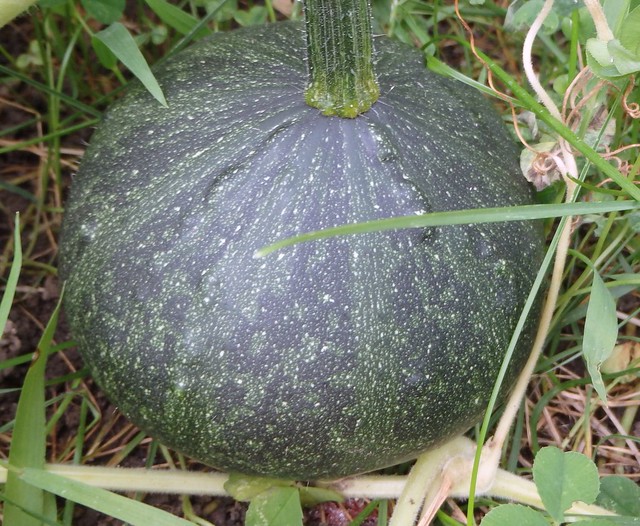
a small, round green gourd

Two disappeared, one is now just a fraction of a rind, and a few scattered “crumbs” were all that remained of the fourth.
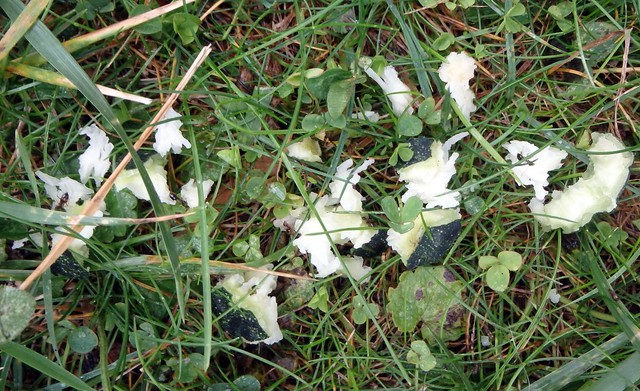
the remains of a green gourd

After this week’s gourd and squash damage, we re-fenced our one pumpkin and one remaining gourd. Without a top to the fence, though, I fear it’s just a matter of time before they’re gone too. At least we have tomatoes and kale!