It started with a small patch of fleabane that popped up in the lawn right behind the house in early June.

a narrow strip of three clumps of plants about two feet tall in the middle of a patchy lawn

Two weeks later came several right at the edge of the railing in the most shady spot of the front yard. There have been a couple here before, but this year they really took off. I called it a “fleabane forest” on Instagram.

up-close view from the side of many fleabane plants

dozens of small daisy-like flowers viewed from above

Little did I know that it would be nothing compared to what happened in the backyard in July: a roughly six feet-by-six feet spot of solid fleabane.

the entire patch of fleabane in the sun, standing far enough back to not have any individual flowers in focus

same clump of flowers but zoomed way in to focus on several in front, with many more blurred in a sunny background

I don’t care that it’s considered weedy; it’s cheery, and it is native.

similar photo but closer in so there are fewer fleabane flowers in the frame

fleabane, zoomed out to where individual flowers are recognizable but there are so many that none are really in focus

Minnesotawildflowers.info recognizes three kinds of fleabane in Minnesota. I am pretty sure the early ones were Philadelphia fleabane. I’m leaning toward prairie fleabane for both of the other locations, and perhaps the difference in bloom time is simply because of different amounts of sunlight. All three varieties that grow in Minnesota are native, though, so I’m not overly concerned about getting the correct identification.

I probably shouldn’t admit this, but I garden without paying much attention to where plants are supposed to grow. I’ll try most flowers once, and if they don’t like the spot, I don’t usually try again. With some notable exceptions (bloodroot keeps breaking my heart), plants will grow in my yard, whether in full sun in the front or in part-shade to mostly-shade in the back.

With that said, and perhaps not surprisingly, I’ve noticed that most of the summer prairie flowers in my yard bloom earlier and more vigorously in full sun.

All comparison photos were taken on July 24; sun first, then shade.

Bee balm was the plant that made me think of comparing the locations:

Yellow coneflower:

Joe-pye weed, just opening up in both spots, but a little further ahead in the full sun:

Pearly everlasting — all over in the front yard, but struggling to make it through all the creeping charlie in the backyard:

Dramatic difference for the black-eyed susan — a huge cluster in the front yard, but just one small plant in the backyard:

(Much more to come about the black-eyed susan situation in the front yard.)

Purple coneflower — not even a comparison because at that point, there were none in the backyard (and even today, August 8, there is just one).

about a dozen large purple coneflowers

I’m not ready to attribute all of the front-yard success to amount of sunlight alone. For example, in the case of the black-eyed susan, in previous years the results were reversed (few in the sun, many in the shade).

And even in part shade, the flowers usually do grow, just later, like the same backyard bee balm location, taken on August 7:

a dozen bee balm flowers, just past peak

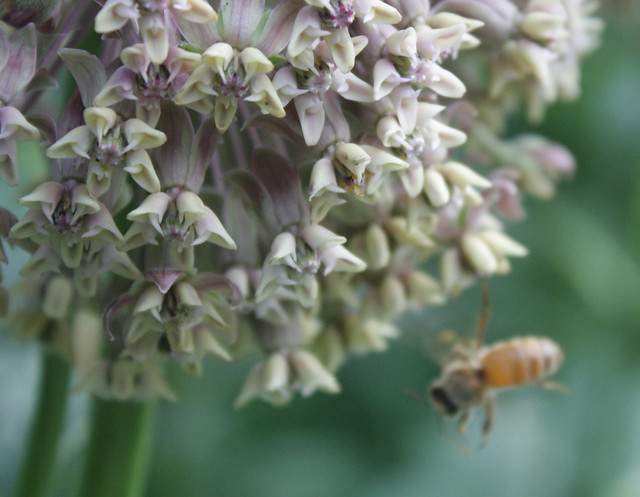
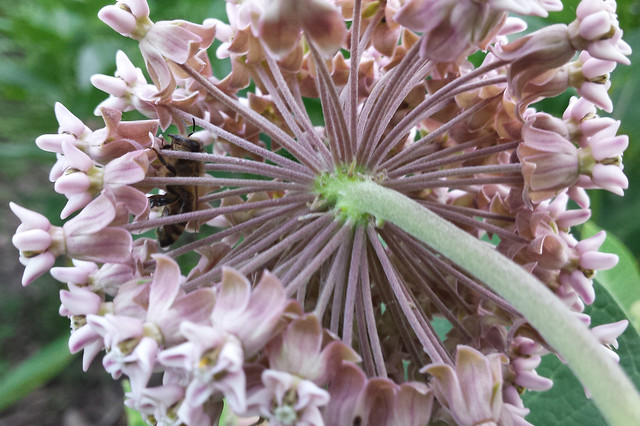
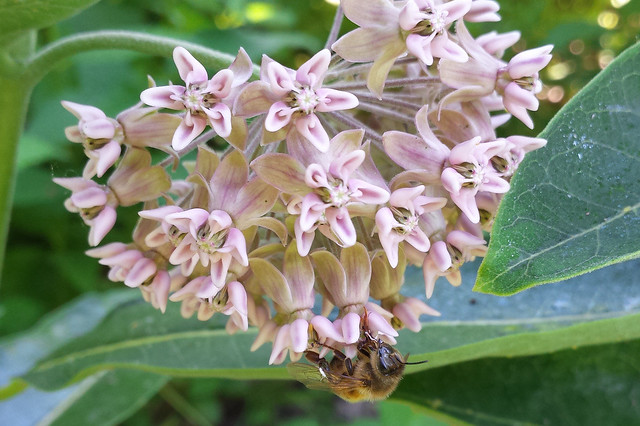
Every summer when the common milkweed is in full bloom, I find insects trapped in its blossoms. They can’t get their legs out because they’re caught in a slit in the flower or on a bundle of pollen called pollinia.

honeybee that appears to be visiting but is stuck on the underside of a cluster

I sometimes see honeybees struggling, like this one from two years ago…

honeybee, out of focus at the bottom of a cluster, hanging by one of its back legs

…and then if they fight enough, they’re often able to get away. I’ve even seen honeybees get stuck, struggle, free themselves, and then immediately get stuck again on another flower.

same honeybee has righted itself, and its wings are beating so fast they look like a blurred circle

But sometimes, they aren’t able to get free. I assume this one struggled so much that it got turned around and found itself in a cage. When I find them, I help them escape. It may be interfering with nature, but I can’t sit by and watch them suffer.

honeybee inside a blossom, viewed from underneath, and the individual flower stalks look like a cage

For the insects that can’t escape, if I don’t find in time, that’s how their story ends. I’ve found many dead insects with their legs stuck in the flowers.

honeybee stuck at the bottom of a cluster

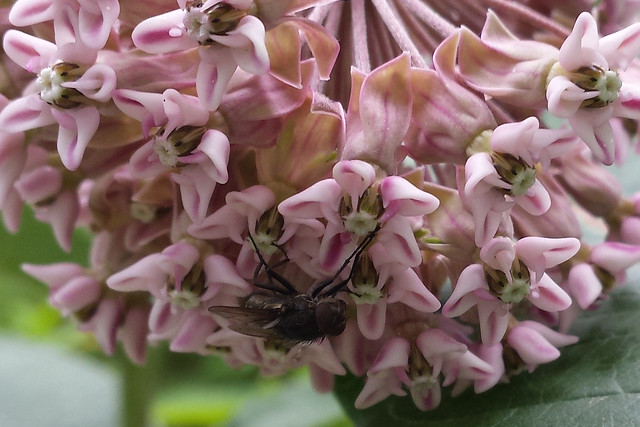
Honeybees, flies, and moths are the only insects I’ve found trapped; bumblebees and other bees, as well as butterflies, apparently are strong enough that this isn’t an issue.

fly with its front two legs trapped in one flower and at least one back leg trapped in another

I found these two moths about two feet apart one morning.

small white moths with a bit of brown stripes, one with its wings open and the other with wings straight behind

The one on the left even lost a leg in the ordeal; you can see it in the first picture too.

facing straight into a blossom, with a white insect leg bent in one of the flowers

Learn more about this phenomenon

I think the title pretty much says it all.

Painted lady:

side view of butterfly facing right underneath a pale-pink cluster, nearly blending in with the flower color

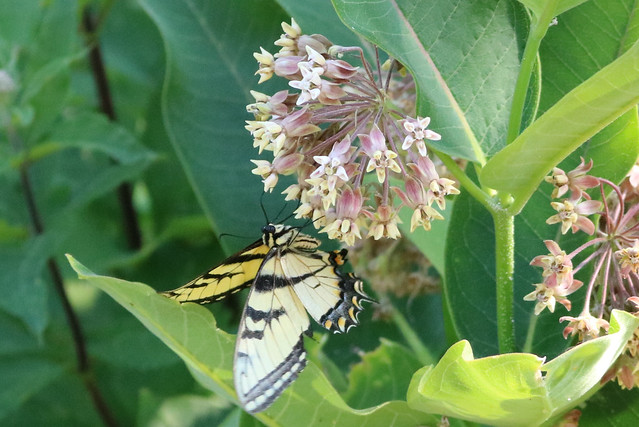
Eastern tiger swallowtail:

facing left under a flower cluster, wings partly open, back wing only partly visible
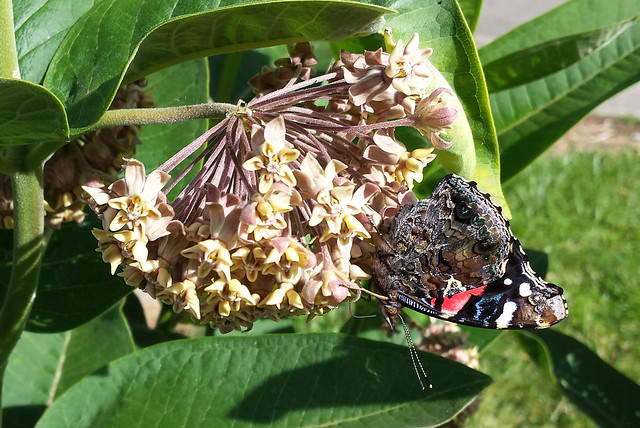
Red admiral with wings closed:

side view of butterfly facing left, hanging off the bottom right side of the flower cluster

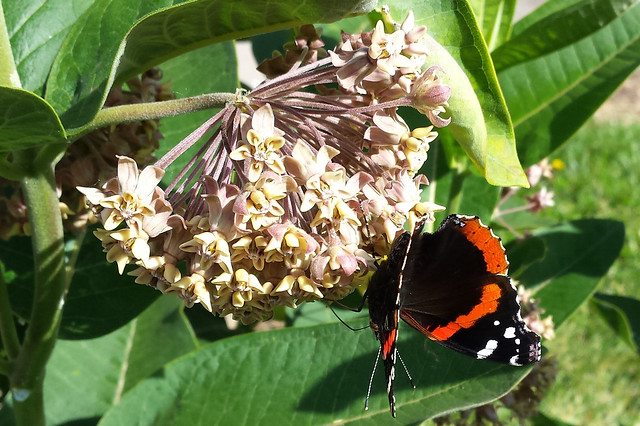
Same butterfly with wings open:

same position, with the wing on the right visible and the wing on the left straight on with the camera

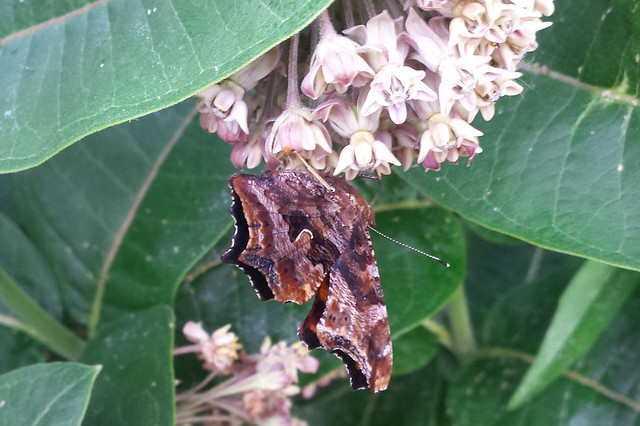
Comma butterfly — wings closed, with the white C / backwards comma visible:

mottled brown butterfly with a small white c, facing up to the right under the flower

Same butterfly with wings open:

wings flat, top wings hanging below the blossom, antennae in an upside-down V

Mourning cloak (taken from the “wrong” side of the sunlight, so it’s in shadow):

facing left underneath a flower cluster, antennae to the left, proboscis in a flower

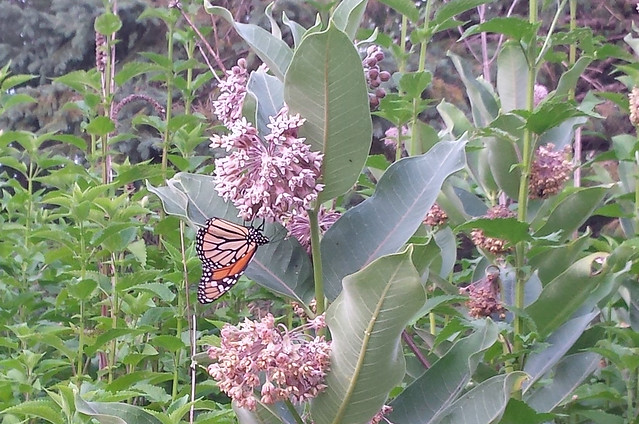
Monarch:

butterfly hanging underneath a blossom, facing right, taken from far away, showing a lot of the plant

And though this one isn’t a butterfly yet, it will be one day, and it’s my favorite photo of the year so far, so I’m including it in this set. Monarch caterpillar in common milkweed:

nearly round blossom, a few flowers moved from the left front to show a caterpillar with its head at the bottom left and its end up near the middle

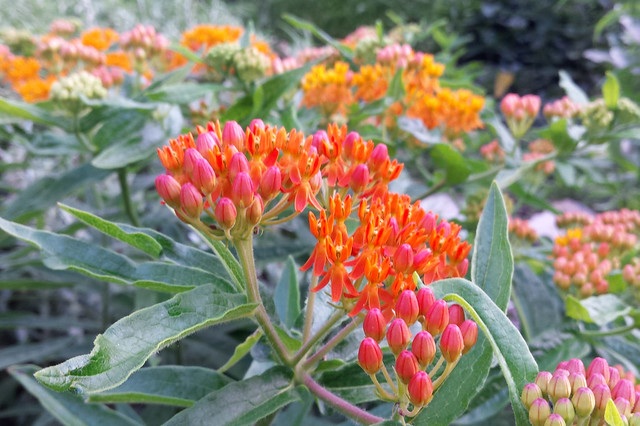
The butterfly weed nearest the street — one big plant that’s been growing for a few years — is two shades of orange:

from above, a nearly round-shaped plant, dark orange flowers on the left, lighter orange flowers on the right

half dark orange, half light orange.

close-up view from the side, dark orange milkweed in focus in front, light orange out of focus in back

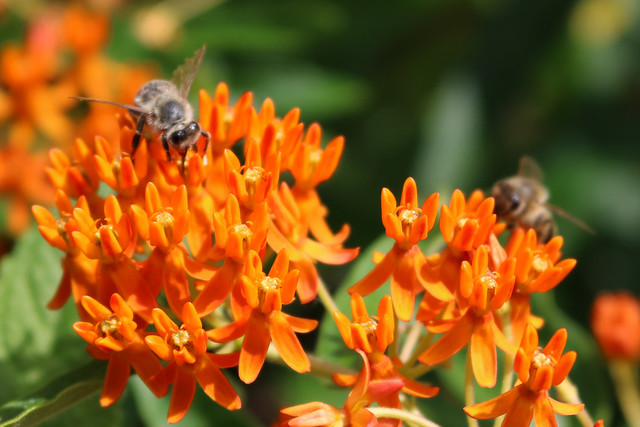
This particular plant (one of at least five butterfly weeds in our front yard) is constantly humming with busy honeybees.

closeup of a stem of dark orange with a honeybee on each side

closeup of a horizontal stem of light orange, with one honeybee on the left and two on the right

I thought about watching for five minutes for an unscientific study of which side the bees prefer. Over several days, I would keep coming back to this flower, and the result wasn’t consistent.

closeup of dark orange, with a honeybee in focus facing down on the left and an out-of-focus honeybee further back on the right

closeup of light orange, with a honeybee in focus facing up on the center-right and an out-of-focus honeybee above facing left

Other bees sometimes make an appearance, too. I don’t know what kind of bee this is.

longhorn bee facing away so the head isn't visible

And being butterfly weed, butterflies sometimes stop by, too. I think this is a type of hairstreak.

small brown butterfly with a small triangle of orange on the bottom of the hind wing and a bluish patch below that

This is the same butterfly weed plant that had six monarch eggs earlier this year.