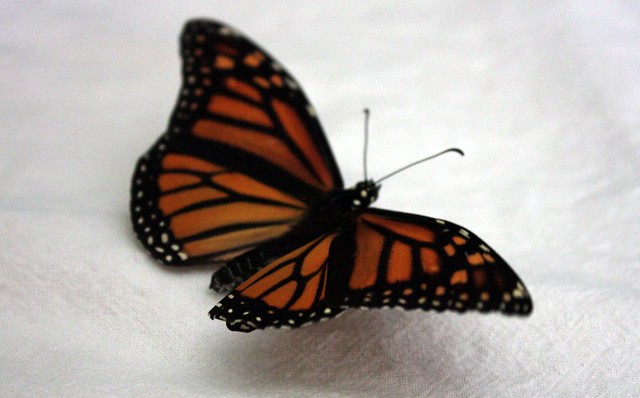
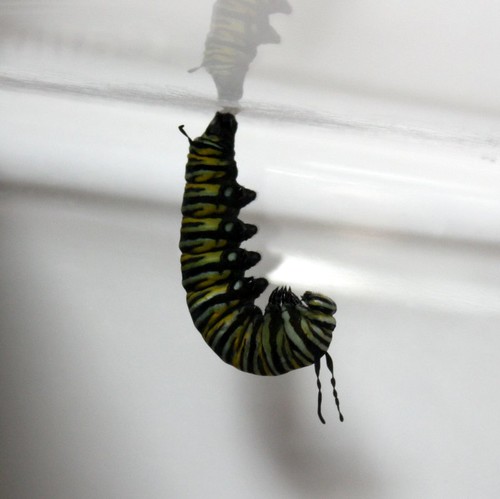
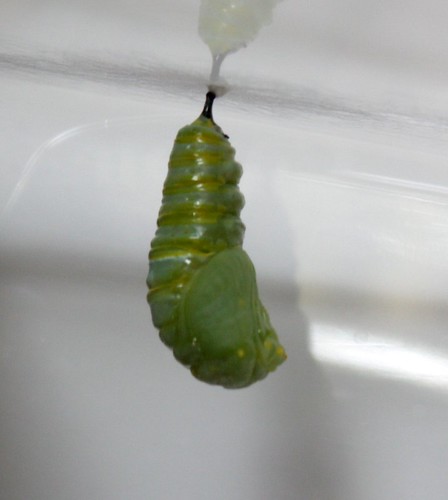
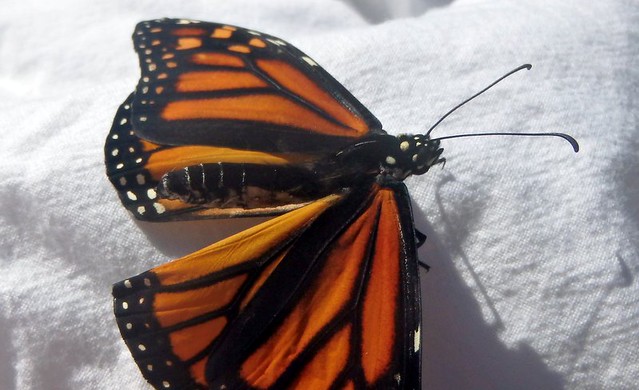
Monarch season is long over in the north and we’re hearing reports of butterflies that have arrived in Mexico. It’s hard to believe that the three we released in September may be 2,000 miles away now! Here’s one last monarch post of 2015 to review our first season of raising.

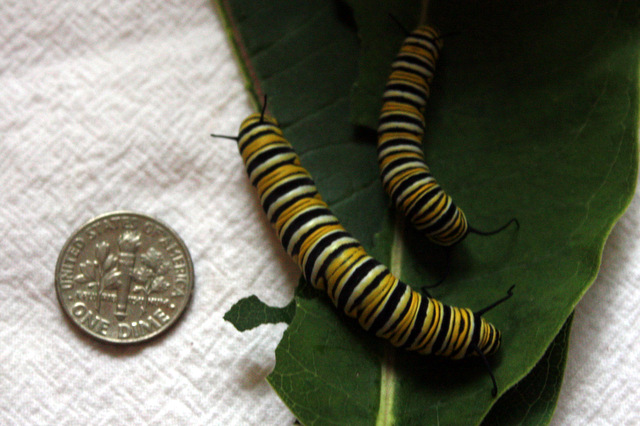
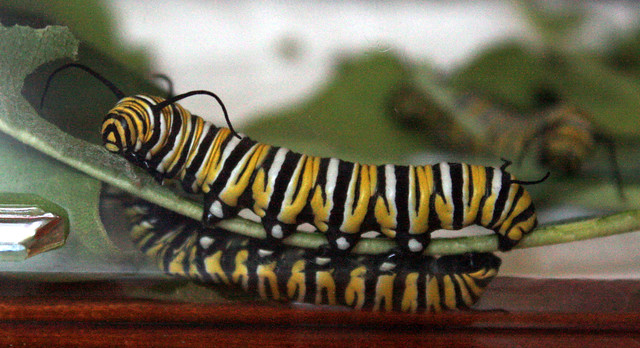
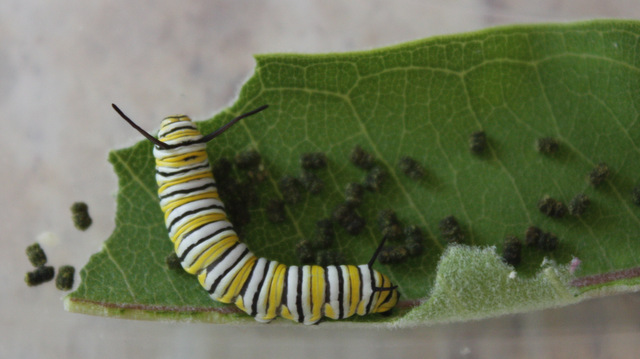
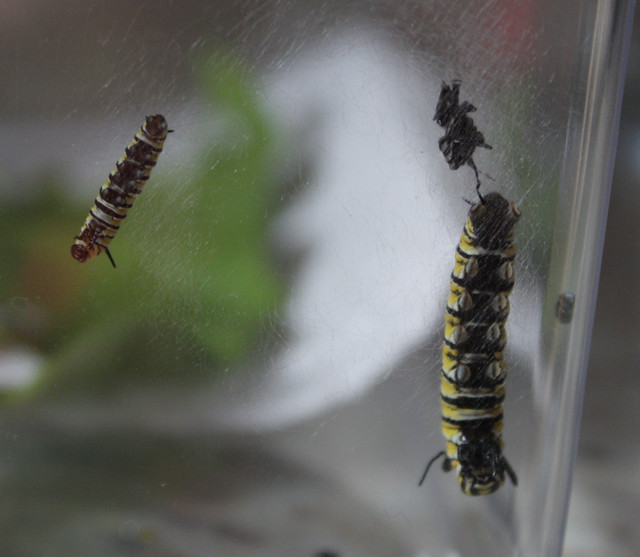
two big caterpillars in acrobatic poses while eating

I was an observer during the first generation of the season. During the second generation, we raised and released nine butterflies. During the migration generation, we raised four butterflies and released three (the fourth couldn’t fly).
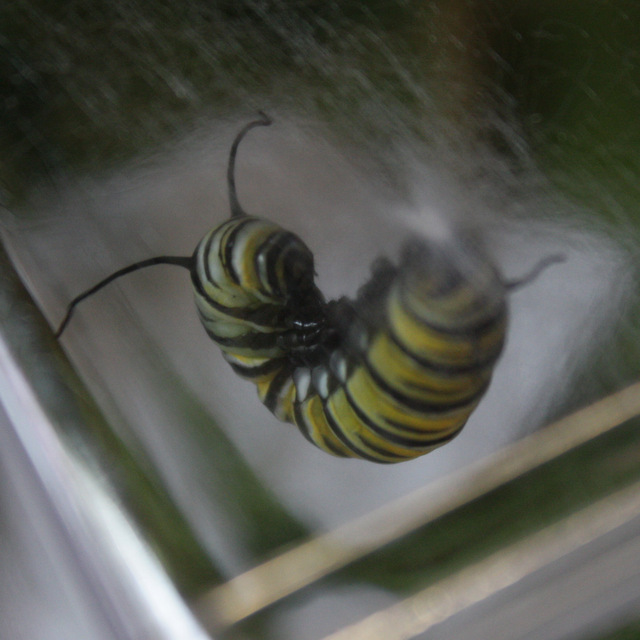
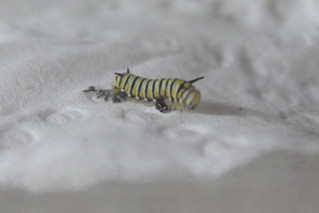
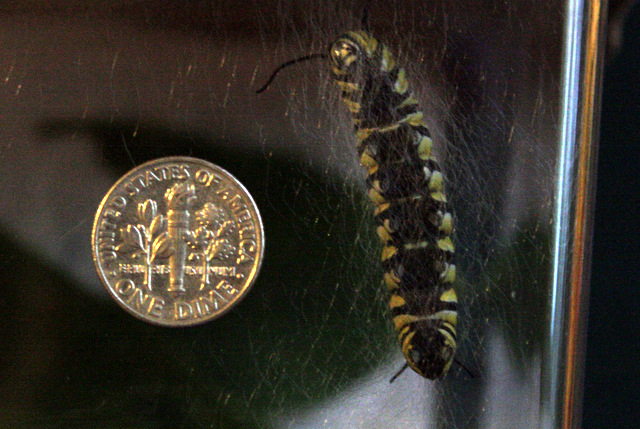
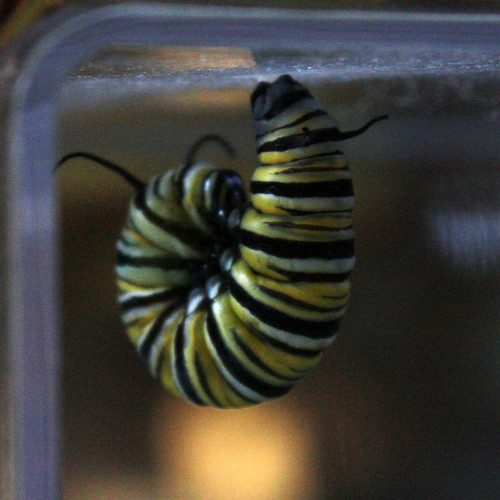
caterpillar in J formation, viewed from above

I recorded 72 videos and took more than 900 photos, though I didn’t save nearly that many.
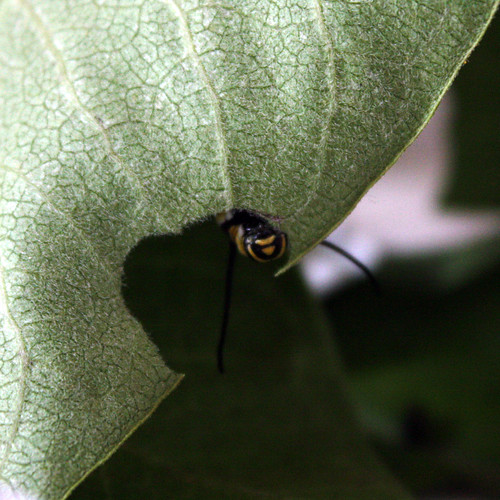
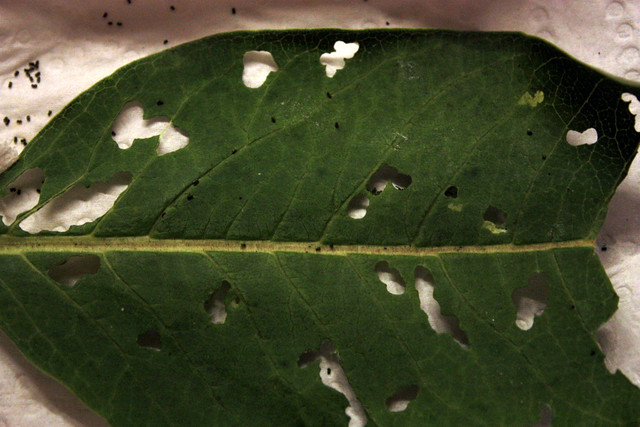
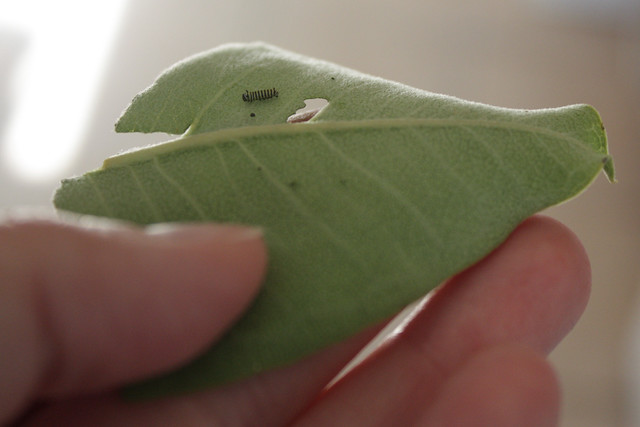
the underside of a leaf, with a caterpillar peeking around a chewed edge

Why so few during the migration generation? I’m guessing it is because we had mostly common milkweed. By the time eggs were laid for the migration season, the common milkweed was not in great shape. I was imagining the female butterflies – who were still visiting the yard – saying, “Ew! I’m not laying my eggs on that disgusting leaf.” It’s a good reminder to diversify the plants to support a full season of insects. I’ve already planted swamp milkweed seeds and will look for more milkweed options next spring.

monarch drinking from joe-pye weed

There was one pair of caterpillars that were always fighting for position. Even when they had climbed to the top of the cage, each was still trying to stake her claim. I felt like I was separating squabbling siblings more than once – “Just mind your own business. Move away so she doesn’t bother you.” – until I realized that I should leave them alone and let them figure it out.

Every day I brought in new milkweed leaves, ripping off bad spots. Many times late at night, I realized that I didn’t have enough and went back out into the yard with a flashlight to harvest more and save them in the fridge, just in case.

one leaf with a spot torn off, and another leaf in a plastic bag

I never understood why they would always finish a wilted old leaf first, even when there was a new, fresh leaf available.
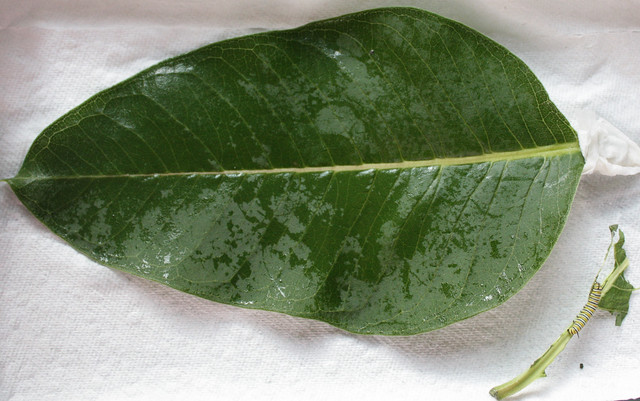
caterpillar eating a leaf down to the stem, next to a wet new leaf

There were two “oops” caterpillars – two leaves I brought in for food had eggs I hadn’t noticed; one even got washed before I found it.
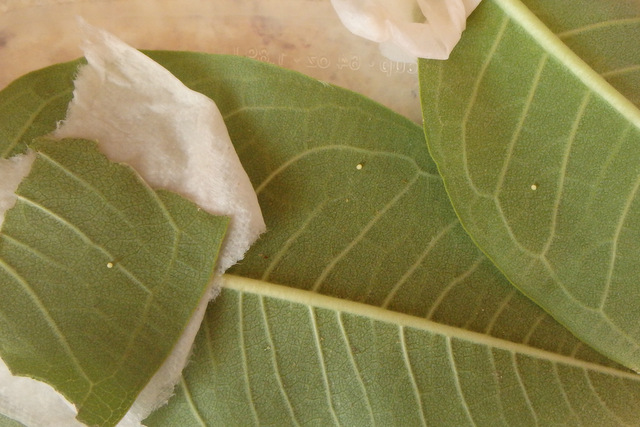
three leaves, each with an egg

Right after molting, with no face…

just molted; new face hasn't come in yet

…because the head capsule pops off during molting:
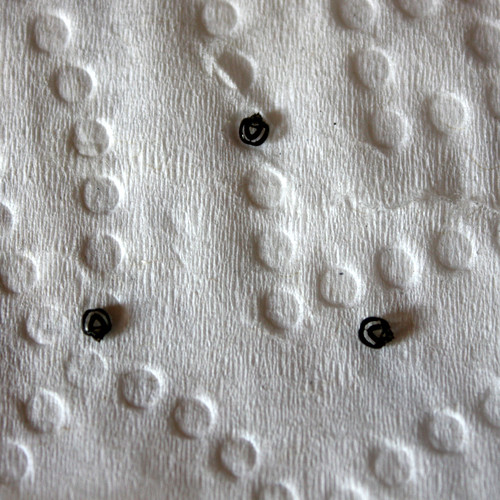
three discarded head capsules

The fascinatingly creepy skin that’s left over after pupation:
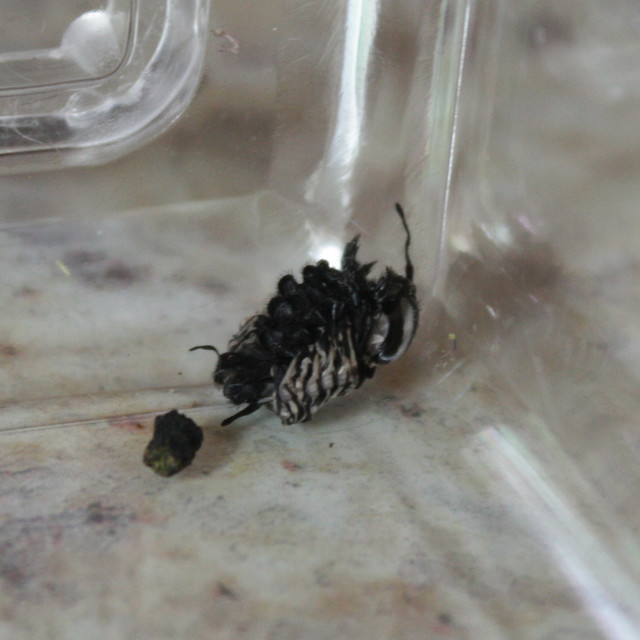
scrunched up skin on the bottom of a cage

Once the skin didn’t detach when the chrysalis was formed, but it turned out fine.

A bigger concern: one caterpillar started discharging a yellow-green liquid the day before she pupated. I isolated her because I was worried about a disease that could spread to another caterpillar, or perhaps the caterpillar had been infected by a tachinid fly that would emerge from the chrysalis (and kill it) and make a mess. But the butterfly was normal.
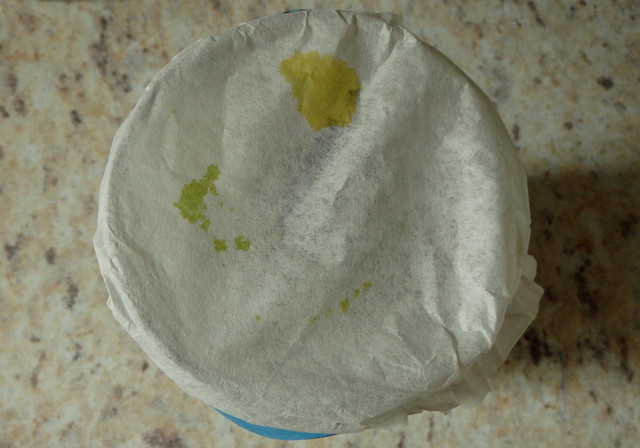
jar with a coffee filter over the top, with yellow stains

When a caterpillar is ready to pupate, it gets into position quickly; I only caught one caterpillar starting to make the long journey up to the top of the cage.

The caterpillars always seemed so surprised to find themselves at the top of the cage. “Wait, what is this green thing?”

caterpillar inspecting a chrysalis

They go through an elaborate process to spin a web during molting and before pupation.

And another long process to create the silk “button” that will hold the chrysalis.

I’m always surprised by how much I miss the caterpillars when they chrysalis-ize. Things are suddenly really quiet, once a chrysalis forms.

the last caterpillar, one day before pupation

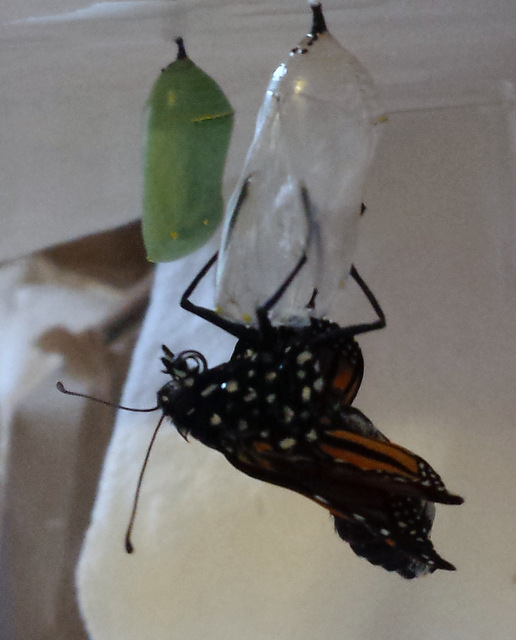
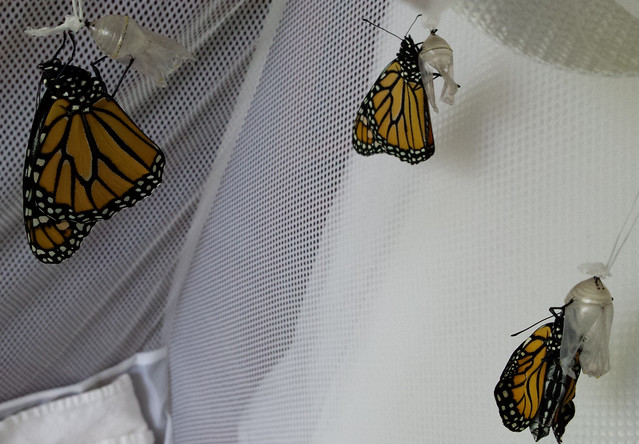
When the first butterfly was ready to emerge from her chrysalis, I was worried she would fall, so I set up lots of towels for cushion. But she didn’t fall, and neither did any other. In fact, one hung from the empty chrysalis all day, then all night, and into the next morning, when I opened the cage to let her out.

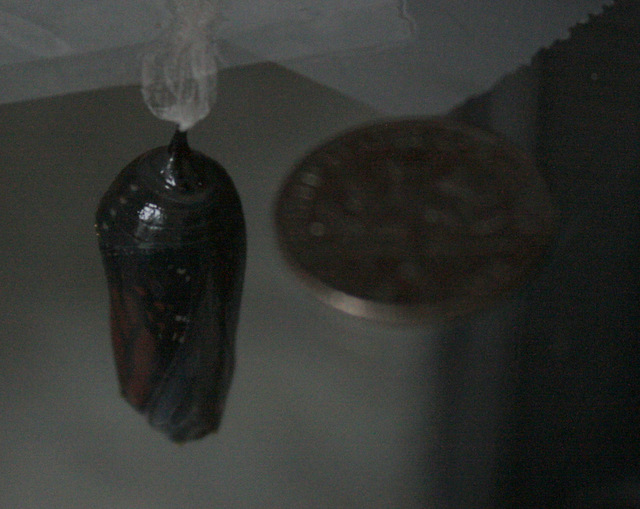
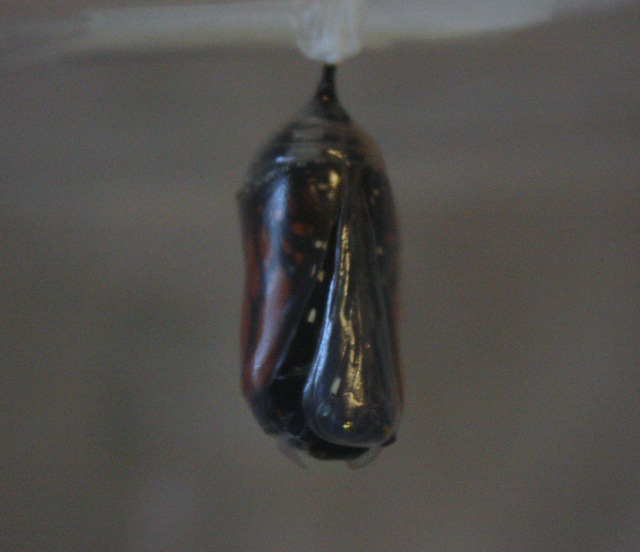
Right before the butterfly emerges, the chrysalis looks a little like Darth Vader.

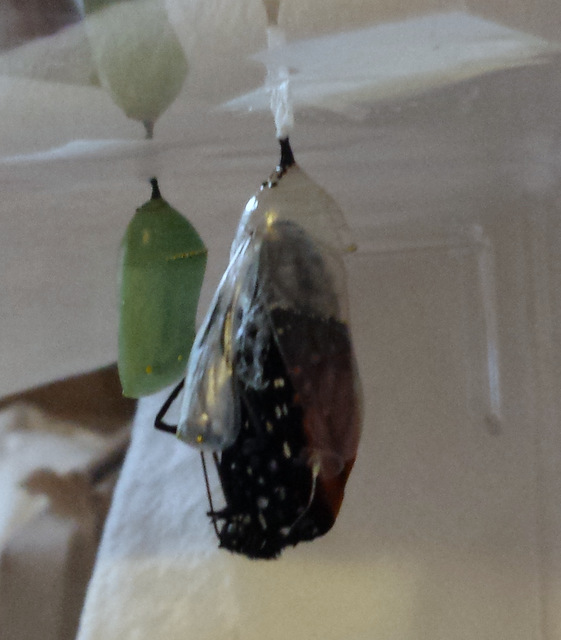
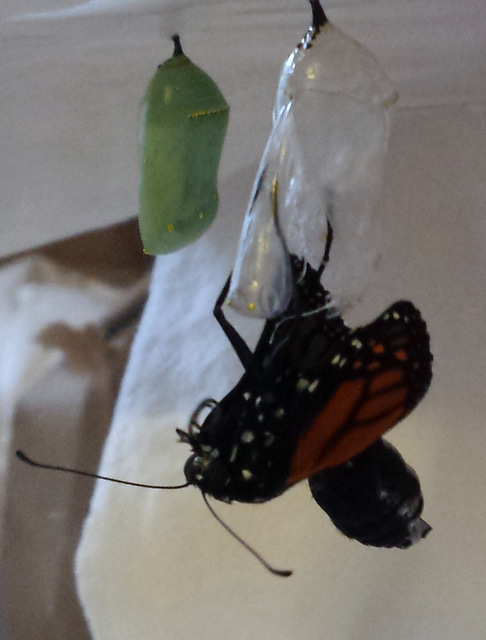
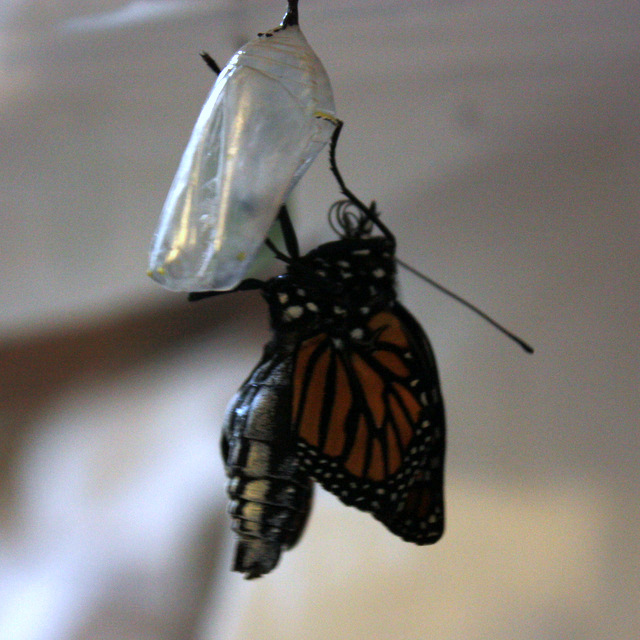
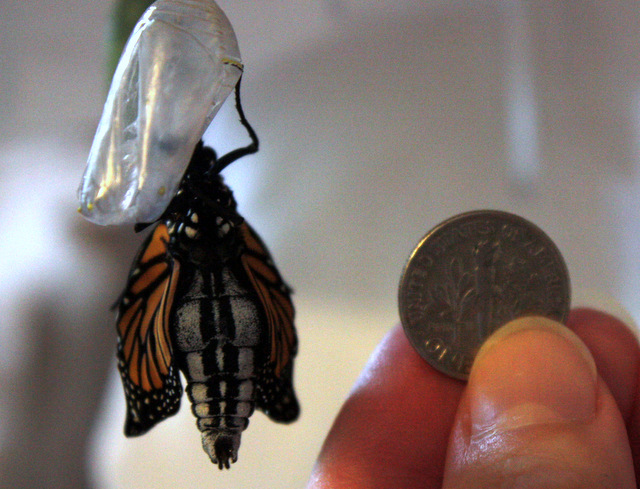
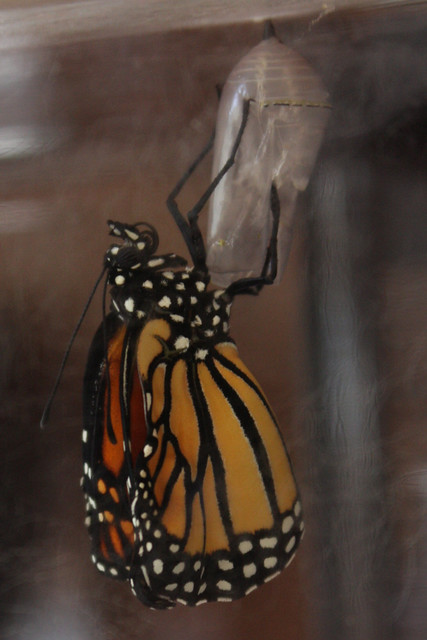
It’s amusing how tiny and wrinkly the butterflies are when they first emerge. But it doesn’t take long for their wings to flatten.

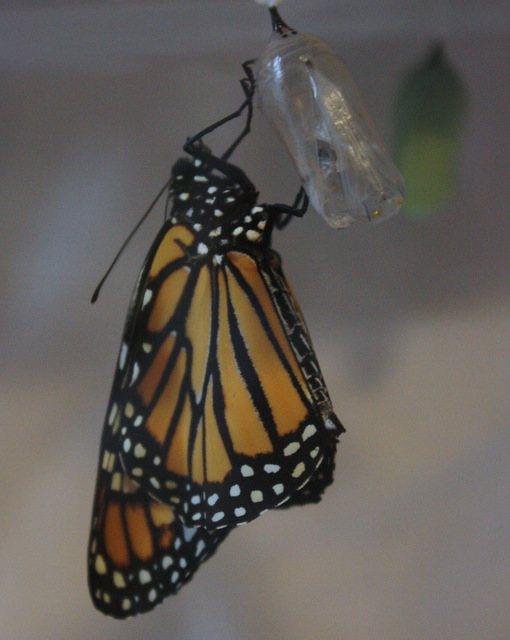
They hold still for several hours while their wings dry.

One was so excited to leave that she tried to crawl through the towel that was draped over the top of the cage. I didn’t see her at first and was worried she had escaped.

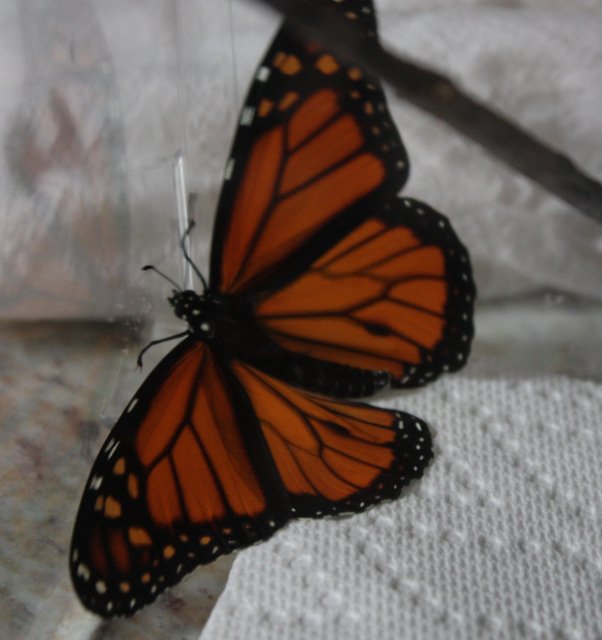
monarch lying on its side on a towel

But NONE of the butterflies escaped in the house!

monarch climbing out of a jar

All but one wanted help getting out of the cage. It’s a fun and funny feeling to have a butterfly crawl onto my hand.

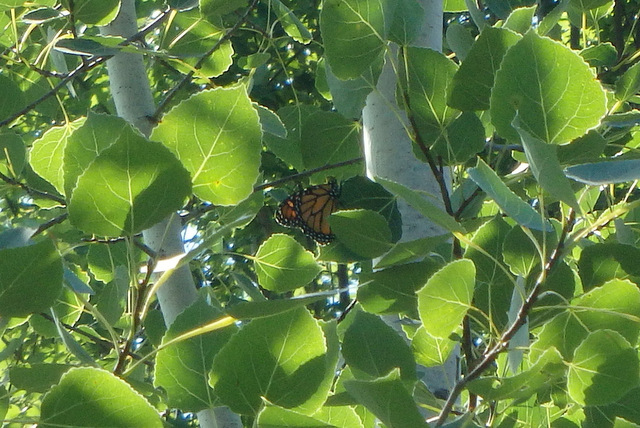
All of them flew off into a tree immediately after they were released.

monarch resting in a pine tree

My favorite memory of the 2015 season: the sound of caterpillars chewing milkweed leaves.

Will we do it again next year? I’m not sure. It’s a lot of work – not so much on any one day, but over the couple of weeks during the caterpillar stage. It’s not possible to take a vacation while there are caterpillars. And some people advise against mass-rearing (although our “operation” could hardly be called “mass”), which makes me wonder whether we should raise any indoors.
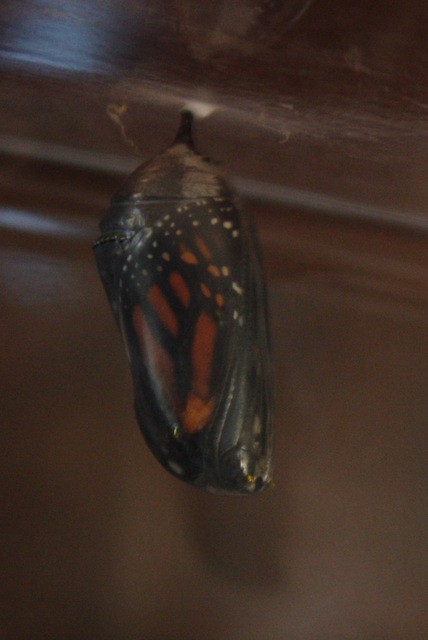
chrysalis with visible butterfly wings

It was a fun and educational experience, and I’m sure that I’ll want to do it again. It’s hard to see caterpillars in the yard and leave them, because I want to keep all of them safe until they turn into butterflies.
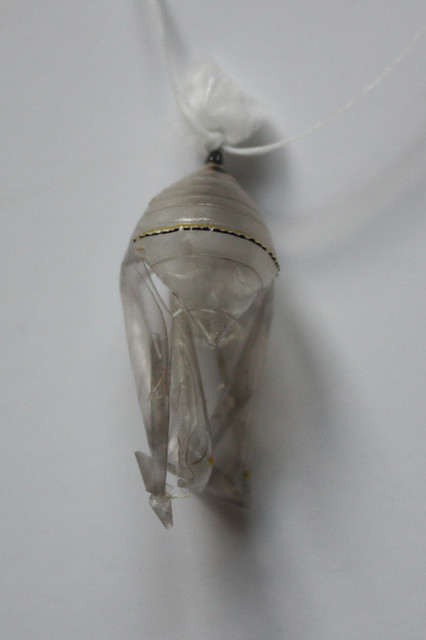
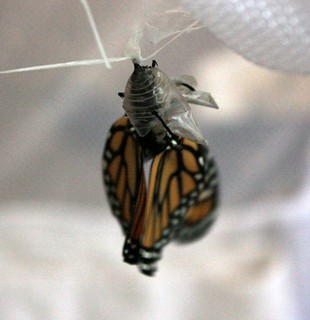
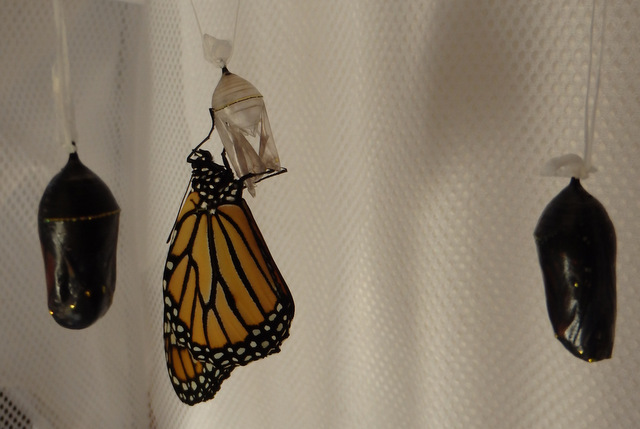
empty chrysalis

More monarch posts

This was our first year of raising monarchs. Most of the time, when a butterfly emerged from its chrysalis, the big event happened before I woke up. So when it was time for the 12th birth, the day after Labor Day, I didn’t even try to wake up early to catch it. But when I checked on her, I noticed a that not only had she emerged, there was major problem: she was stuck in the chrysalis.

chrysalis viewed from above with a butterfly's wings below

Her head and wings were out, but her abdomen was stuck to the very top of the chrysalis. It was obvious that she had been struggling to free herself for some time.

Best practices say that you should not help a monarch who is stuck. If this problem occurs, it is because something is wrong and the monarch isn’t healthy enough to live. But how in the world could I not help?! It was terrible to watch her frantic struggling. And I’m already helping by raising monarchs indoors, away from predators. Of course I felt like I had to help her.

Luckily, my husband was at home that morning to assist. I cut down the chrysalis, and we gently laid her on a towel. It didn’t take much to pull the chrysalis off.

gloved hands tugging at the top of the chrysalis

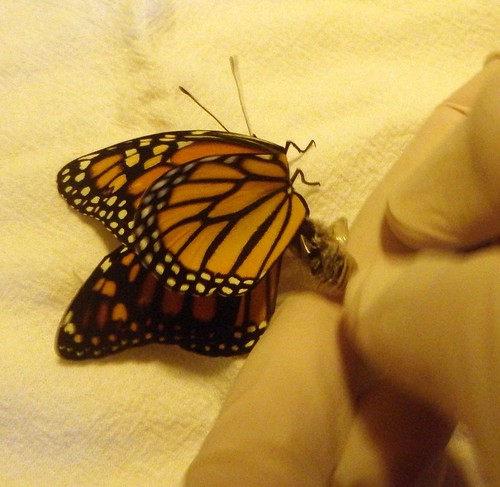
Her wings were limp, which I thought meant she might be new enough that she still had time to finish drying. I struggled to get her back into the cage because she was desperate to climb up my hands rather than be set down. She knew she needed to be able to hang to let her wings dry.

monarch with wings unfolded in a pair of gloved hands

Unfortunately, when I got home from work that night, her wings still weren’t straight. I thought she flew a tiny bit but then realized it was more of a jump with a flutter. I had already decided to keep her inside overnight, and in the morning, not much had changed.

So what to do? It was the migration season, and she couldn’t fly. She needed to get to Mexico, or she would freeze or be eaten. Would it be more humane to euthanize her? Or should I keep her inside as long as she could survive?

There’s not a lot of advice for a situation like this. The only thing I could find was along these lines: “If the butterfly can’t fly, you should feed the butterfly sugar-water or rotten fruit.” Well, of course we should feed her. But then what? Do we keep her for the nine months that the migration generation lives? And even then, if she can’t fly, we wouldn’t be able to let her out even when the others returned to Minnesota in the spring. This was pretty stressful.

I mashed up an old banana and somehow managed to set her down near – or more accurately, in – it. By the time I had a chance to wonder whether she’d know what to do, I noticed her proboscis was already in the banana.

https://youtu.be/kuLk4OU9k8U

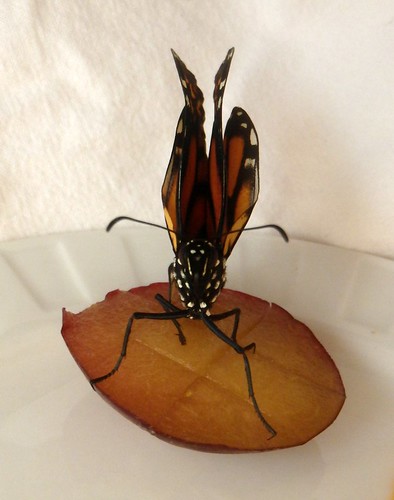
Later she was standing on top of a slice of plum, so I was assured she could move around on her own (even with fruit-covered feet). But it was obvious that her wings weren’t correct.

monarch with its wings back, the bottom two bent inward and the tips of the top two folded outward

With the lack of a better option, we kept feeding her as the days passed. When I had first told people weeks earlier that I was raising monarchs, several people asked me if I planned to keep them. I thought they were crazy. The whole point is to raise healthy butterflies so they can be released. And now we were keeping one as a pet.

I took her outside when I released a healthy monarch. She seemed to enjoy sitting in the sun and made a couple attempts at flying.

https://youtu.be/rOPRSMK3XAY

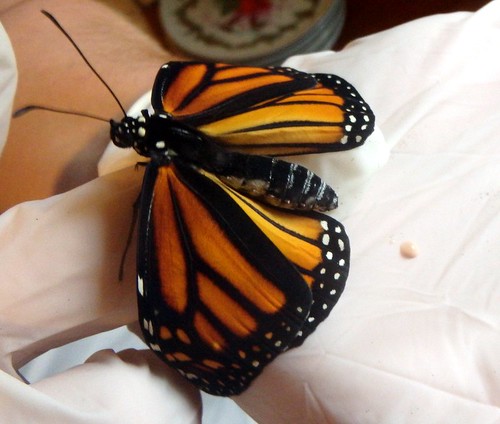
Five days after she emerged, she was very active. For an entire hour, she sat near the mashed bananas: drink, drink, drink, rest. Repeat. It even seemed like she was doing exercises, waving her wings and lifting her abdomen. And then she was trying very hard to fly. It didn’t work so well when she was on a flat surface, but if I picked her up, she could jump and fly away – except I eventually realized that she wasn’t so much flying as she was gliding; her path was always gently to the floor.

monarch with its wings expanded on a white towel

The following night she was even more spunky. She wouldn’t sit still anymore, walking all over the table and gliding over to the window and climbing the curtains.

monarch on a window screen

Many times I picked her up and she jumped off my finger. She seemed determined to fly, and she seemed mad that it wasn’t working.

blurry image of a monarch rapidly fluttering its wings

It seemed that she got discouraged after this. The next night, she would barely eat and only briefly tried to fly.

The next morning she was listless on the floor of the cage, one of her legs already folded up. It was time to help her go. Fortunately Bill was home to help me. We put a tissue in a jar to give her a soft spot to rest, and then placed a cotton ball soaked in nail-polish remover in the jar and sealed the cover. Almost immediately, she was gone.

I never intended to have a butterfly as a pet, but this one stole our hearts. I’m sad that something was wrong to prevent her from flying, and that we couldn’t fix her. Though if we hadn’t helped her out of the chrysalis, she would have died anyway. We did the best we could to help her.

So what went wrong? Everything seemed normal when she was a caterpillar. The one thing I noticed was that it seemed to take her a really long time to get into the J position: she was at the top of the cage for a whole day before making the silk pad and falling back into the J.

monarch in J position

But I watched her transform, and that process seemed fine.

newly formed chrysalis that is still bumpy, not smooth

She’s the chrysalis in this photo:

monarch chrysalis above a caterpillar that's eating a milkweed leaf

But of course, she ended up stuck in the chrysalis. Also, her abdomen had irregular white marks instead of the usual defined lines.

wings flat, abdomen raised to show white splotches

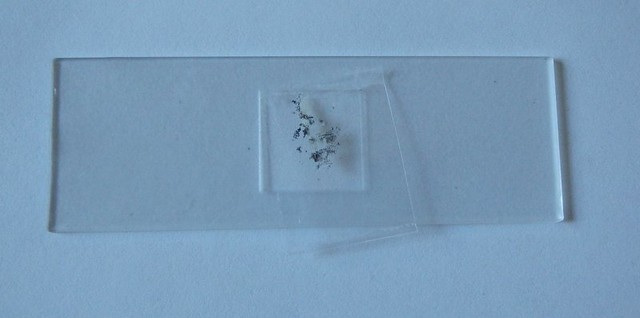
Because of those two things, I thought it might be OE, a parasite that lives inside monarchs and related butterflies. We collected a sample of her scales and used our microscope but couldn’t find anything. But since it’s a very cheap model and we weren’t sure it was powerful enough to see tiny OE spores, we sent it for testing.
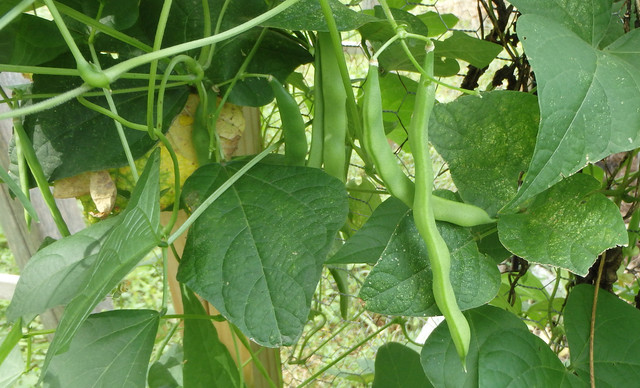
scales in clear tape, sitting on a microscope slide

Edith at Shady Oak Butterfly Farm didn’t find even one OE spore, proving that tests are needed to determine OE, not just observation. Here’s what she told me via email: “The problem is that the spotlight is so bright on OE that other diseases are openly doing their nasty work and no one blames them. They treat for OE and sometimes OE treatments won’t take care of the other diseases. … It reminds me of magicians imitating pick pockets. We are so busy looking at their right hands with the flashy tricks that we don’t see their left hands picking the subject’s pockets, right there in plain view.”

Another parasite, or a virus or disease, could have been the culprit. A younger butterfly – which had been raised in the same container as this one – was fine, though, which makes me think it wasn’t a contagious problem. Still, it’s a good reminder for next year that we will need to thoroughly clean the caterpillars’ cages daily (which we did this year anyway) and bleach them between generations (likewise) to try to prevent issues.

monarch with wings expanded on a white towel, with one wing visibly bent under

This post is now many years old, and I have closed the comments. I am not a butterfly expert, so I cannot provide advice to people who have butterflies that can’t fly. In fact, after two summers of raising a handful of caterpillars, I no longer do this. It’s a lot of work, but more importantly, research published in recent years shows that monarchs raised in captivity have less success in migration than wild monarchs. Learn more from Xerces Society: why captive raising isn’t the way to help monarchs.

More about our monarchs

In early spring we decided to convert more of our yard from lawn to garden. We marked off a giant rectangle in the backyard and I immediately thought, swimming pool! But instead we stuck with the plan and started removing the sod for a garden. The robins were very excited about the freshly uncovered worms.

rolls of sod, and a robin sitting on a roll of sod

We planted some of the vegetables from seed, and added some fruit and veggie plants:

a box full of new plants

The raspberry half of the new garden was covered with wood mulch, and the vegetable half was covered in leaf mulch (not pretty, but effective). Here’s how our plants did:

One of our distant neighbors has a thick row of lettuce at the edge of his prolific vegetable garden. I thought we should imitate that because it may be an effective barrier for rabbits. So we had lots of lettuce – even though we quickly decided to put up a fence anyway – enough that we couldn’t come close to keeping up with it, and it went to seed. Interesting flower variety:

row of closely-spaced lettuce, four different kinds of lettuce flowers

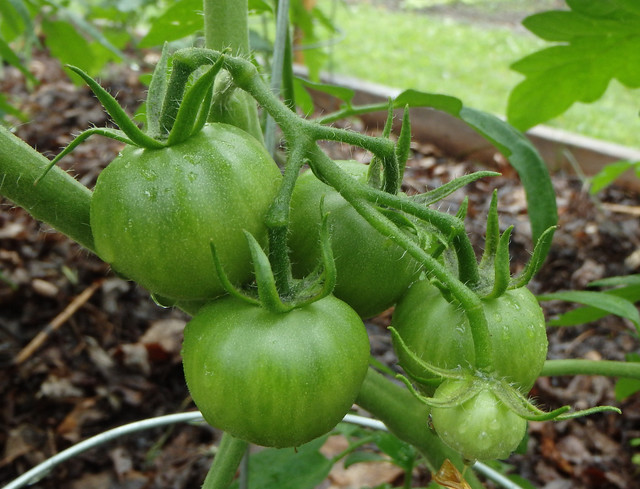
We started with four tomato plants, and then took in about a dozen more that were going to be composted. They did well at first, but suddenly half were eaten by squirrels, and half rotted on the vine, perhaps because of all of the rain. But there seems to be a resurgence lately, and I may try fried green tomatoes this week.

green tomatoes on the vine

Of course we had BLTs with homegrown L and T.

bacon-lettuce-tomato sandwich

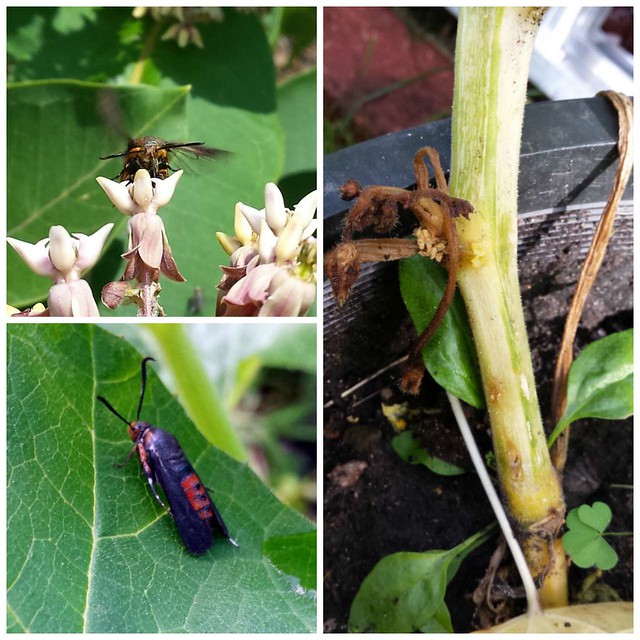
We planted some squashes and gourds from seed, and we also purchased some plants. Neither did very well, though it looks like all of the plants were attacked by squash borer, and some became a home for slugs.

squash vine borer from the front and top, and a vine that is dying

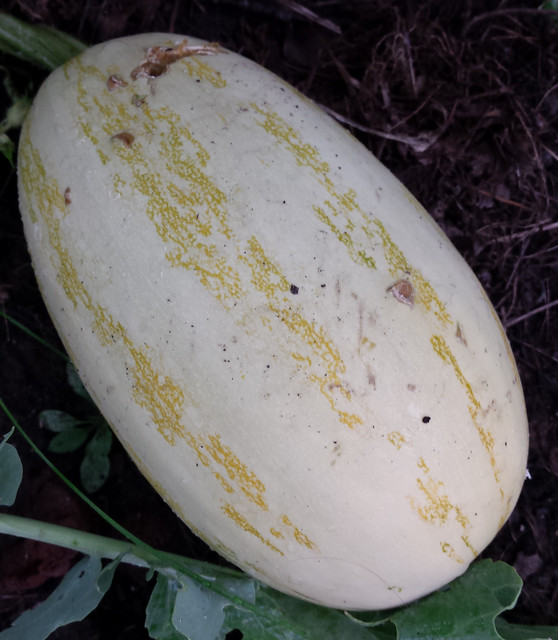
One vine has looked pretty good in spite of the bugs, but it has produced only one fruit (I think it’s a spaghetti squash).

white, oblong squash

A yellow squash grew but was quickly discovered by squirrels. A second one is now growing but will likely be destroyed soon, too. Even the plants that weren’t attacked by squirrels or bugs ended up covered with powdery mildew.

powdery mildew covering the leaves of a small squash plant

Our pumpkin vine has lately been growing long and flowering a lot, but it’s unfortunately going to be too little, too late.

pumpkin flower and a vine that has grown beyond the fence

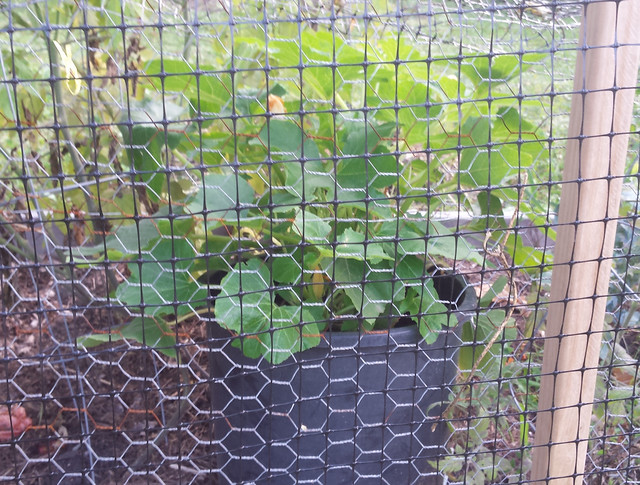
We have one more opportunity with some late-growing acorn squash, and we relocated it to the smaller covered garden to protect it from any more squirrel interference.

acorn squash protected by a net

Broccoli flowered before it reached a size I would have considered harvesting. Peas did okay, but we didn’t get a lot, and I didn’t know when to pick them. Next year I will know better. We’re probably done attempting to grow corn, though. This was the second year we tried, and what the squirrels didn’t chop down, the wind knocked over.

short cornstalk laying on the ground

Beans recovered from early squirrel interference and are looking good, finally.

several green beans hanging from a vine

Our four eggplants flowered but didn’t produce any fruit.

purple eggplant blossom

Our neighbor generously gave us two dozen extra kohlrabi plants. They were a big success, and they’re actually kind of tasty. We’ve tried them steamed and roasted.

two kohlrabi plants growing together

Potatoes: two plants popped up in the compost pile, then we transplanted them to the main garden. We also purchased yukon gold and a purple variety of seed potatoes. They had pretty white flowers that even turned into tomato-like fruit, apparently because of wet weather.

potato plants, flowers, and fruit

All of the plants are doing well and the ones we’ve dug up so far have produced 3-5 potatoes apiece, though some have had strange holes. I was entertained that the purple-skinned potatoes also have purple flesh.

a pile of brown and purple potatoes, and a purple potato cut in half

We planted a lot of kale this year and that tasted okay, but one plant overwintered really well. This was the one I turned to weekly for kale chips, and it kept regrowing all season.

a big kale plant

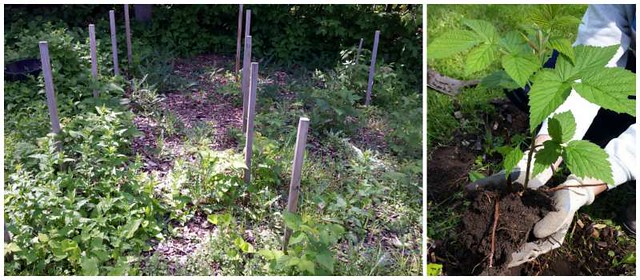
This was the year to finally do something about our underperforming raspberry bushes. We originally planted them in a shady spot of the backyard about three years ago, and they’ve never amounted to much. This year we decided that they deserved more sun, and we moved them to the west side of the new garden.

the old raspberry location, and a freshly dug plant ready to be moved

About half of them started producing flowers and then berries.

raspberry plants in mulch

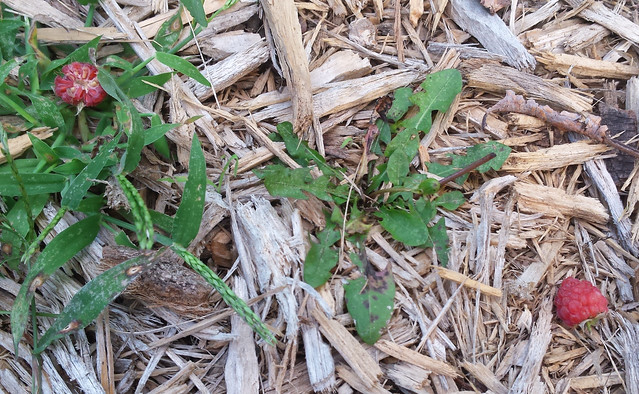
Our squirrels can’t leave them alone, though, so we haven’t yet been able to enjoy the newly productive bushes. (I’m dreaming of a giant squirrel-proof greenhouse for next year.)

two raspberries on the ground

Another potential for next year: strawberries. We bought several plants, but almost immediately, rabbits ate several of them. They still produced a few berries, and the rest of the year they grew well and even sent out runners. We have high hopes for next year – assuming we can protect them well enough from the winter.

strawberry plants on a lawn chair

One Saturday morning as I was cleaning the caterpillar cages, I noticed one of the eggs looked dark on top. Then I saw the egg was moving and realized I was watching a caterpillar hatch!

tiny caterpillar climbing out of its egg

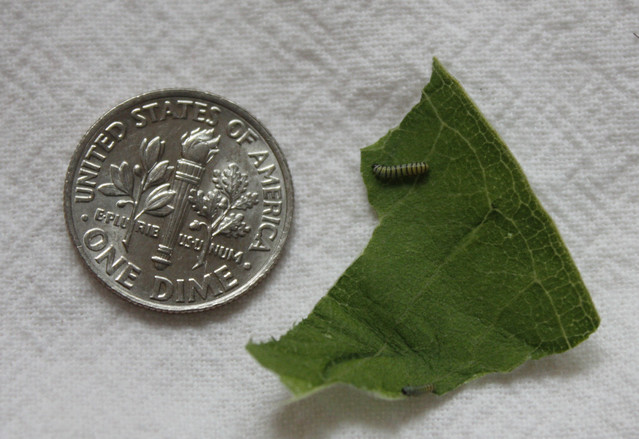
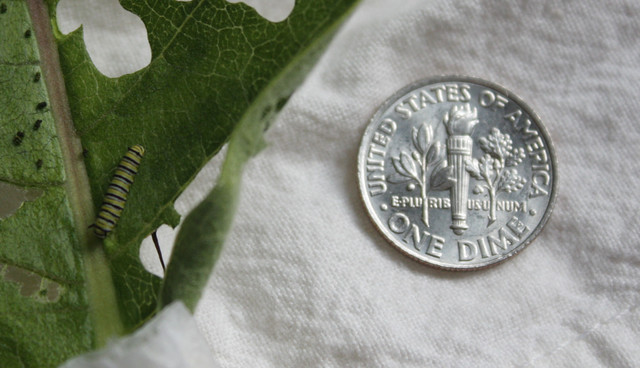
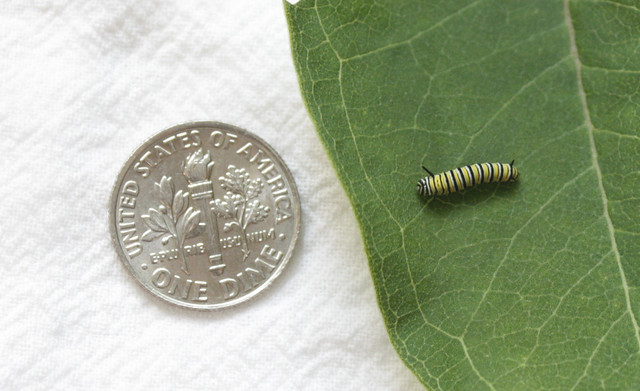
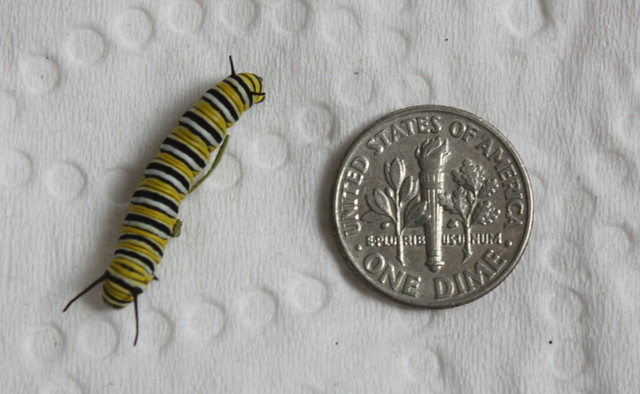
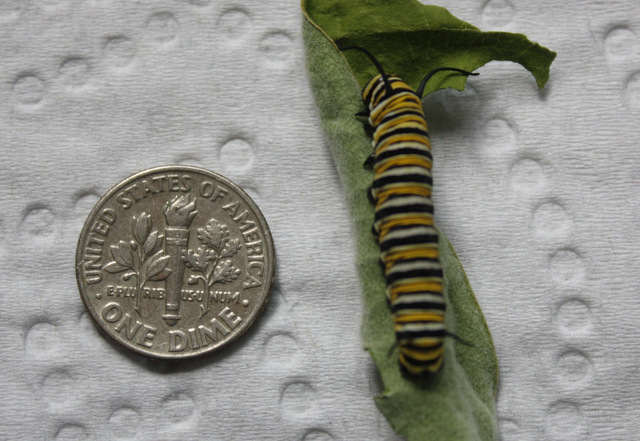
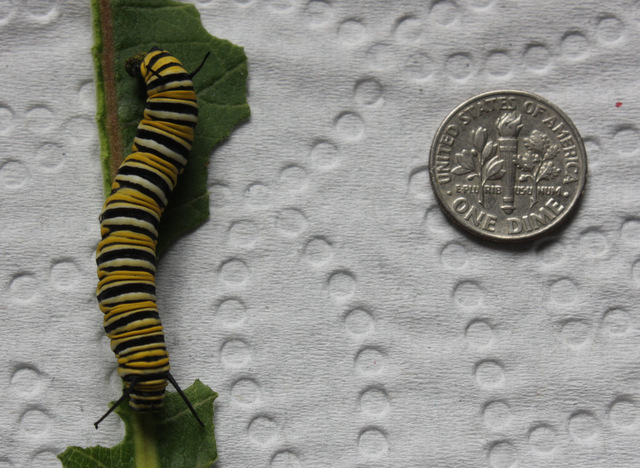
I thought I would remember all of the details of this caterpillar’s life – when he hatched, when he molted, and on and on – but of course I didn’t. It’s hard enough to remember with just one caterpillar, but we were taking care of six and, eventually, nine. But I did take a photo every day, with a dime as a reference for his size.

July 18 – newly emerged and eating the egg:

eating the egg

July 19:

on a paper towel, roughly the size of the flame on a dime

July 20:

on a leaf, much bigger than the flame

July 21:

half the size of the dime's torch, first visible tentacles

July 22:

as tall as the torch, with a recognizable caterpillar face

That night, I found him hanging by a silk thread off the side of the cage. I hadn’t seen anything like this before – I didn’t even realize they spun silk for moltings until this moment – and didn’t know what to do. Was he stuck? Was this part of the molting process? I wasn’t sure if I should intervene or let him figure it out.

But 20 minutes later, he was still there and appeared to be struggling because he was twisting and turning, and was even folding himself upside-down, seeming to be trying to bite at the spot where he was stuck. I decided I had to do something, so I gently brushed a Q-tip on the side of the cage, sweeping him onto the “floor.” He then quickly walked off the thread himself, and I realized I had done the right thing.

July 23:

about the same length but with longer tentacles

July 24:

almost as long as the dime

July 25 – suddenly, they get really big really fast:

longer than the dime

July 26:

tentacles have curved over

July 27:

twice the diameter of the dime

July 28 – last day before the transformation:

more than twice the dime's diameter, and fatter

Night of July 28 – getting into position. Their bodies are shorter and fatter at this point.

looking down onto the cage at the underside of the caterpillar

Morning of July 29 – hanging from the silk pad:

looking down onto the cage at the caterpillar in J position

Later that morning, a chrysalis:

chrysalis still with stripes, about 1.5 times the diameter of the dime

Eight days later, the green is gone and orange-and-black wings are showing through:

chrysalis from above

The next morning, I woke up early to try to catch the emergence. And then I waited… and waited. Two hours later, he finally emerged:

chrysalis from the front, with the first panel open but butterfly completely inside

chrysalis from the side, with one folded leg poking out

starting to slide out the bottom

body out, antennae unfolded

all four legs holding on

front legs moved to the top of the empty chrysalis

abdomen down, wings back but small and wrinkled

looking straight at the abdomen with the dime as reference, about half the length

drying, wings still somewhat wrinkled

holding on tight to the chrysalis, wings smooth

And now I had confirmation that I was right to call it a male. (Though that was just luck, since you can’t tell the difference at the caterpillar stage.)

at the bottom of the cage with wings spread

Unfortunately, he emerged on the first rainy day in more than a week. Best practices say you shouldn’t release butterflies in the rain because they’re too light to tolerate raindrops, so this was the one I previously mentioned looking wistfully out the window:

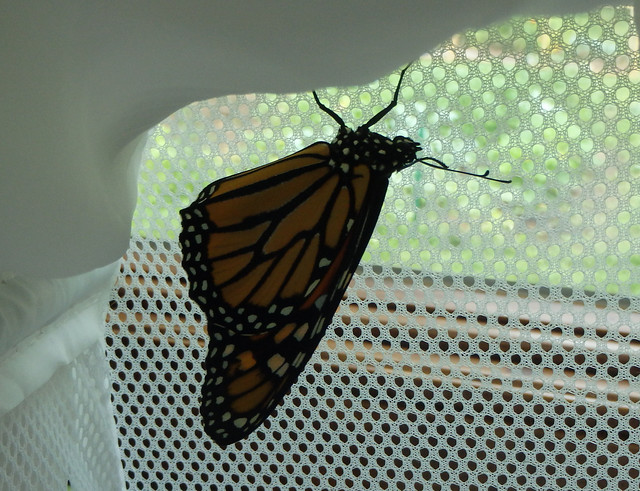
hanging upside-down from a cage while looking out the window

The next morning was sunny, and he was ready to be released:

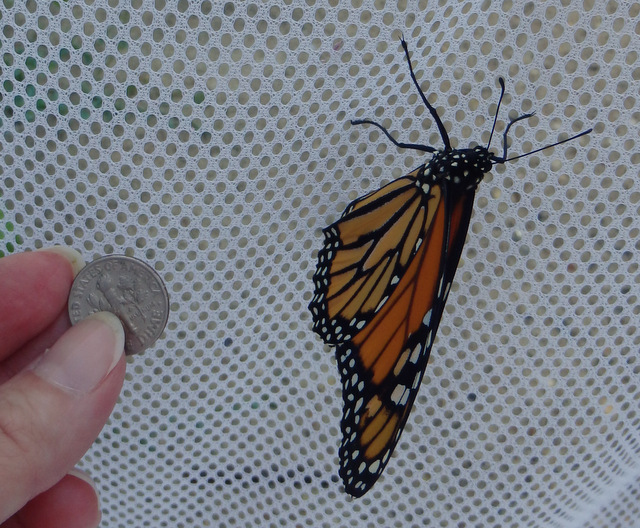
hanging to the side of the mesh cage, much bigger than a dime

One last comparison with a dime:

side view as he's hanging off my fingertips

Then I moved him to a black-eyed susan, and off he flew:

letting him climb onto a flower

More about our monarchs

It was only a matter of time before my noticing the goings-on of monarchs in the garden turned into fostering caterpillars in our kitchen.

two caterpillars sharing a leaf

According to several monarch sites, only around 5 to 10 percent of monarch eggs result in butterflies. The rest are struck by predators (including ladybugs!) or disease. And the population of adult monarchs that overwinter in Mexico has dropped dramatically over the last several years.
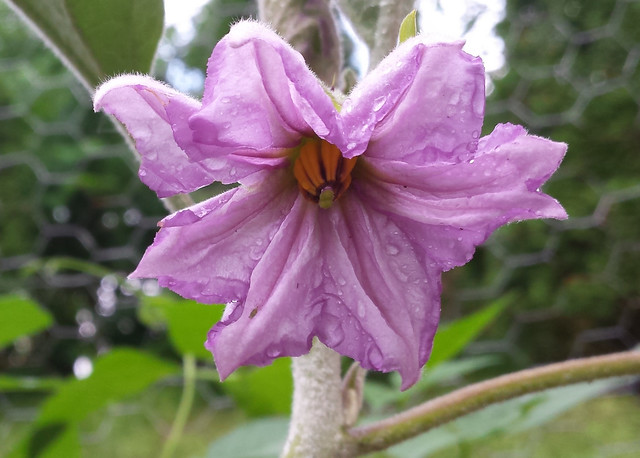
caterpillar in J formation

We’re doing our part to help the population rebound by bringing them indoors. I want to help them all, but we only have so much space (and time), so I’m doing the best I can with the ones in our care. This generation, that meant nine caterpillars: three brought in as caterpillars, six that hatched inside. There also were three other eggs that didn’t hatch.

one new butterfly and two dark chrysalises

The last six weeks have been a blur of eggs, caterpillars, moltings, milkweed, chrysalises, and wings. Plus dozens of milkweed leaves.
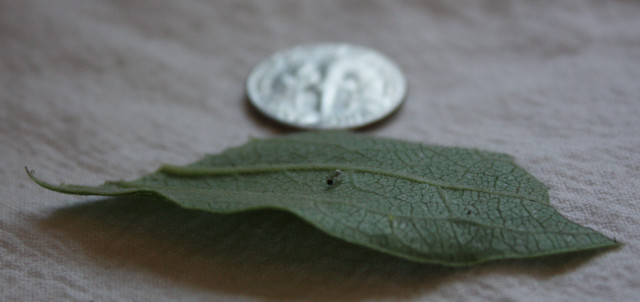
milkweed leaf with lots of holes

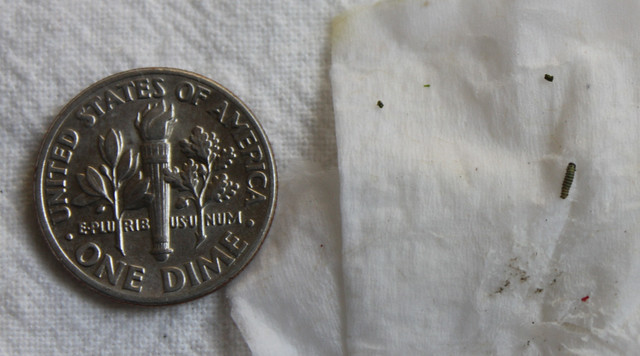
And poop. Lots and lots of poop. (Or to be more scientific, “frass.”) When they’re little, the poop looks like pepper flakes.
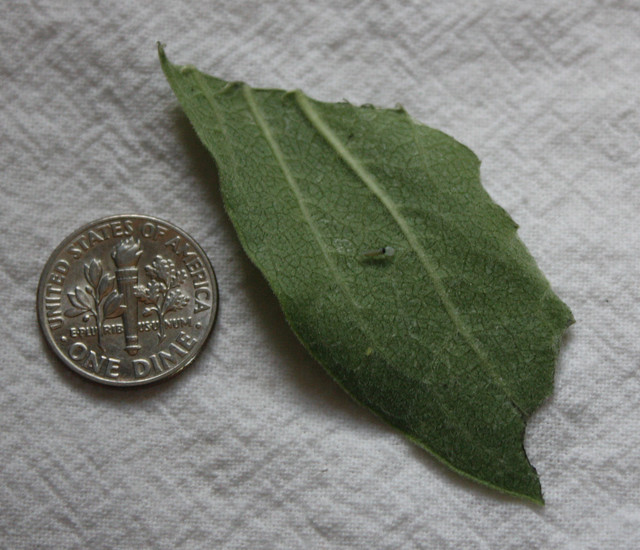
medium-sized caterpillar and frass

I don’t prefer the term “larva.” I know it’s scientific, but it sounds like something undesirable and writhing and creepy. I’m going with “caterpillar.”
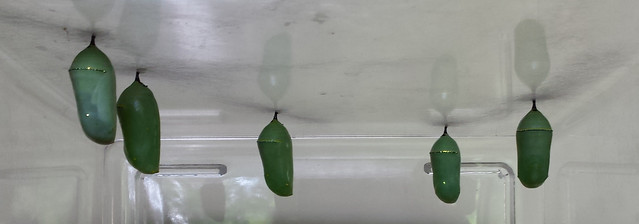
Same with “pupa” – it’s a beautiful green chrysalis.

five chrysalises hanging in one container

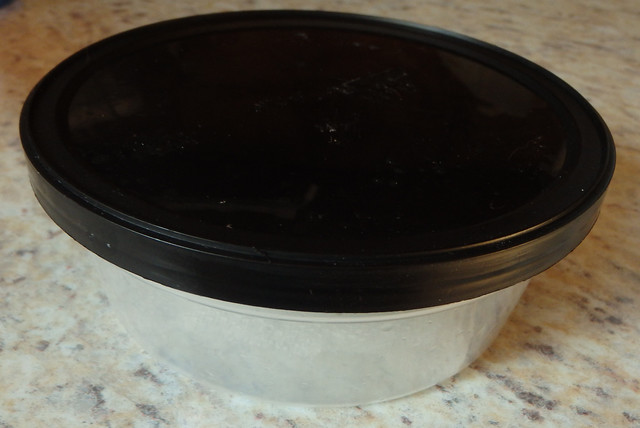
The system I’ve settled with:

incubator (for eggs that haven’t hatched) – this would be better with a clear lid

small plastic container with a black lid

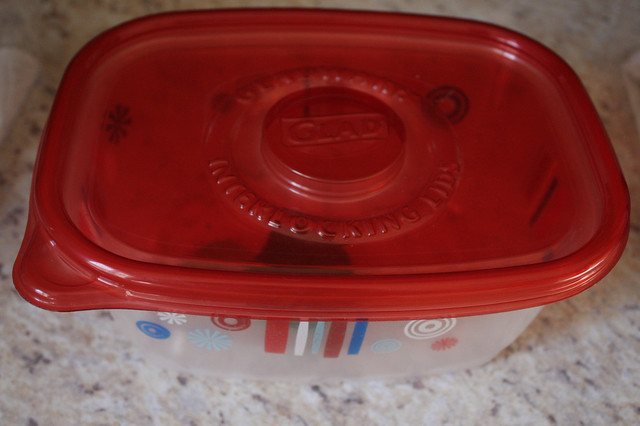
nursery (for the littlest hatchlings)

large gladware container

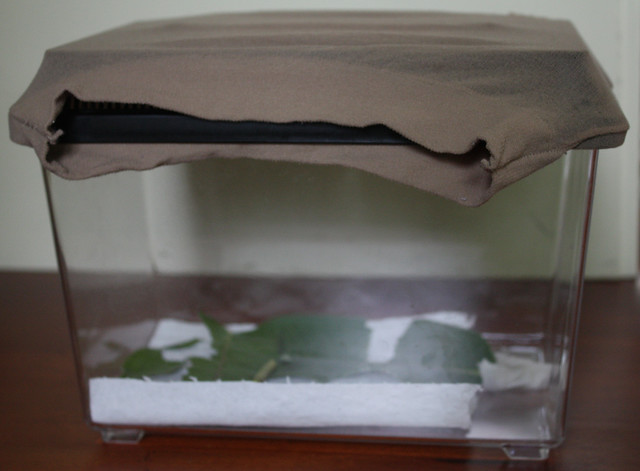
small cage and big cage for caterpillars, sorted by size, using nylons over the openings so they don’t escape

small plastic cage with nylons over the lid

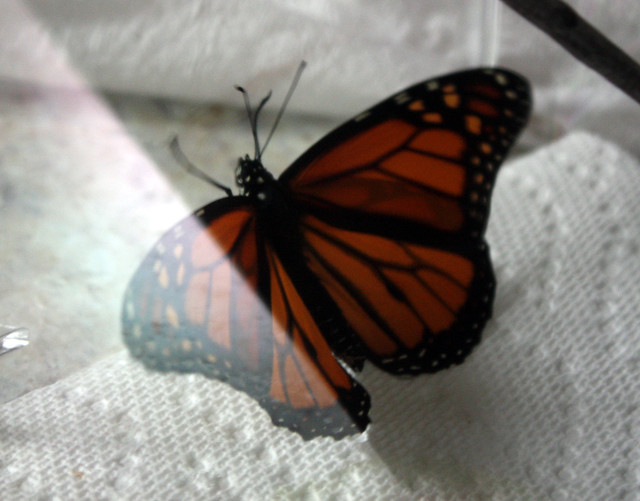
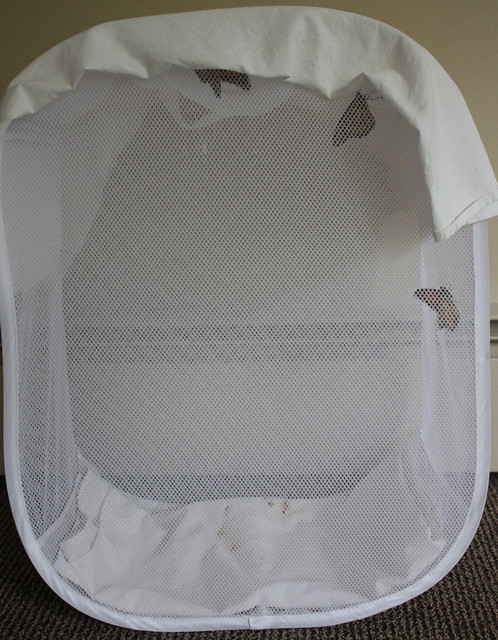
laundry hamper for when a butterfly hatches but I’m not around to let it go for a couple hours. We found out with the first butterfly that after its wings are dry, it will be ready to start flying – and then it panics when it can’t climb back up the plastic walls.

plastic container with a butterfly ready for release

These hampers give them more space to move and even fly a bit.

mesh laundry hamper with three butterflies

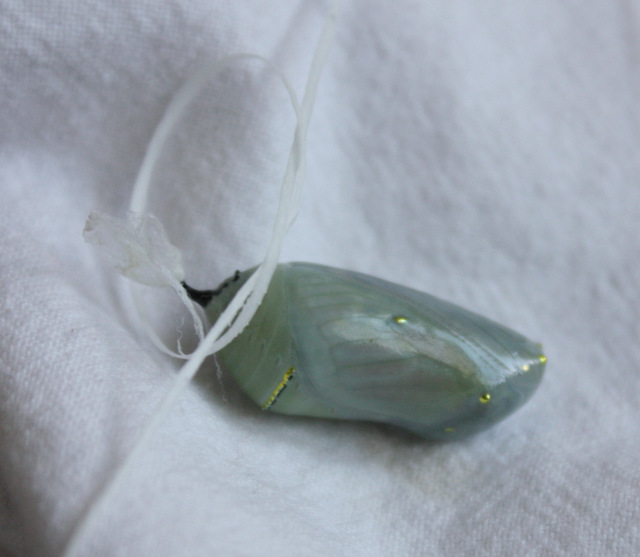
I’ve gotten pretty good at relocating chrysalises – something I never thought I would do. They form the chrysalises in the plastic containers, but most days, leaving them there isn’t a good idea because I am not home to release them right away. One site suggests knotting dental floss around the cremaster, and that works well. I then tie it on the strap of the laundry hamper.

tying dental floss around the top of a chrysalis

I watched two caterpillars transform into chrysalises – a process that’s both strange and exciting.

The sites say that butterflies emerge after 8 to 12 days of being in a chrysalis. Our first chrysalis started turning dark on day 5, and by day 6 I was fearing the worst. There are a number of things that can happen, from tachnid flies to black death to the OE parasite. But my worry was unfounded: the butterfly was simply finishing earlier than expected! I was so relieved to see wings starting to appear through the chrysalis.

chrysalis with visible butterfly wings

Sure enough, at 8:20am – when I was in another room getting my things together to go to work – it eclosed (scientific term for emerged).

newly emerged butterfly that is still wrinkly

The emergence happens so fast, it’s very easy to miss. Once it even happened when I was in the same room, and I still missed it! But I did see two of the nine butterflies come out.

Then comes the release. Many of the butterflies arrived on work days, so I needed to come home over lunch to let them out. The first was released on a windy roller-coaster of a day. (Yes, I did get teary-eyed when she flew away.)

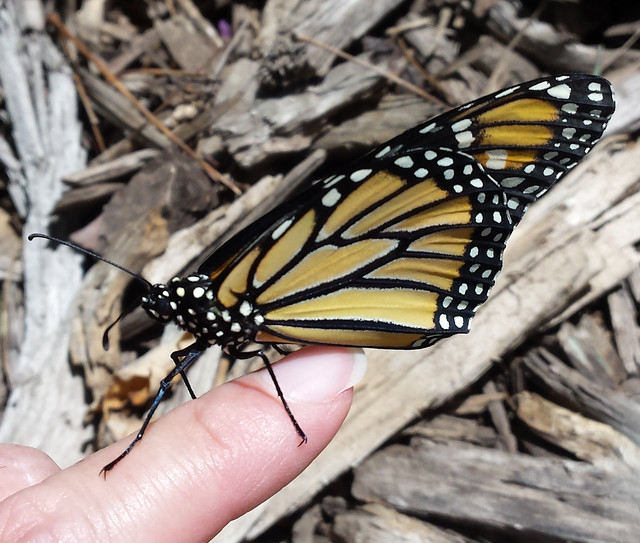
butterfly resting on a finger

We released second caterpillar at our friends’ brand-new home; their daughters named him Eric. He took a short test flight and then rested in a tree.

butterfly resting in a tree

One exciting day, THREE monarchs emerged!

three brand-new monarchs hanging onto their chrysalises

We had to keep two overnight – one because of weather (don’t release them in the rain) and one because we weren’t home during the afternoon – and they did not like being kept inside.

monarch in a hamper looking out the window

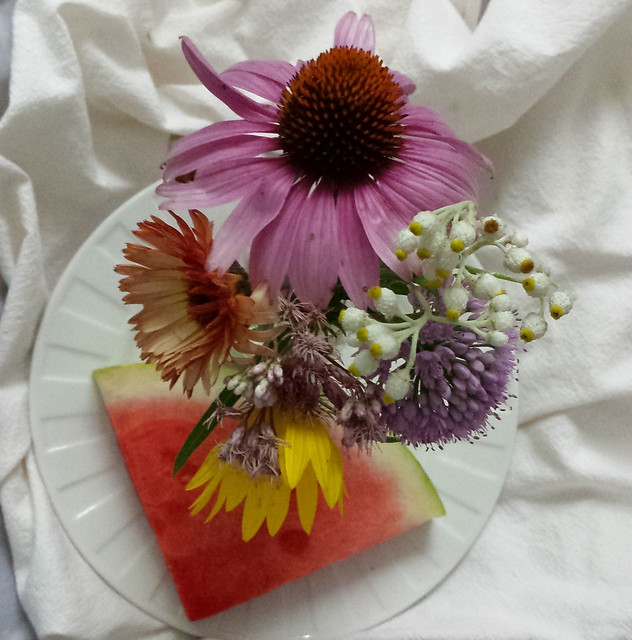
Though we did provide them with a delicious dinner.

wildflowers and a slice of watermelon

I’ve learned a lot: for example, the caterpillar I filmed “out on a stroll” in the garden was probably looking for a quiet place to molt. (Good rule of thumb: they know what they’re doing and don’t need help from humans.)

two caterpillars molting on the side of a plastic container

They eat a lot. Fortunately we have enough milkweed. They don’t seem to like the butterfly weed, even though plenty of eggs have been laid on butterfly weed. Now that it’s late in the season, though, the milkweed isn’t looking so good. I’ve been trimming it to encourage new growth.

And now: the final generation of the season is underway, the ones that will migrate for the winter. So far I’ve found two cats and four eggs. It’s a lot of work, but I think it’s worth it.

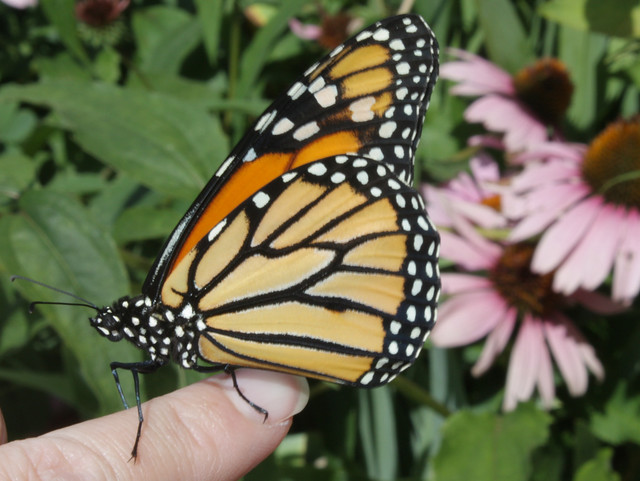
monarch with purple coneflowers

Order of emergence of our first generation:

  1. Wednesday 7/29, girl, 8:20am
  2. Saturday 8/1, boy, before 8:00am
  3. Tuesday 8/4, boy, 8:20am
  4. Tuesday 8/4 (should have been #3), girl, 10:15am
  5. Tuesday 8/4, girl, 10:35am
  6. Thursday 8/6, boy, 8:55am
  7. Friday 8/7, boy, unknown time
  8. Monday 8/10, girl, before 8:00 am
  9. Saturday 8/15, girl, before 8:00 am

More about our monarchs