It’s the first of October, the prettiest month of the year. Our garden is much thinner than it was in the summer, but there is still plenty of activity.
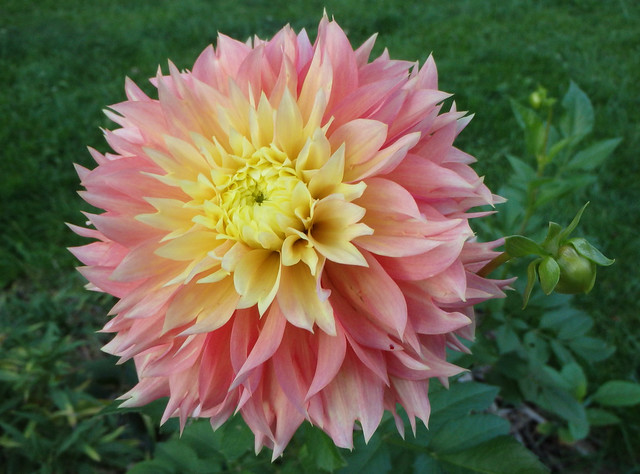
Finally, one dahlia is blooming:
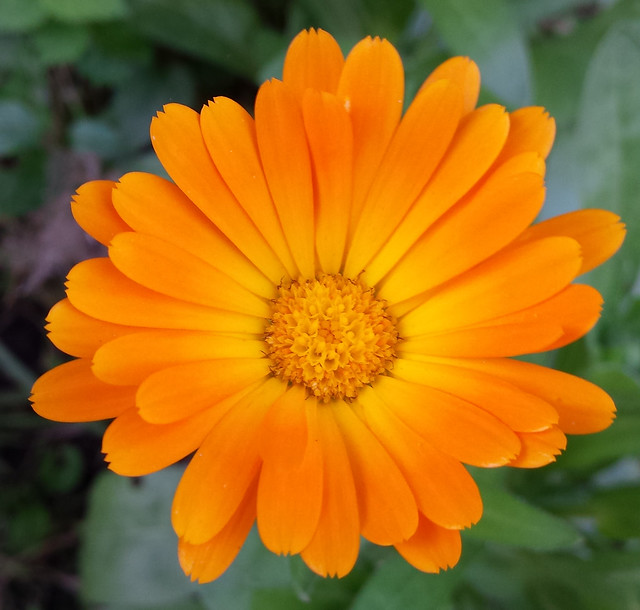
Along with lots of calendula:
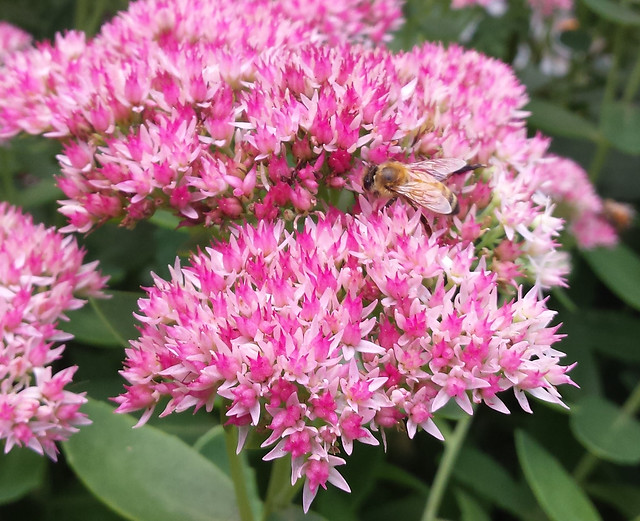
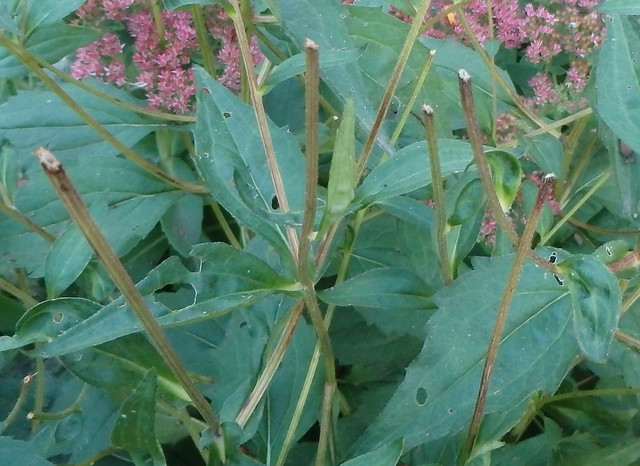
The appropriately named “autumn joy” sedum:
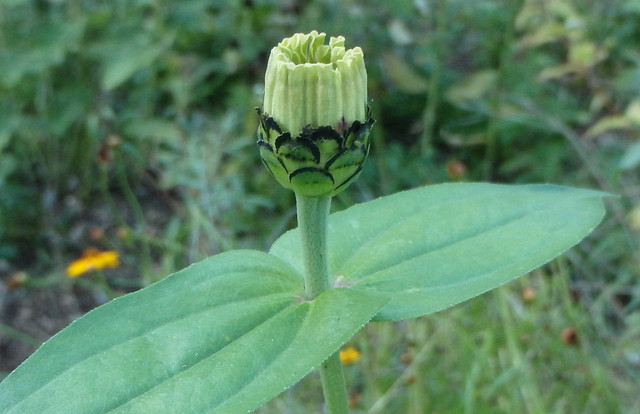
Zinnias and cosmos are still flowering…
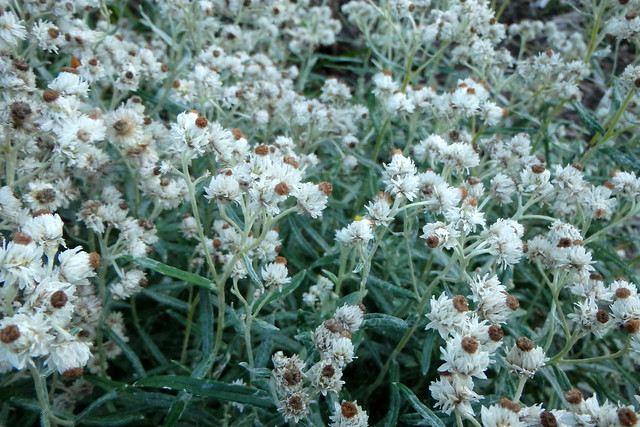
…while other flowers are at the end of their blooming, like this pearly everlasting:
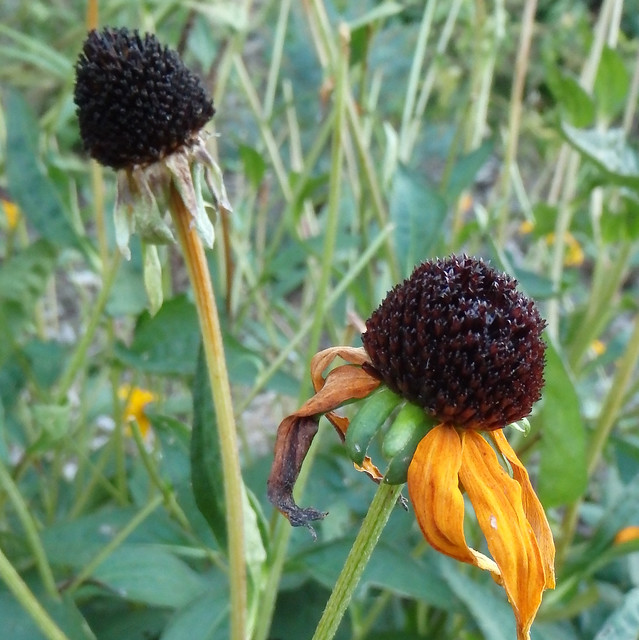
and the black-eyed susan:
I haven’t figured out what’s been snipping off the black-eyed susan flower heads:
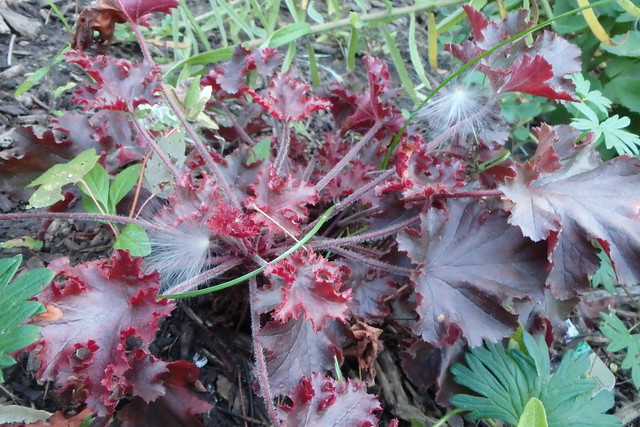
Coral bells are pretty all year but fit in best in autumn:
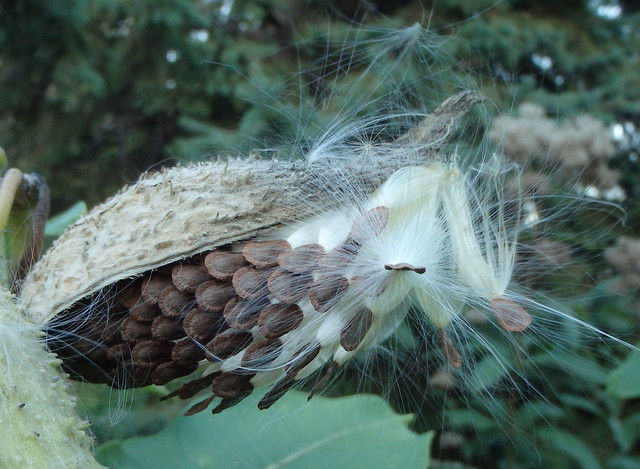
The milkweed pods burst open this week without my noticing…
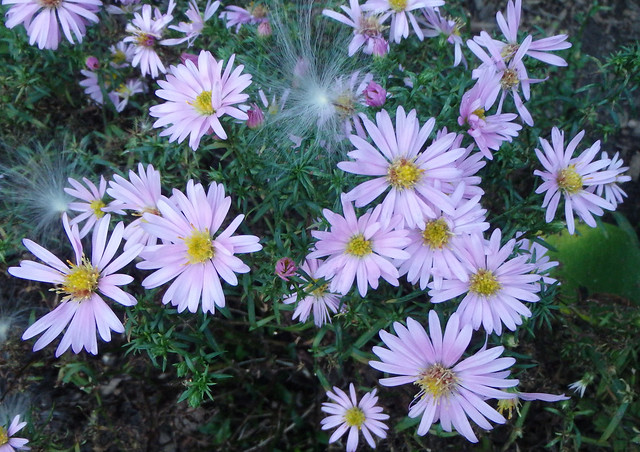
…and milkweed fluff is ending up everywhere, like in this wood’s pink aster:
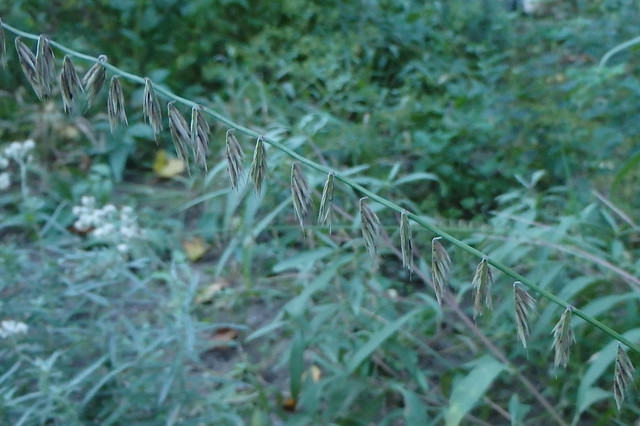
Grasses are in seed:
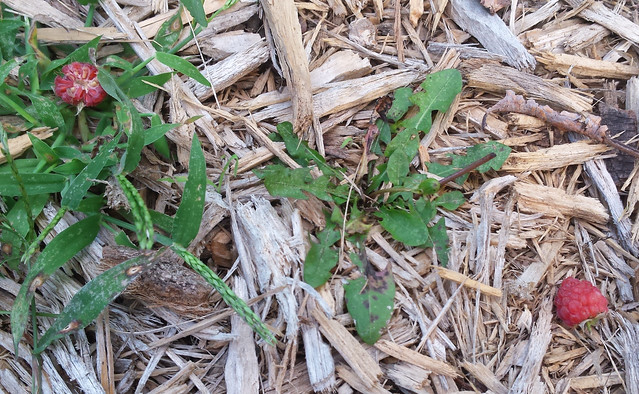
And even the raspberries are reacting to the season:
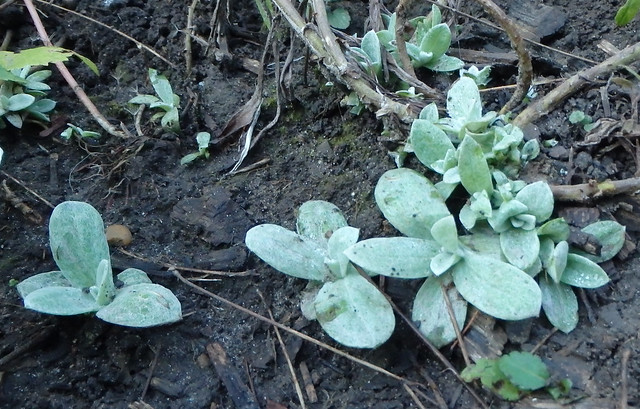
Some confused flowers, like pearly everlasting, are sprouting new plants after the recent rain and warm temperatures:
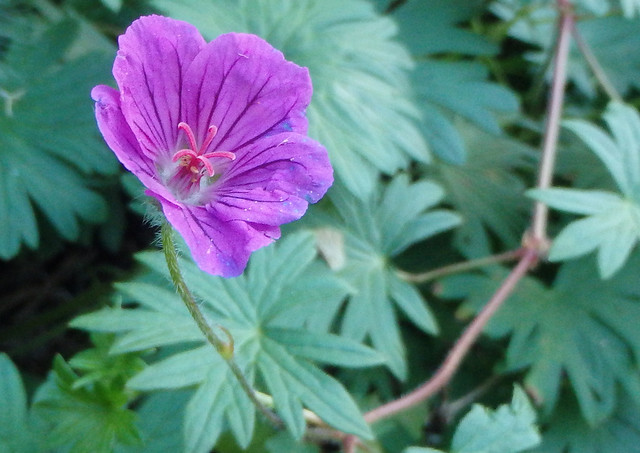
…or reblooming, like the tiny monster geranium does every fall:
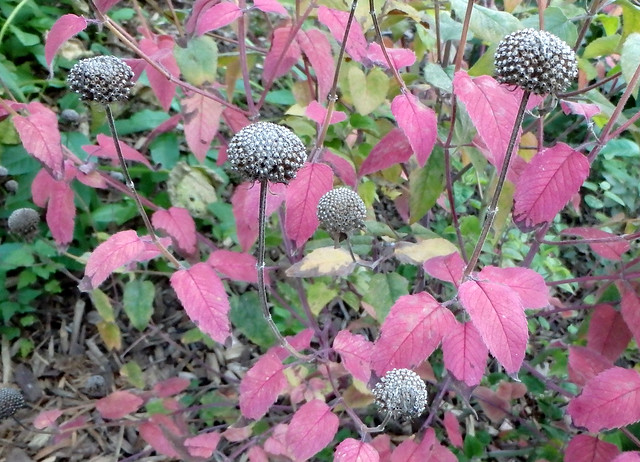
I love bee balm – which just might be prettier after it’s done blooming:
In early spring we decided to convert more of our yard from lawn to garden. We marked off a giant rectangle in the backyard and I immediately thought, swimming pool! But instead we stuck with the plan and started removing the sod for a garden. The robins were very excited about the freshly uncovered worms.
We planted some of the vegetables from seed, and added some fruit and veggie plants:
The raspberry half of the new garden was covered with wood mulch, and the vegetable half was covered in leaf mulch (not pretty, but effective). Here’s how our plants did:
One of our distant neighbors has a thick row of lettuce at the edge of his prolific vegetable garden. I thought we should imitate that because it may be an effective barrier for rabbits. So we had lots of lettuce – even though we quickly decided to put up a fence anyway – enough that we couldn’t come close to keeping up with it, and it went to seed. Interesting flower variety:
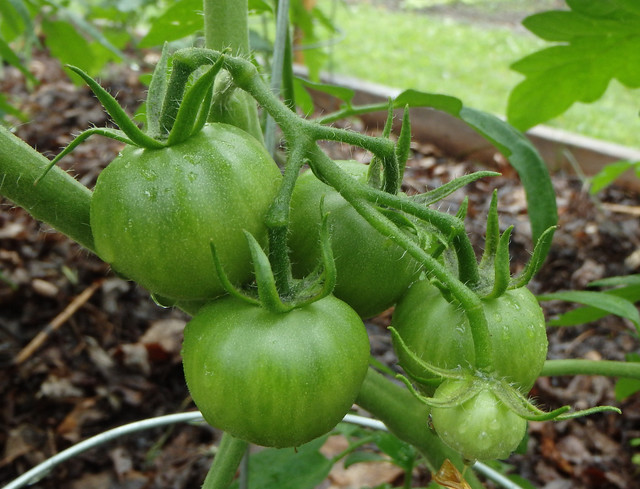
We started with four tomato plants, and then took in about a dozen more that were going to be composted. They did well at first, but suddenly half were eaten by squirrels, and half rotted on the vine, perhaps because of all of the rain. But there seems to be a resurgence lately, and I may try fried green tomatoes this week.
Of course we had BLTs with homegrown L and T.
We planted some squashes and gourds from seed, and we also purchased some plants. Neither did very well, though it looks like all of the plants were attacked by squash borer, and some became a home for slugs.
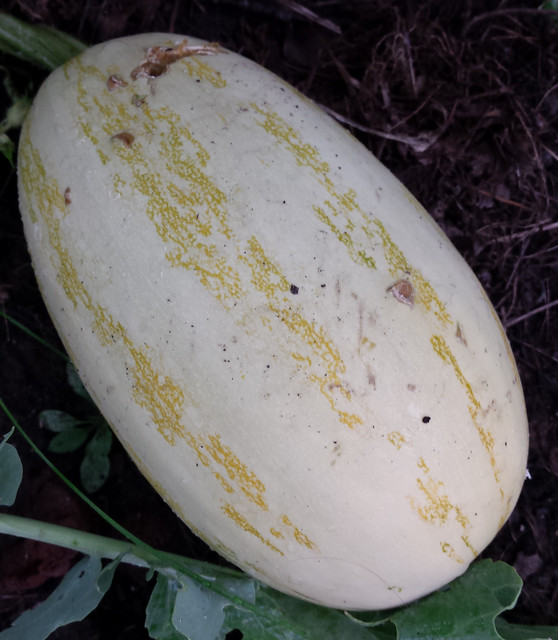
One vine has looked pretty good in spite of the bugs, but it has produced only one fruit (I think it’s a spaghetti squash).
A yellow squash grew but was quickly discovered by squirrels. A second one is now growing but will likely be destroyed soon, too. Even the plants that weren’t attacked by squirrels or bugs ended up covered with powdery mildew.
Our pumpkin vine has lately been growing long and flowering a lot, but it’s unfortunately going to be too little, too late.
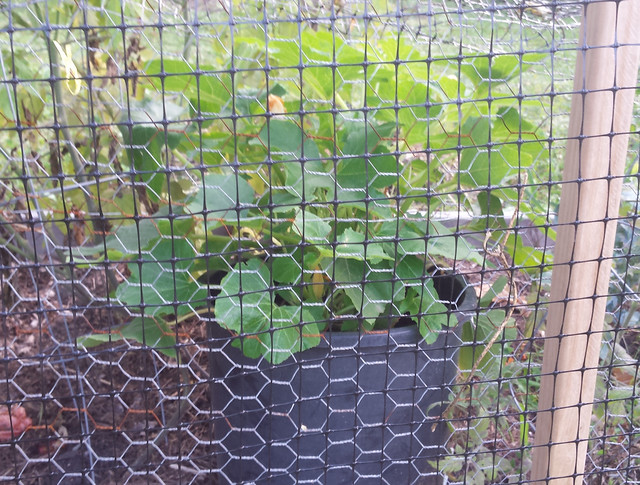
We have one more opportunity with some late-growing acorn squash, and we relocated it to the smaller covered garden to protect it from any more squirrel interference.
Broccoli flowered before it reached a size I would have considered harvesting. Peas did okay, but we didn’t get a lot, and I didn’t know when to pick them. Next year I will know better. We’re probably done attempting to grow corn, though. This was the second year we tried, and what the squirrels didn’t chop down, the wind knocked over.
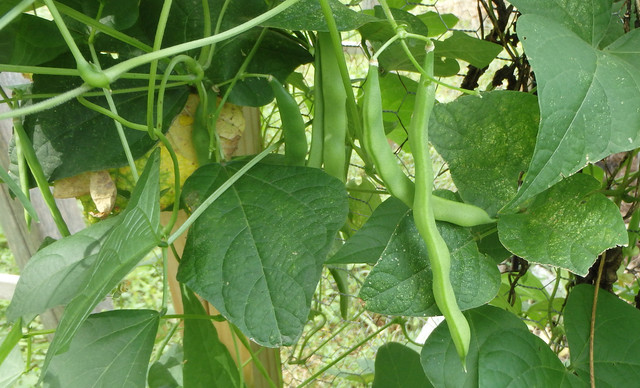
Beans recovered from early squirrel interference and are looking good, finally.
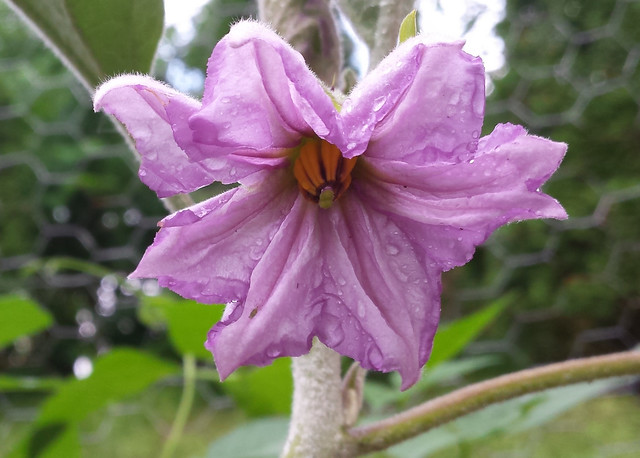
Our four eggplants flowered but didn’t produce any fruit.
Our neighbor generously gave us two dozen extra kohlrabi plants. They were a big success, and they’re actually kind of tasty. We’ve tried them steamed and roasted.
Potatoes: two plants popped up in the compost pile, then we transplanted them to the main garden. We also purchased yukon gold and a purple variety of seed potatoes. They had pretty white flowers that even turned into tomato-like fruit, apparently because of wet weather.
All of the plants are doing well and the ones we’ve dug up so far have produced 3-5 potatoes apiece, though some have had strange holes. I was entertained that the purple-skinned potatoes also have purple flesh.
We planted a lot of kale this year and that tasted okay, but one plant overwintered really well. This was the one I turned to weekly for kale chips, and it kept regrowing all season.
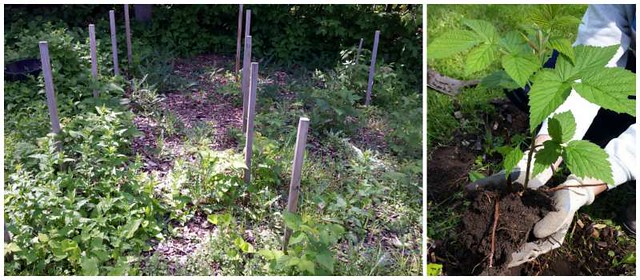
This was the year to finally do something about our underperforming raspberry bushes. We originally planted them in a shady spot of the backyard about three years ago, and they’ve never amounted to much. This year we decided that they deserved more sun, and we moved them to the west side of the new garden.
About half of them started producing flowers and then berries.
Our squirrels can’t leave them alone, though, so we haven’t yet been able to enjoy the newly productive bushes. (I’m dreaming of a giant squirrel-proof greenhouse for next year.)
Another potential for next year: strawberries. We bought several plants, but almost immediately, rabbits ate several of them. They still produced a few berries, and the rest of the year they grew well and even sent out runners. We have high hopes for next year – assuming we can protect them well enough from the winter.
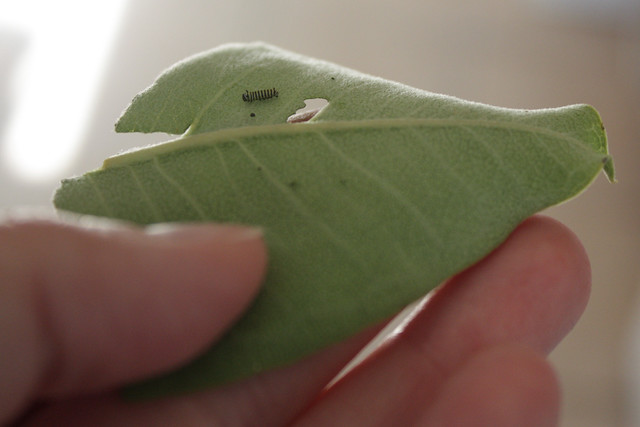
One Saturday morning as I was cleaning the caterpillar cages, I noticed one of the eggs looked dark on top. Then I saw the egg was moving and realized I was watching a caterpillar hatch!
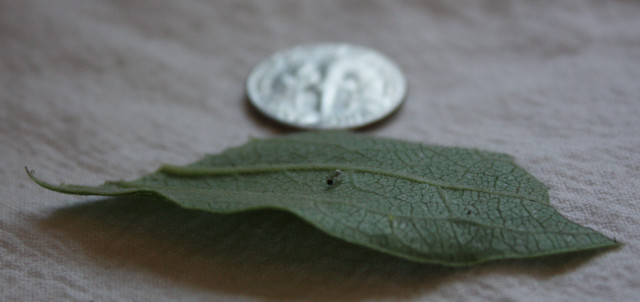
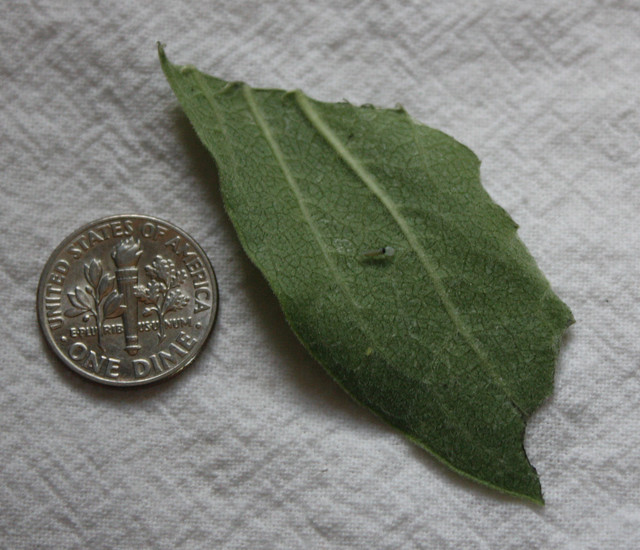
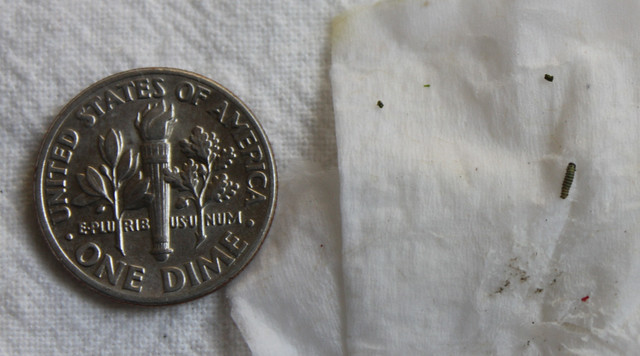
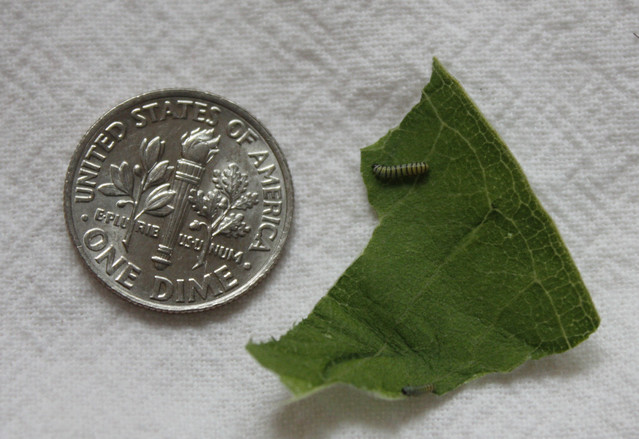
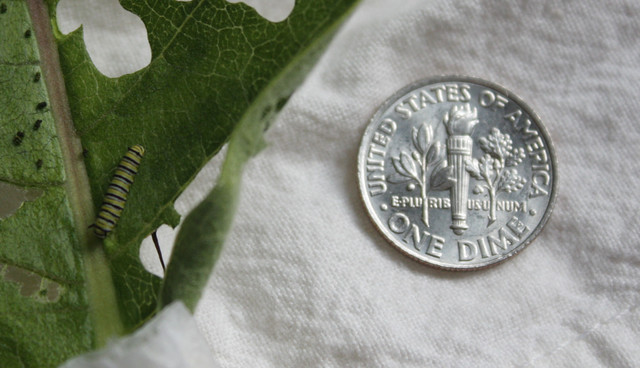
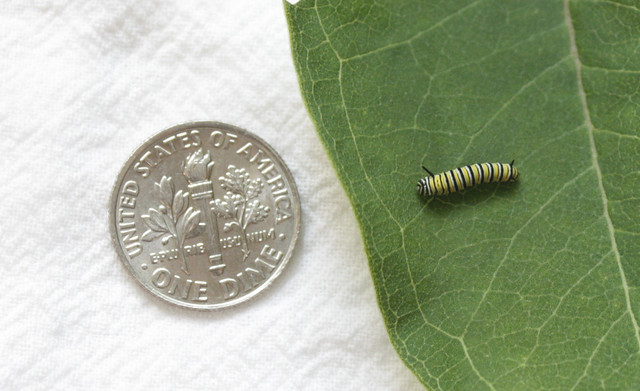
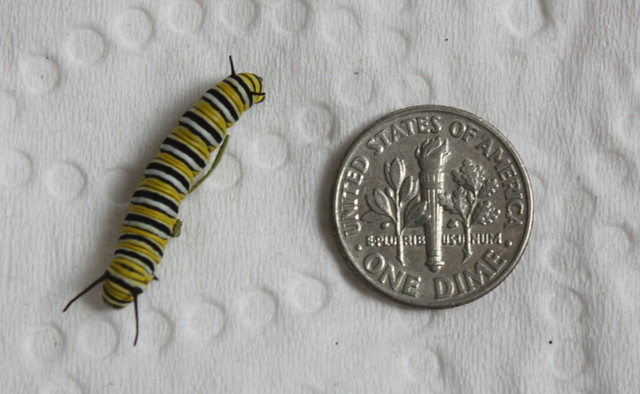
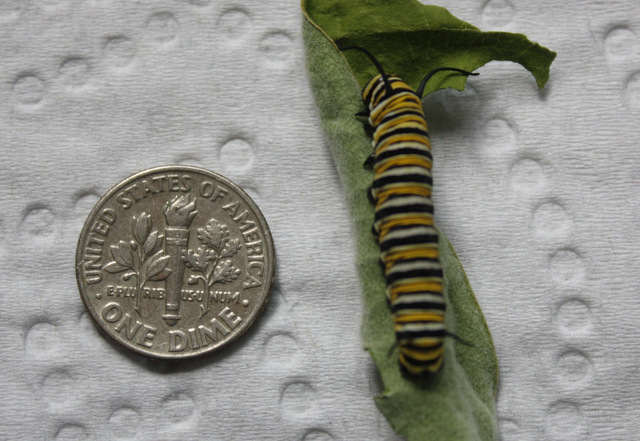
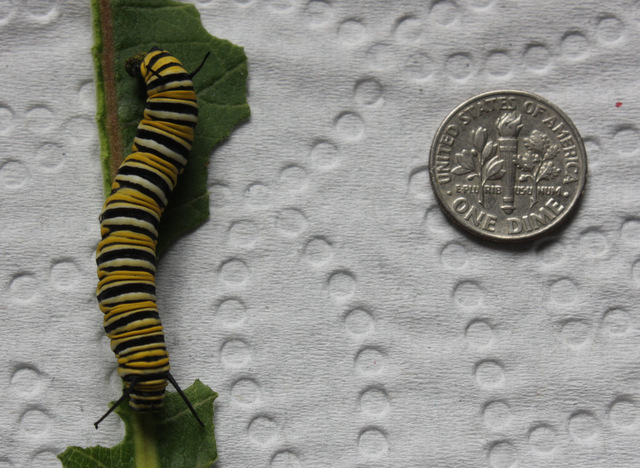
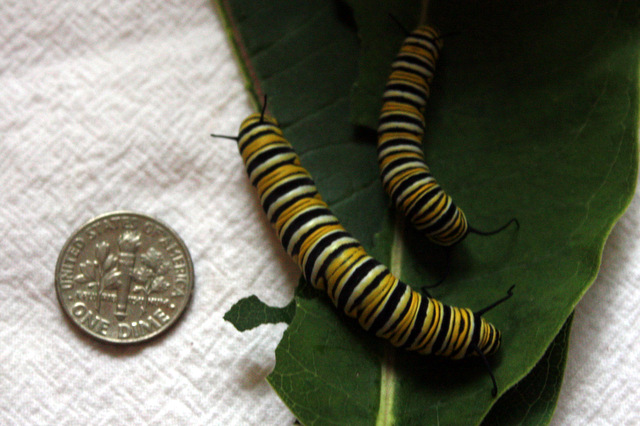
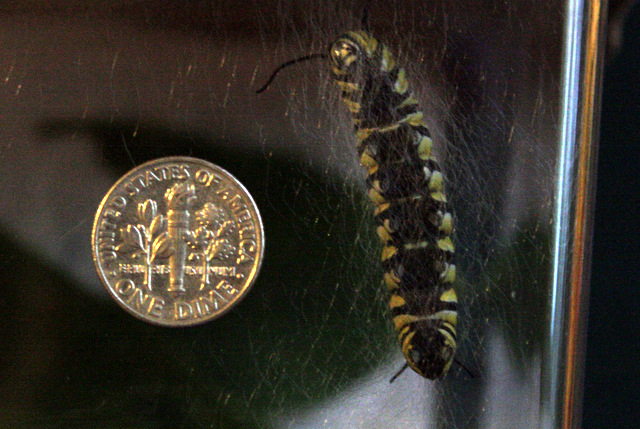
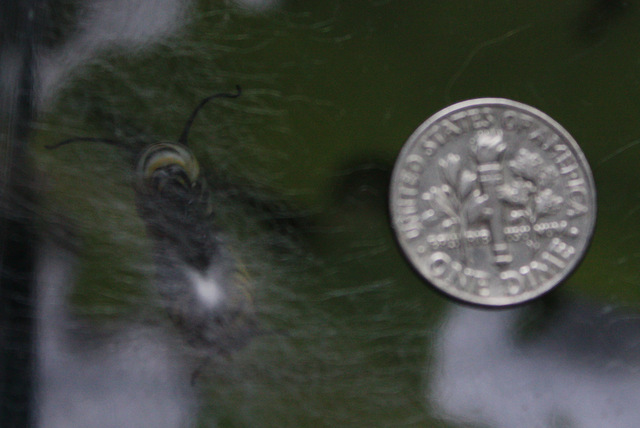
I thought I would remember all of the details of this caterpillar’s life – when he hatched, when he molted, and on and on – but of course I didn’t. It’s hard enough to remember with just one caterpillar, but we were taking care of six and, eventually, nine. But I did take a photo every day, with a dime as a reference for his size.
July 18 – newly emerged and eating the egg:
July 19:
July 20:
July 21:
July 22:
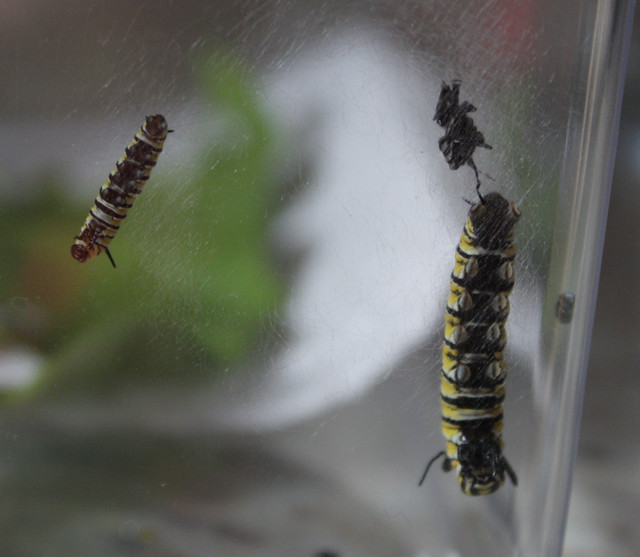
That night, I found him hanging by a silk thread off the side of the cage. I hadn’t seen anything like this before – I didn’t even realize they spun silk for moltings until this moment – and didn’t know what to do. Was he stuck? Was this part of the molting process? I wasn’t sure if I should intervene or let him figure it out.
But 20 minutes later, he was still there and appeared to be struggling because he was twisting and turning, and was even folding himself upside-down, seeming to be trying to bite at the spot where he was stuck. I decided I had to do something, so I gently brushed a Q-tip on the side of the cage, sweeping him onto the “floor.” He then quickly walked off the thread himself, and I realized I had done the right thing.
July 23:
July 24:
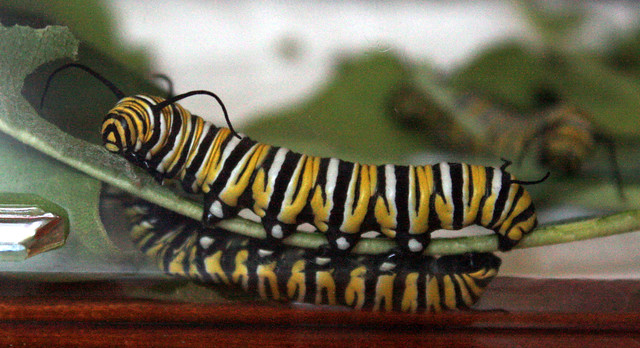
July 25 – suddenly, they get really big really fast:
July 26:
July 27:
July 28 – last day before the transformation:
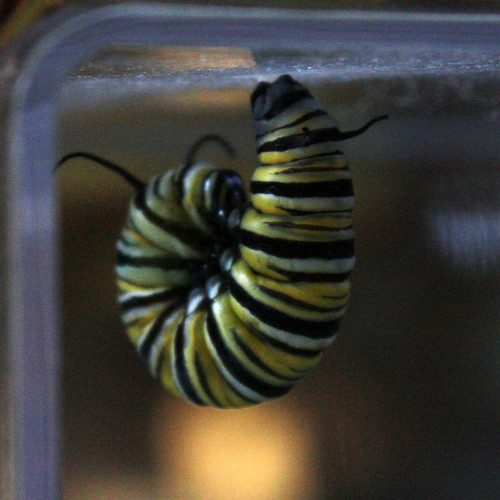
Night of July 28 – getting into position. Their bodies are shorter and fatter at this point.
Morning of July 29 – hanging from the silk pad:
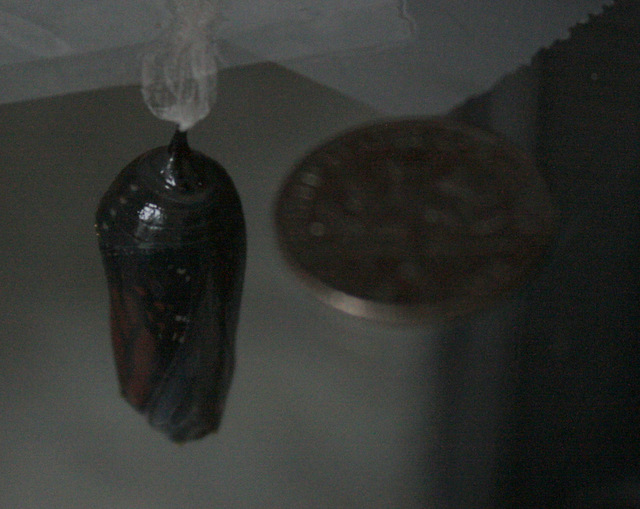
Later that morning, a chrysalis:
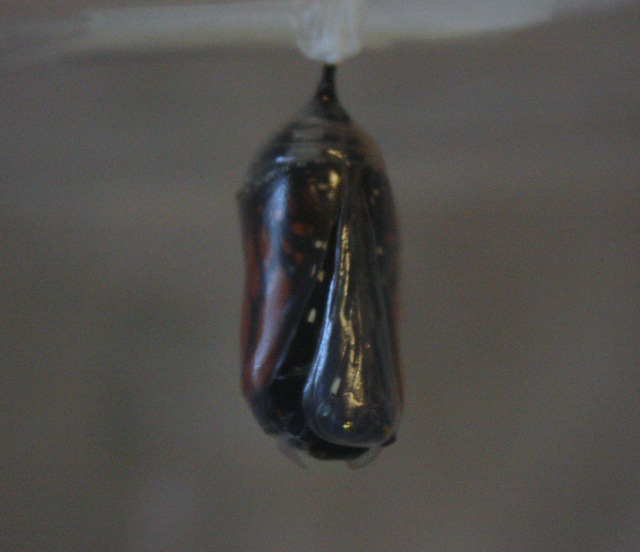
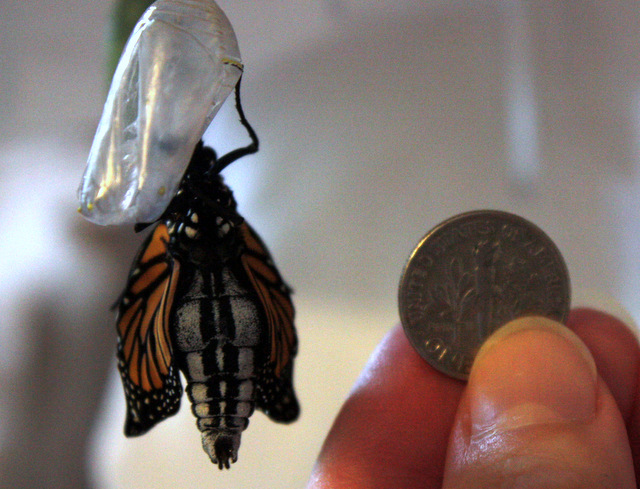
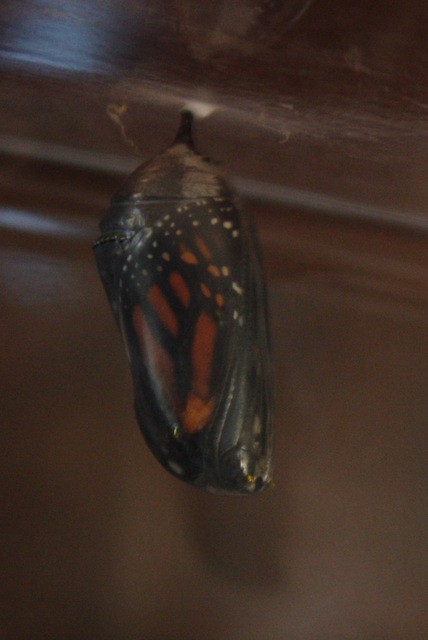
Eight days later, the green is gone and orange-and-black wings are showing through:
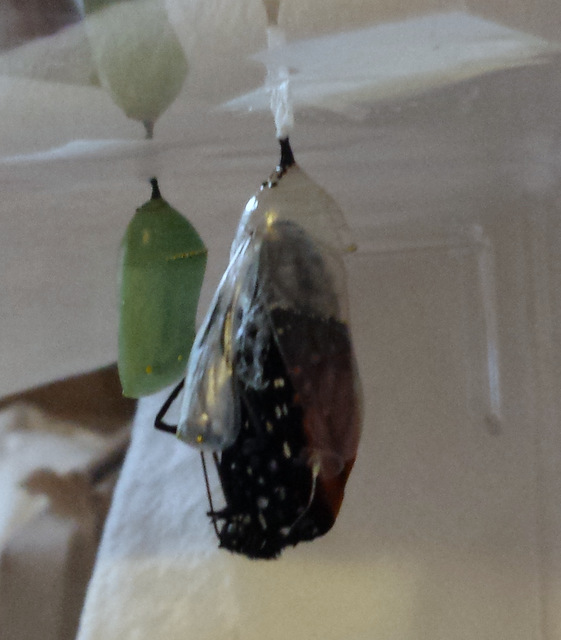
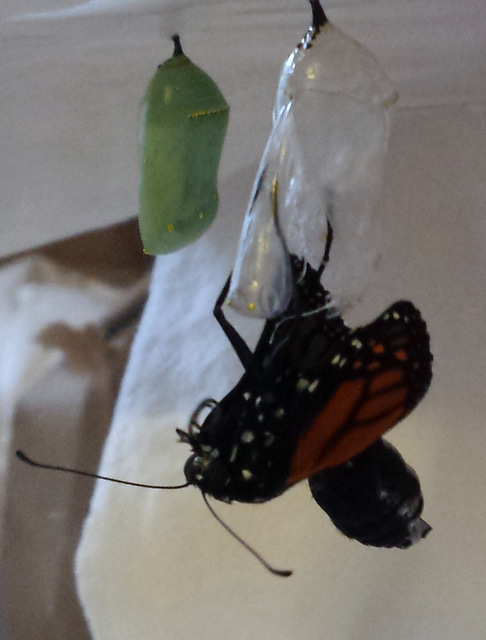
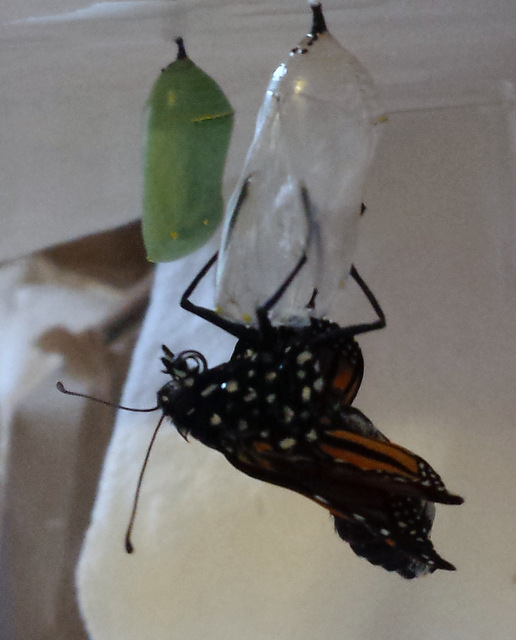
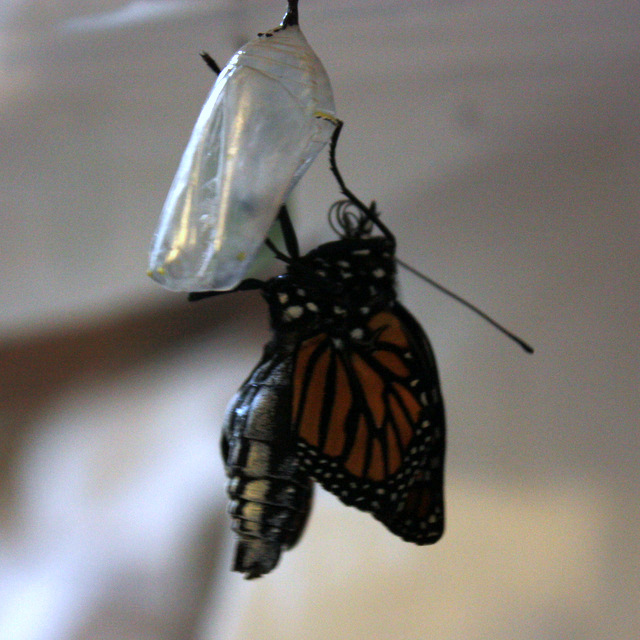
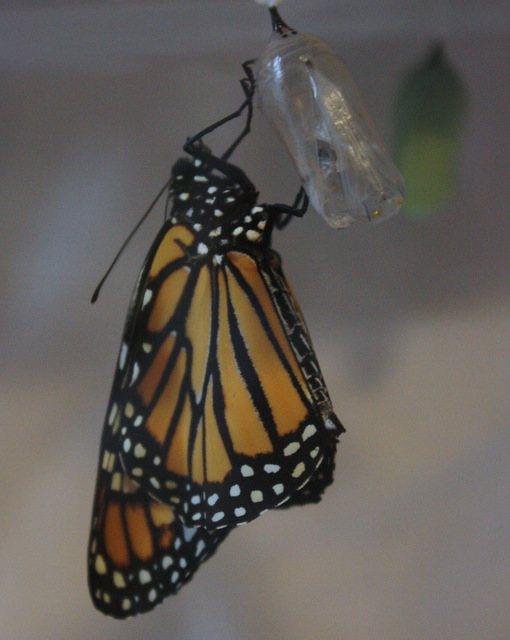
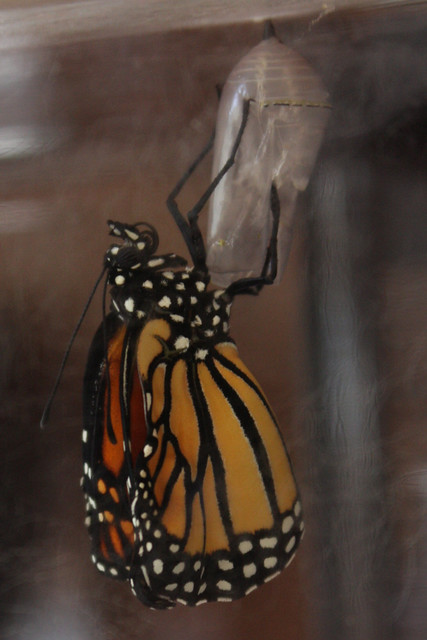
The next morning, I woke up early to try to catch the emergence. And then I waited… and waited. Two hours later, he finally emerged:
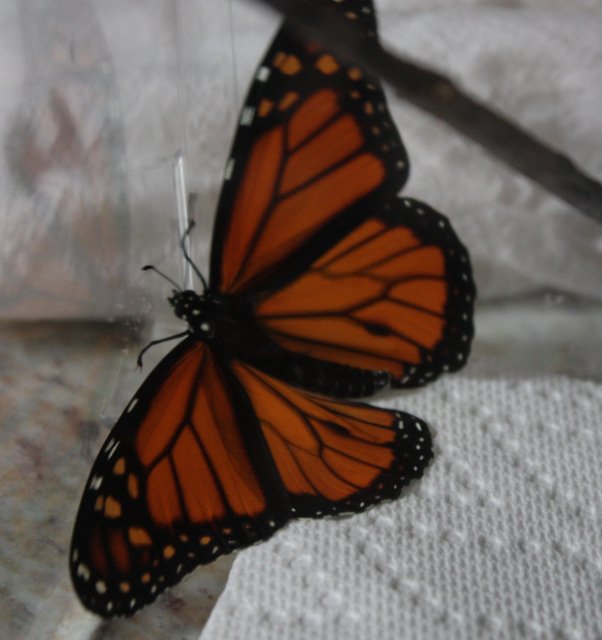
And now I had confirmation that I was right to call it a male. (Though that was just luck, since you can’t tell the difference at the caterpillar stage.)
Unfortunately, he emerged on the first rainy day in more than a week. Best practices say you shouldn’t release butterflies in the rain because they’re too light to tolerate raindrops, so this was the one I previously mentioned looking wistfully out the window:
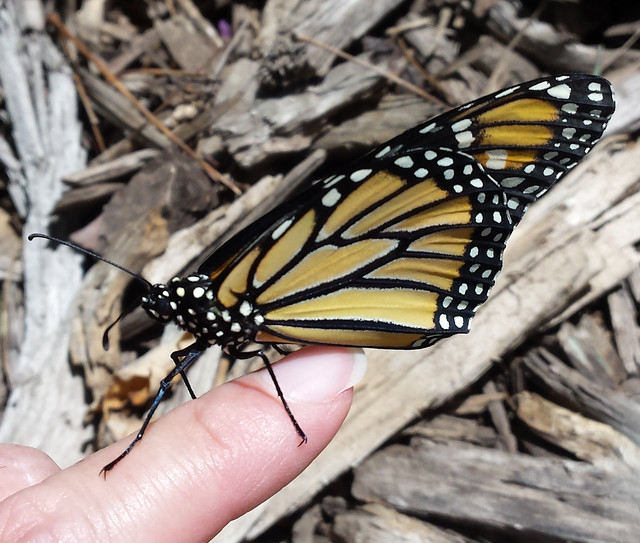
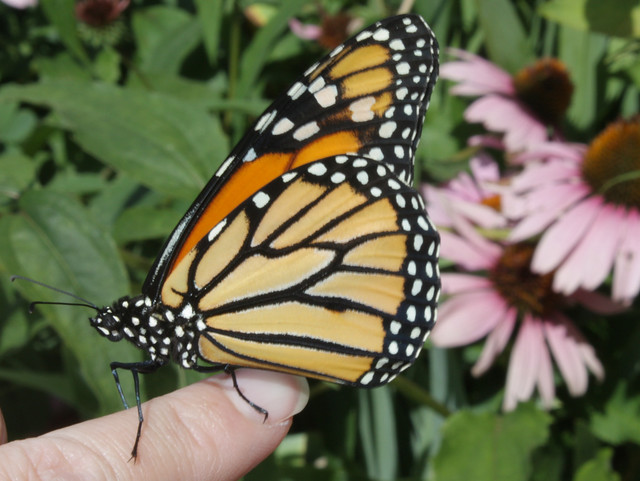
The next morning was sunny, and he was ready to be released:
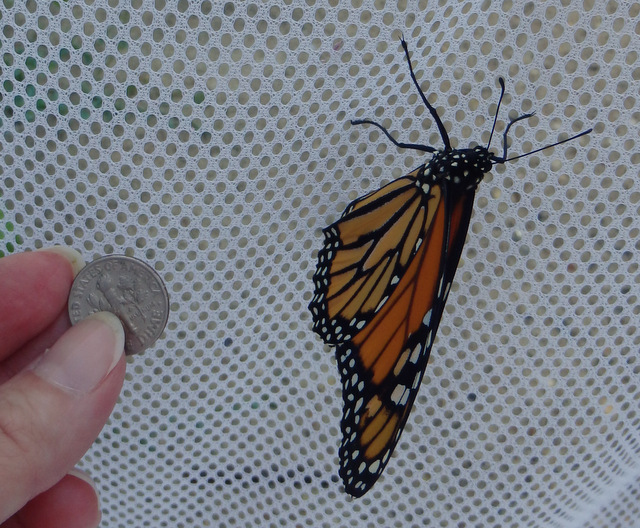
One last comparison with a dime:
Then I moved him to a black-eyed susan, and off he flew:
According to several monarch sites, only around 5 to 10 percent of monarch eggs result in butterflies. The rest are struck by predators (including ladybugs!) or disease. And the population of adult monarchs that overwinter in Mexico has dropped dramatically over the last several years.
We’re doing our part to help the population rebound by bringing them indoors. I want to help them all, but we only have so much space (and time), so I’m doing the best I can with the ones in our care. This generation, that meant nine caterpillars: three brought in as caterpillars, six that hatched inside. There also were three other eggs that didn’t hatch.
The last six weeks have been a blur of eggs, caterpillars, moltings, milkweed, chrysalises, and wings. Plus dozens of milkweed leaves.
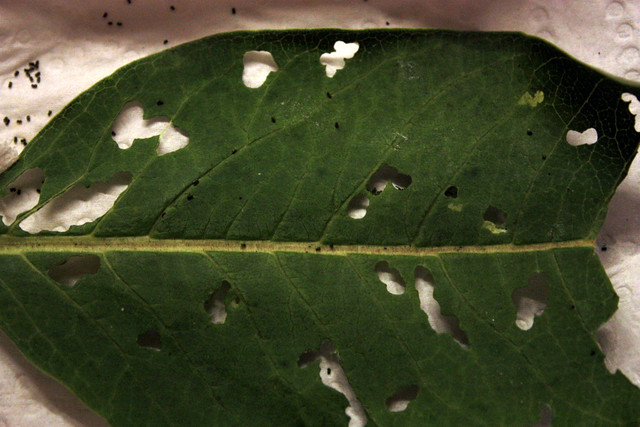
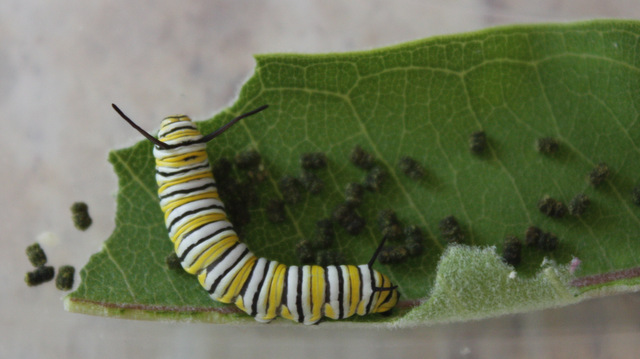
And poop. Lots and lots of poop. (Or to be more scientific, “frass.”) When they’re little, the poop looks like pepper flakes.
I don’t prefer the term “larva.” I know it’s scientific, but it sounds like something undesirable and writhing and creepy. I’m going with “caterpillar.”
Same with “pupa” – it’s a beautiful green chrysalis.
The system I’ve settled with:
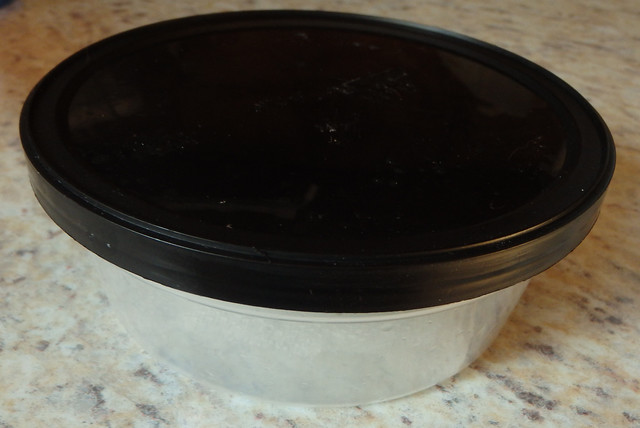
incubator (for eggs that haven’t hatched) – this would be better with a clear lid
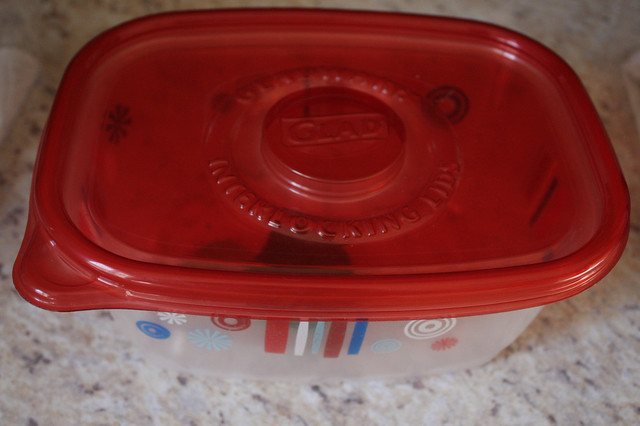
nursery (for the littlest hatchlings)
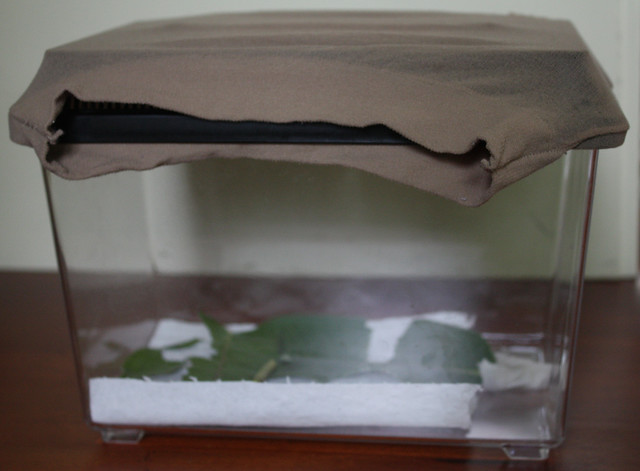
small cage and big cage for caterpillars, sorted by size, using nylons over the openings so they don’t escape
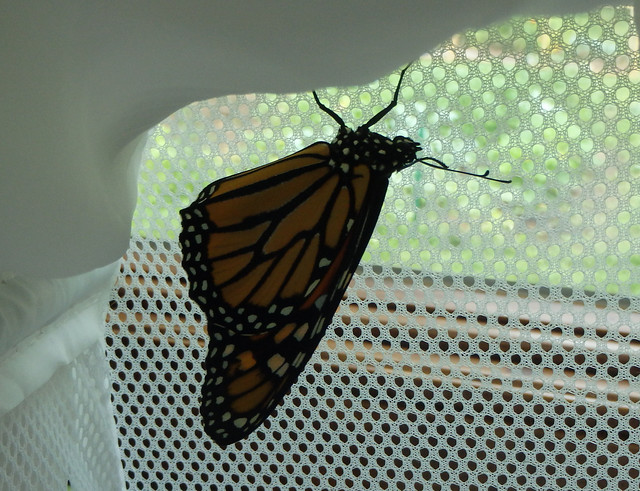
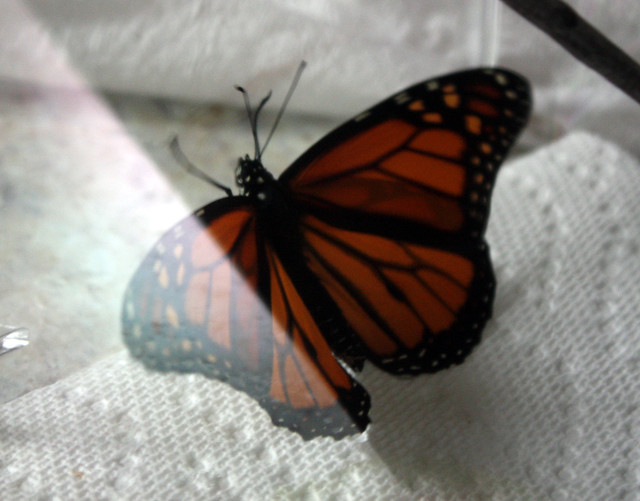
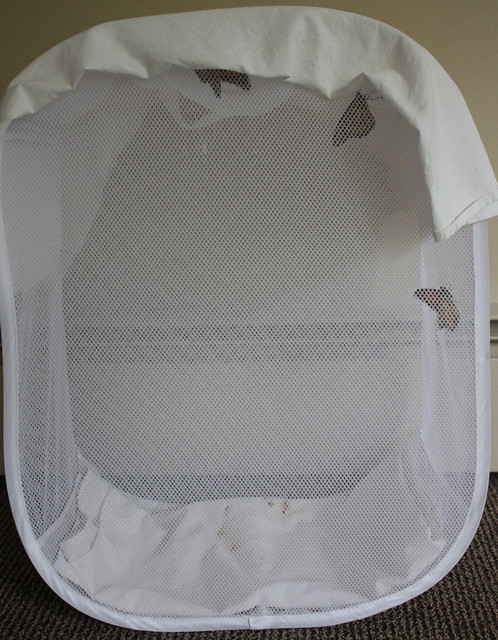
laundry hamper for when a butterfly hatches but I’m not around to let it go for a couple hours. We found out with the first butterfly that after its wings are dry, it will be ready to start flying – and then it panics when it can’t climb back up the plastic walls.
These hampers give them more space to move and even fly a bit.
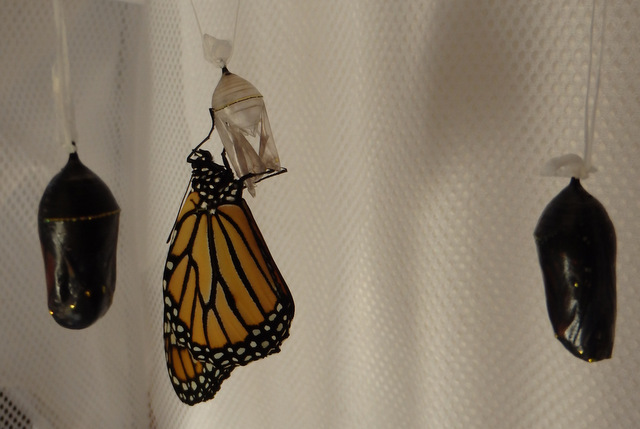
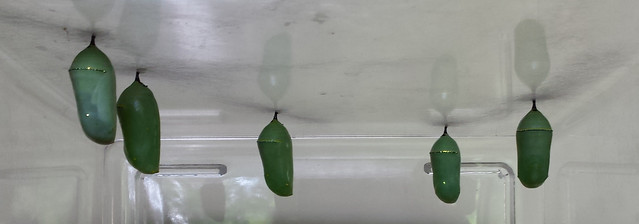
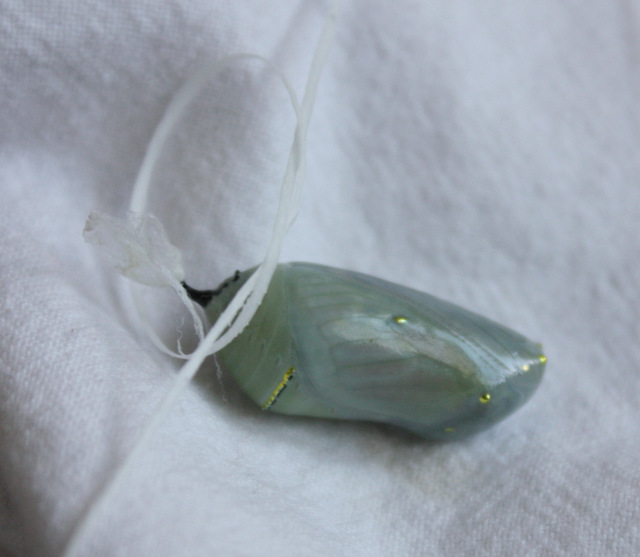
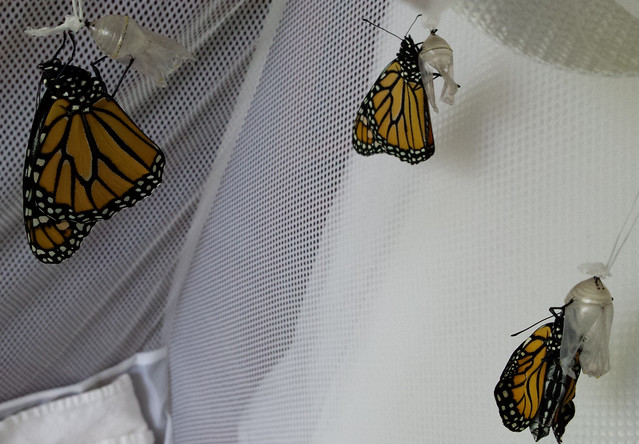
I’ve gotten pretty good at relocating chrysalises – something I never thought I would do. They form the chrysalises in the plastic containers, but most days, leaving them there isn’t a good idea because I am not home to release them right away. One site suggests knotting dental floss around the cremaster, and that works well. I then tie it on the strap of the laundry hamper.
I watched two caterpillars transform into chrysalises – a process that’s both strange and exciting.
The sites say that butterflies emerge after 8 to 12 days of being in a chrysalis. Our first chrysalis started turning dark on day 5, and by day 6 I was fearing the worst. There are a number of things that can happen, from tachnid flies to black death to the OE parasite. But my worry was unfounded: the butterfly was simply finishing earlier than expected! I was so relieved to see wings starting to appear through the chrysalis.
Sure enough, at 8:20am – when I was in another room getting my things together to go to work – it eclosed (scientific term for emerged).
The emergence happens so fast, it’s very easy to miss. Once it even happened when I was in the same room, and I still missed it! But I did see two of the nine butterflies come out.
Then comes the release. Many of the butterflies arrived on work days, so I needed to come home over lunch to let them out. The first was released on a windy roller-coaster of a day. (Yes, I did get teary-eyed when she flew away.)
We released second caterpillar at our friends’ brand-new home; their daughters named him Eric. He took a short test flight and then rested in a tree.
One exciting day, THREE monarchs emerged!
We had to keep two overnight – one because of weather (don’t release them in the rain) and one because we weren’t home during the afternoon – and they did not like being kept inside.
Though we did provide them with a delicious dinner.
I’ve learned a lot: for example, the caterpillar I filmed “out on a stroll” in the garden was probably looking for a quiet place to molt. (Good rule of thumb: they know what they’re doing and don’t need help from humans.)
They eat a lot. Fortunately we have enough milkweed. They don’t seem to like the butterfly weed, even though plenty of eggs have been laid on butterfly weed. Now that it’s late in the season, though, the milkweed isn’t looking so good. I’ve been trimming it to encourage new growth.
And now: the final generation of the season is underway, the ones that will migrate for the winter. So far I’ve found two cats and four eggs. It’s a lot of work, but I think it’s worth it.
So many bees. Lots and lots of big and little bees have been visiting the garden this summer, and they’re getting busier and busier as August rolls along. It’s been fun to watch their antics.
I had a video of several types of bees all ready to go – even uploaded to YouTube – and then realized there are many other pollinators I could include. I have photos but not video of any wasps, like the great black wasps that have been spotted on several occasions. And the turtlehead is blooming now, enticing bumblebees to climb into its blossoms. Soldier beetles are all over the black-eyed susan. Several kinds of butterflies have visited the common milkweed. And how could I forget joe-pye weed, which attracts pretty much every insect in the yard? I need to get back into the garden and add more.
Of course, I could think of more flowers and insects to film until it snows, so I need to start somewhere. Here’s a short compilation of six flowers and their bees.
Someday I may be able to identify more than just bumblebees and honeybees. My guesses:
Honeybees on butterfly weed
Small bees (resin bees?) on culver’s root
Bumblebee and other bees on cup plant
Bees (resin bees again?) on blue vervain
Tiny bees (sweat bees?) and soldier beetles on goldenrod





















 crystallofolia