The stiff goldenrod began blooming this week, and that’s attracting many bumblebees and honeybees and at least three locust borers, which are yellow-and-black longhorned beetles. And then I spotted this:

long and thin insect, mostly black with two yellow horizontal bands around the middle, with transparent wings

It looked like a tiny hummingbird moth with its transparent wings and tail shaped like a lobster’s. In fact, when I searched for “clear wings lobster tail,” all the results were about hummingbird moths – but this is just a fraction of the size, and it doesn’t flit like a hummingbird but instead it acts like a bee or fly. It swishes its “tail” up and down like a mermaid.

Instagram to the rescue. Just 20 minutes after I posted a photo and asked for help identifying the insect, one of my buddies identified it as a clearwing borer moth, and I think I’ve further identified it as a dogwood borer.

The University of Minnesota’s Center for Urban Ecology and Sustainability calls clearwing borers “native pests” that sometimes kill trees and sometimes don’t cause serious damage.
This is the third borer I’ve seen in the last two years. The others:

Perhaps the most famous borer these days is the destructive, invasive emerald ash borer beetle – fortunately, I haven’t seen one of these yet. And there are others that aren’t quite as destructive, though they do cause damage.

More about clearwing borer moths


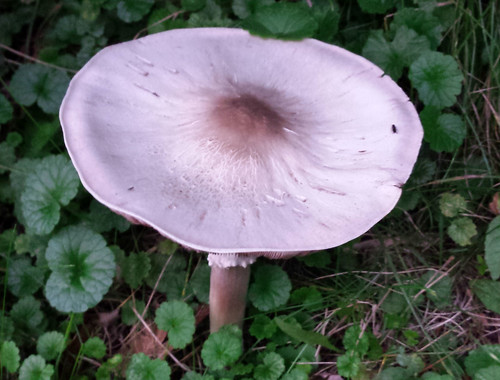
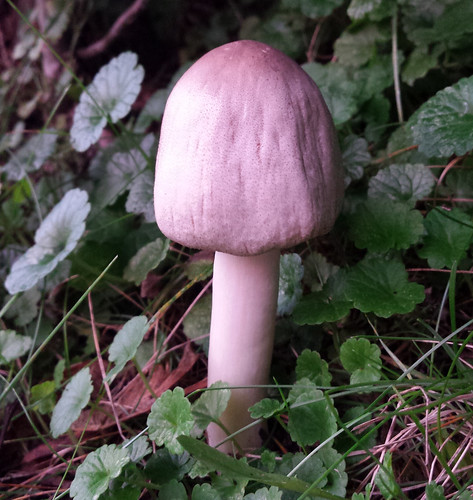
We’ve received a lot of rain over the last two weeks. On Wednesday when I got home and was making my rounds through the gardens, this cute mushroom jumped out at me from under a tree on the hillside:

mushroom with a thick white stem and a beige rounded cap

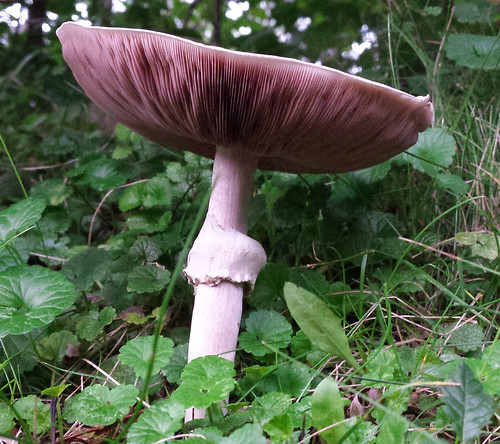
The next day its “umbrella” had unfurled.

top view of a flat, round mushroom with a darker spot in the center

side view of the mushroom, with many gills

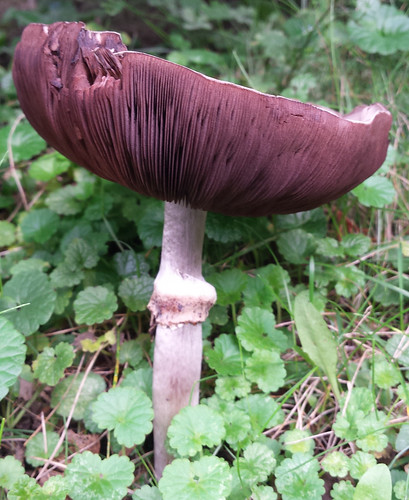
And one day later, the umbrella was turning brown.

same view but the gills are much darker and starting to fall apart

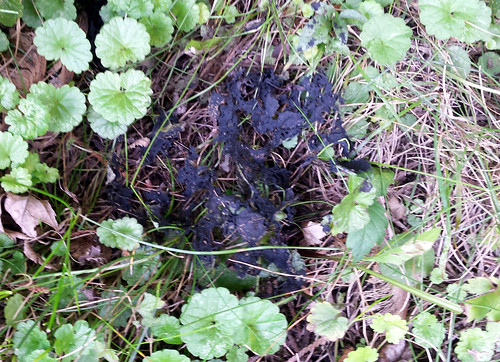
We were out of town for the weekend, so I didn’t see what happened next. All I know is that on Monday evening, this is what I found:

decomposed black plant material

…which makes me very interested in finding another one so I can watch it every day until the end to see what happens at each step.

Though I can guess that it’s some type of inky cap mushroom, based on the disintegration behavior, DO NOT take this as confirmation or denial for identification purposes. I am way too nervous about mushrooms’ potential for being poisonous, so I’ll just enjoy them in nature and leave my mushroom-eating to what I find in the store.

Giant bumblebee? Small hummingbird? Flying shrimp?

bee balm with a large yellow-and-black insect

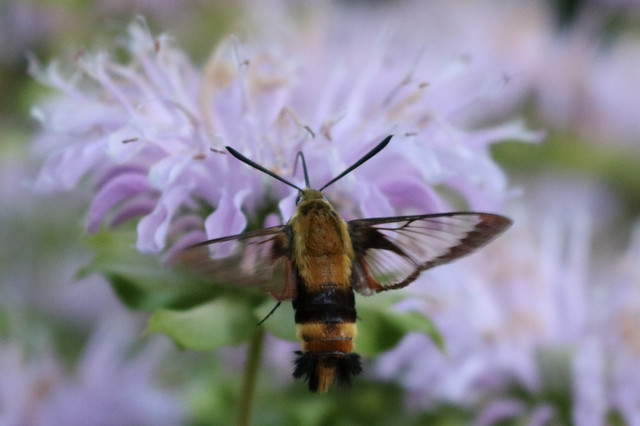
Twice in the last week I saw a hummingbird moth in our garden. The first time I had only my phone to document it. It appears to be a hummingbird clearwing, Hemaris thysbe, and sort of looks like a flying shrimp or lobster.

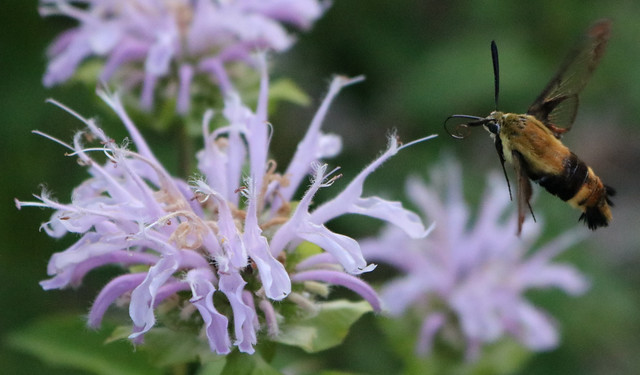
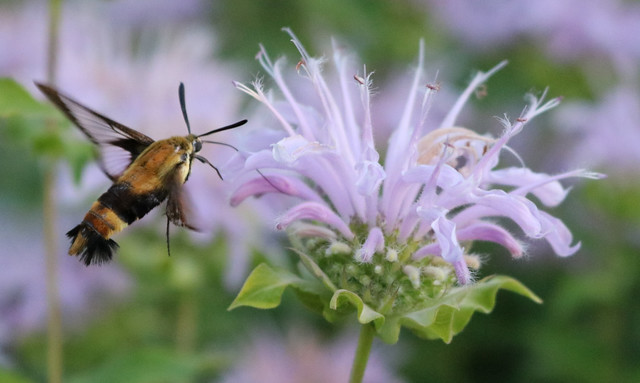
Yesterday, I was lucky enough to see one again when I had a “real” camera. This time it was a different moth – snowberry clearwing, or Hemaris diffinis – which looks more like a giant bumblebee.

yellow-and-black moth viewed from the left side, flying vertically with its proboscis inside a light purple bee balm

I reeled off more than a hundred shots, hoping that at least a few would be clear.

same moth viewed from above, its wings flat but blurry

A hummingbird moth looks like a hummingbird with its small size, darting behavior, and wings that move so fast they can barely be seen, but it is about half the size of a hummingbird and has antennae and a curling proboscis, which the birds do not.

moth nearing a bee balm from the top right, with its proboscis curled

Look how long the proboscis is when unfurled – all the way down into the flower:

moth to the left of a bee balm, with its proboscis extending two inches into the flower tube

The reason for the “clearwing” descriptor is obvious in this photo (at least, one of the clear wings is visible):

moth at the bottom left of a bee balm, with its left wing in focus and the green background visible through the wing

There are four species of hummingbird moths in North America, and in one week, I saw two of them in my own garden! Both times I saw this moth, it was evening, after the sun had gone behind the trees, and both times it was on our big cluster of bee balm.

snowberry at the right of a bee balm with its proboscis deep in the flower

hummingbird clearwing at the left of a bee balm, a little farther away but reaching its front foot to touch the flower

I also tried video both nights, with amateurish results because I could never accurately anticipate where they were going to go next – though a faint humming noise can be heard. This is the hummingbird clearwing:

And this is the snowberry clearwing:

Both nights the moths let me watch them flutter around for more than 10 minutes – and then, suddenly, each was gone.

bee balm on the left, snowberry flying straight up out of the top right of the picture

More about hummingbird moths

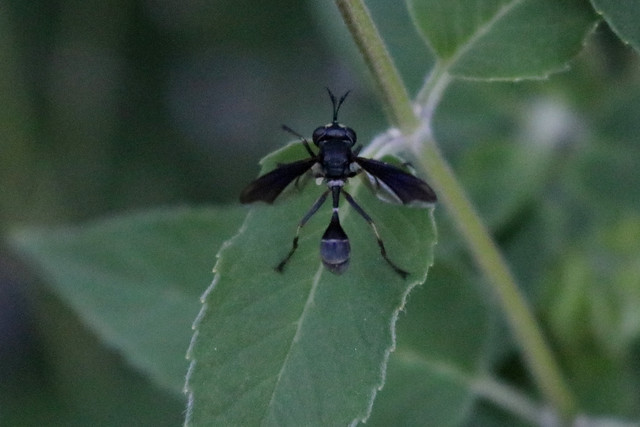
While wandering around the wildflower garden late last evening, I noticed a small black insect resting on a bee balm leaf. My first thought was that it could be the offspring of the potter wasp I observed a month ago since it was smaller than the wasp I saw in June.

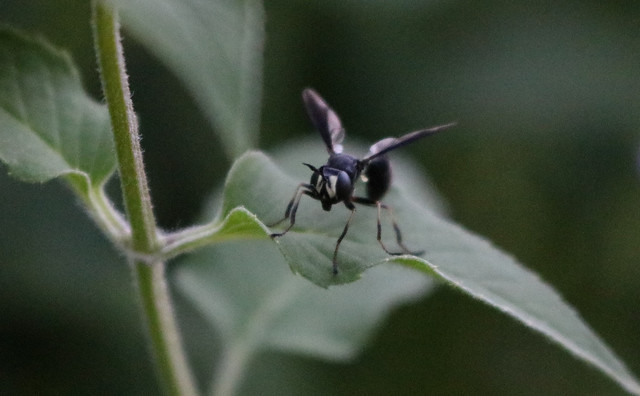
side view of a thin black insect facing to the left, with a white bands on waist and two on abdomen

But I have been fooled by flies that look like bees many times, so I decided to look closer. And sure enough, the antennae were short – a big clue that it’s a fly.

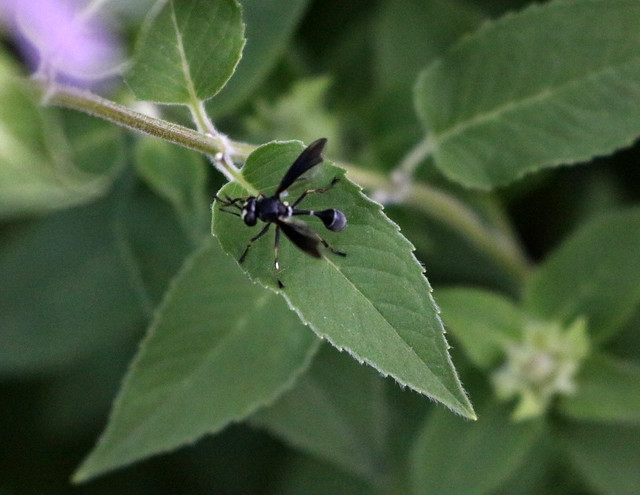
top view of the insect, with the two small antennae at the top

And then I noticed the big eyes – another clue. In fact, these almost look like cartoon eyes.

view from the front, with two large eyes and two large white spots in the middle

Diagnosis: thick-headed fly, possibly Physocephala furcillata. It’s a parasite that indirectly kills bees when it lays its eggs.

top view with the head facing left, showing the narrow waist

This fly is so similar to a wasp, on first glance, that I had to double-check my images of the potter wasp to make sure I hadn’t overlooked a key feature on that one, but I’m still convinced on the potter wasp. (Plus, I don’t think flies build pots.)

comparison of fly vs. potter wasp - hard to see wasp's antennae but heads are different

More about thick-headed flies


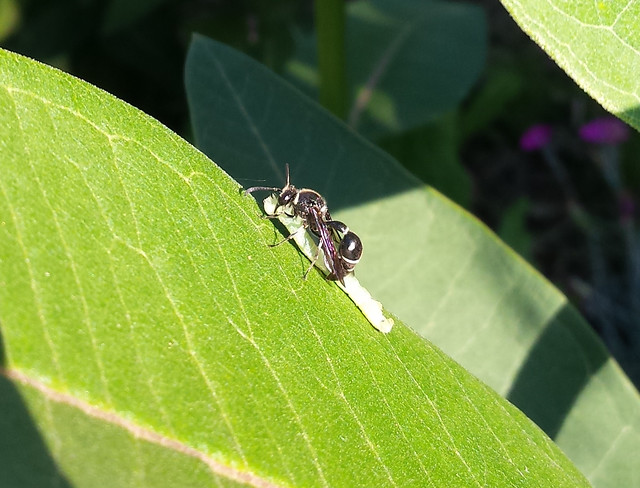
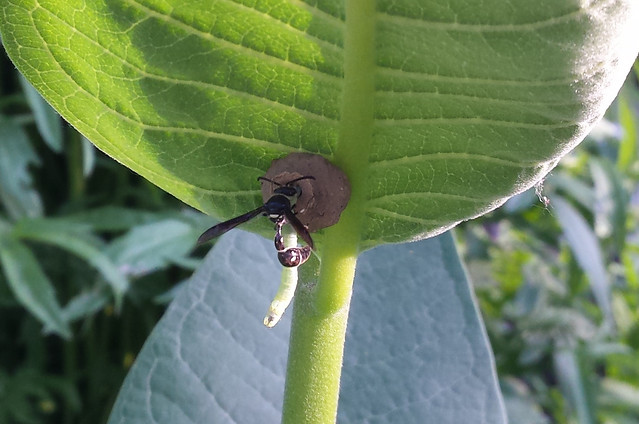
A large, strange insect was flying clumsily above the milkweed. It dropped to a leaf and I saw that it was a wasp carrying a green caterpillar (possibly a cabbage looper).

potter wasp standing above a long green caterpillar on a large, green leaf

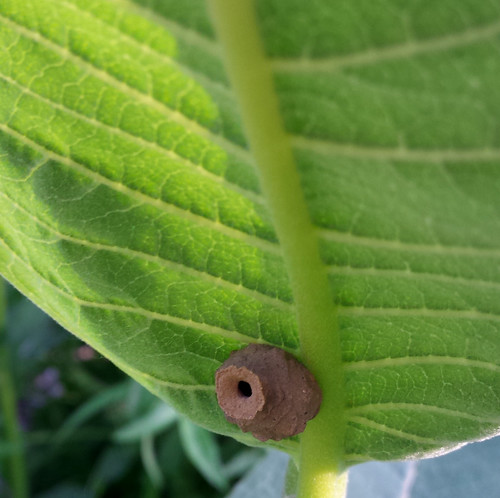
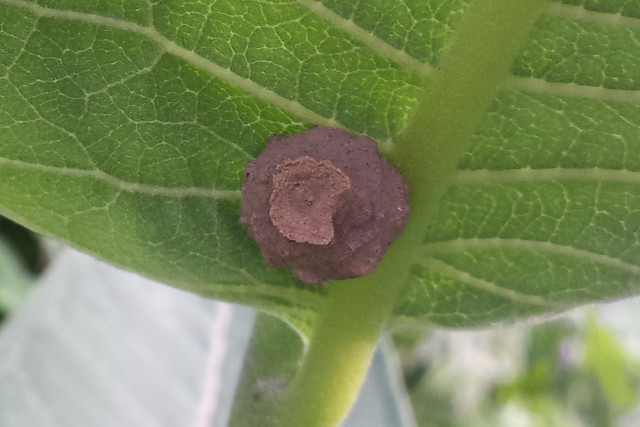
I thought it was eating the caterpillar until I noticed a mud nest on the underside of another leaf.

small mud nest at the base of the underside of a milkweed leaf

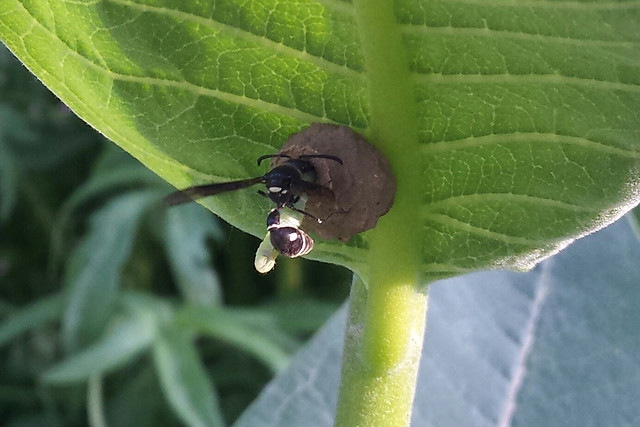
Soon the wasp flew to the nest and crammed the caterpillar in.

wasp at the base of the mud nest, with nearly the entire caterpillar hanging down

more than half of the caterpillar has disappeared

less than an inch of the caterpillar is still visible

Then I realized that this is a wasp that was paralyzing the caterpillar to store it as food for its young (currently an egg) in the nest. An Instagram friend identified it as a potter wasp, which shouldn’t be surprising, given the shape of the nest. The next day, I was lucky enough to catch the scene again.

wasp walking up the milkweed stem while carrying a paralyzed caterpillar

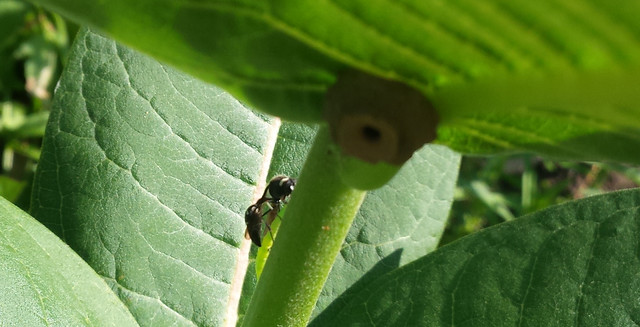
This time it started out the same, but the last inch or so of caterpillar took a lot longer.

Perhaps the pot was too full this time? She worked and worked from all angles to make it fit.

Eventually she was done.

potter wasp nest, just before sealing, with some green showing inside the pot hole

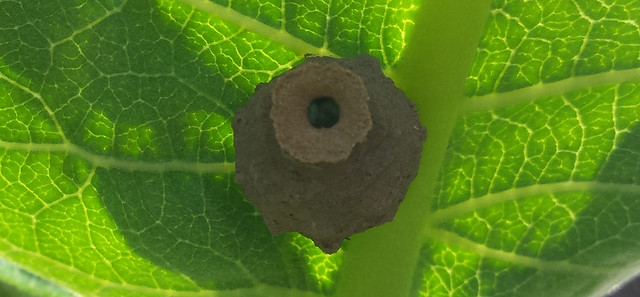
A couple minutes later, she apparently came back and sealed it up (unfortunately I missed that step) and in the process, part of the “lid” chipped off.

nest with the hole sealed, and a chip off the right side of the lid

It’s now two weeks later, and the pot looks the same. The egg will eventually hatch, and the larva will eat the stored caterpillars and then chew its way out of the side of the pot. One of the coolest things I have ever seen in nature – and it was all in my own front yard.