Over the last two weeks I’ve been reviewing and tagging and editing and sometimes deleting the thousands of photos I took in our garden last year. As usual, not every plant survived. Several of the failures on this list were considered successes just a year ago.
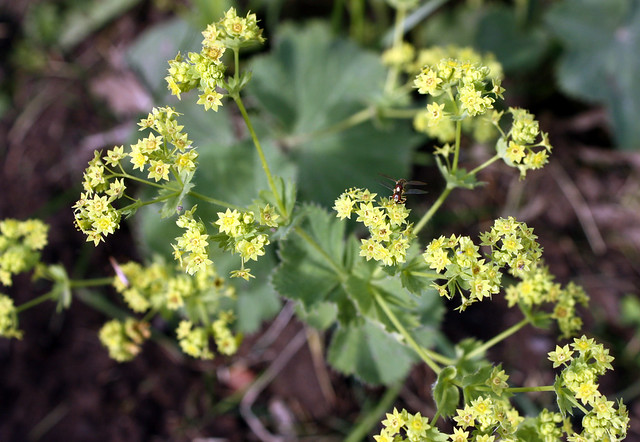
Lady’s mantle: This one was never one of my favorites – mostly because it was so subtle it was easy to overlook. The flowers are so tiny they are barely noticeable against the leaves. In 2015, not even the leaves grew. (This photo is from 2012.)
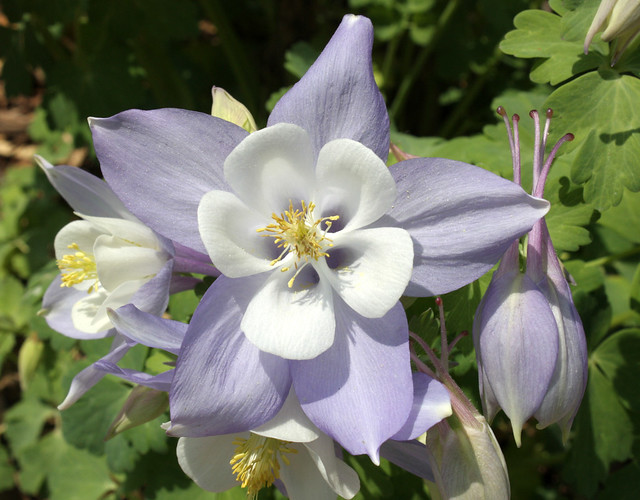
Columbine was on my bigger and better list in 2014, when this photo was taken, but it was completely gone in 2015!
Evening primrose apparently didn’t survive a squirrel attack in 2014. We have another variety of evening primrose in a different location, though. (This photo is from 2013.)
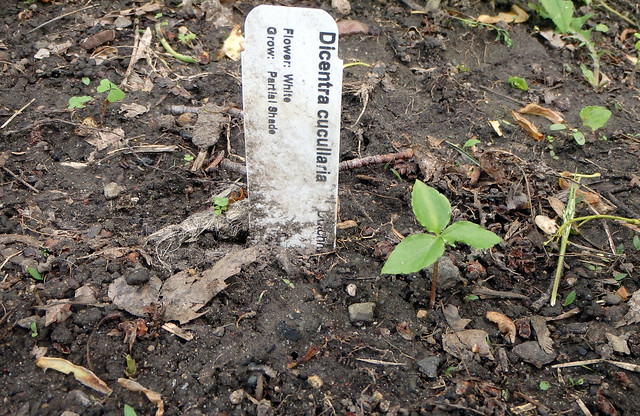
Dutchman’s breeches: This early-spring flower was planted in late 2014; nothing came up in 2015.
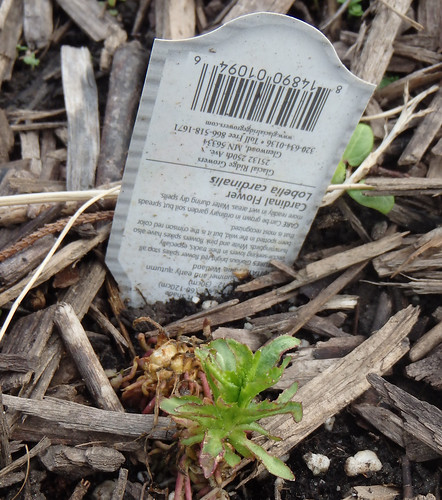
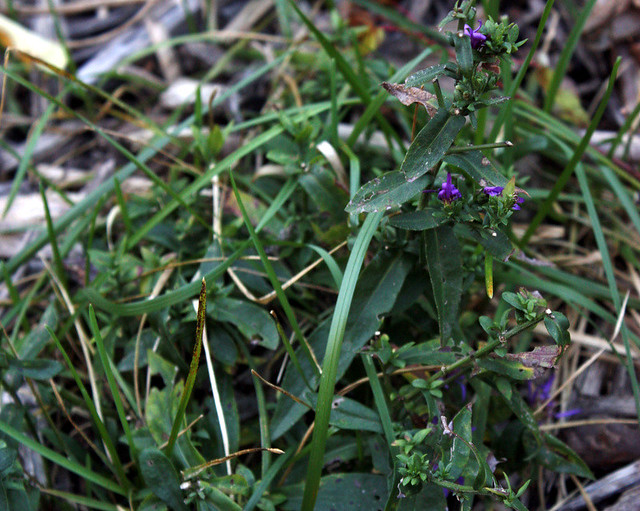
Cardinal flower was planted a couple years ago, but it’s never done more than this.
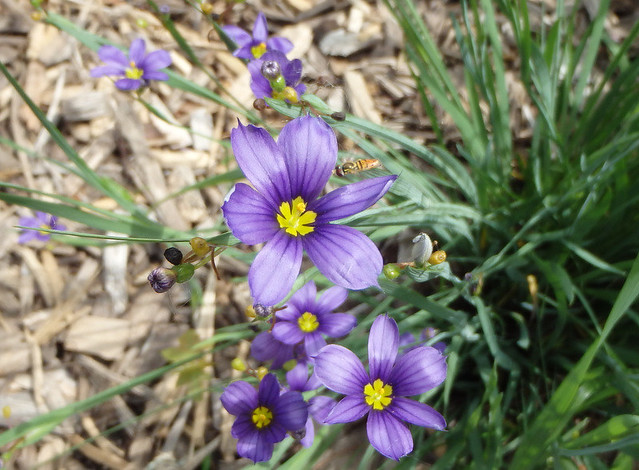
Blue-eyed grass: We’ve had mixed success with this one in the past; in fact, in 2014 I listed it as a failure in one location and a success in another. This year, the successful location disappeared too. (This photo is from 2014.)
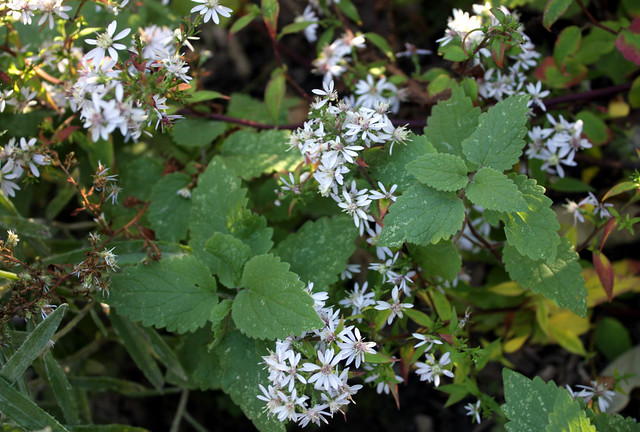
Still not getting much traction on native asters or New England asters. The native one did come back, though not anywhere close to its 2013 level, perhaps because giant hyssop seedlings are crowding it.
The New England divided plant came back decently in one location…
…and flamed out in another; will need to re-remove the grass from that location.
A hybrid New England aster (“Woods Pink”) started strong but crusted over early.
Hens-and-chicks: This was on the success list in 2014, when it bloomed for the first time. I put this on the failures list for 2015 because I think it disappeared. It was there in the spring, though smaller than in previous years, and then I never saw it again. When not blooming, it was nearly invisible against the woodchips, and I was always worried about accidentally stepping on it. It may be that it is still there and was hidden by another plant, likely the far-spreading geranium. (This photo is from 2013.)
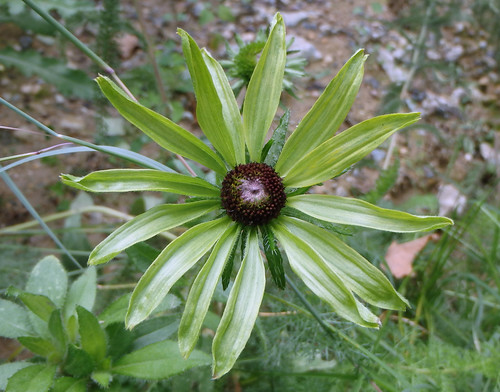
Our backyard “testing ground” had a lot of what I’m generically calling black-eyed susans, because I haven’t found a closer match yet. These were planted from a “seeds on a stick” mix from the DNR. (I wish I would have saved the label!) Some were fine, but some had green growths… and some were green flowers.
Seems to be aster yellows, which has no cure, so I pulled all of the affected plants.
(In researching this disease I found images of affected coneflowers, and I have seen that – though not green – in our purple coneflower. Will need to check that one carefully this summer.)
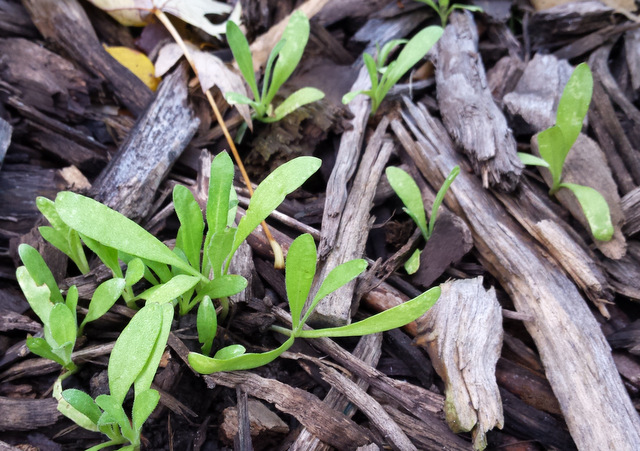
Most disappointing flower of 2015: native coreopsis. It was growing so well and flowering just a few months after we bought a six-pack of plants late in 2014, I was sure that we would need to divide it at least once in 2015 – but it disappeared. We kept the spot free all year, just in case, but nothing appeared.
But there were many more successes than failures – and I’ll show those soon.
We were treated to a nice autumn that lasted about two weeks longer than it usually does, but suddenly it’s cold. Our first lasting snow fell this week, and there is more on the way tomorrow. In the last couple of weeks, I collected lots of seeds from our yard.
Yellow coneflower,
blazing star,
joe-pye weed,
culver’s root,
stiff goldenrod,
cup plant,
purple prairie clover.
I packed up some seeds to share with coworkers…
…and made my own custom mix of these and eight more whose names didn’t fit on the envelope. (Now I’m noticing a mistake: we have stiff goldenrod, not smooth goldenrod.)
We’ll use these seeds – along with a grass mix from Prairie Restorations – next spring in a big area of our backyard that we’re converting from lawn. It would’ve been best to get them planted this autumn, but the lawn hasn’t been removed yet. I’m not sure how many of the seeds will grow in 2016 without being winterized, but I’ll try keeping them in the fridge until spring to help the process.
Some seeds were gathered to share – and some were gathered to prevent more growth. Milkweed is both. It’s pretty as one pod…
…but it creates hundreds more seeds than I need, especially since the plant also spreads underground.
Pearly everlasting results in thousands of seeds. I love the plant – and so do butterflies and bees – but it is spreading aggressively. I collected the seeds to get them out of the garden.
We also spent some time in cleaning up the garden before winter. I left most of the plant stalks where they grew, but I cut down the enormous cup plant and a couple others, storing the stalks in the backyard until spring, in case insects need shelter to hibernate.
And we divided and moved some plants. The irises were a couple years overdue, so their bulbs were packed tightly together. We split this group into three and moved it to new areas.
The snowdrop anemone doesn’t flower long, and now its leaves are taking over. We removed this big section from the main garden and planted it under a pine tree. I suspect that sometime in the future, we might be permanently removing it from the yard, but for now, we’re going to try it in a new location where it won’t crowd out the joe-pye weed and giant hyssop.
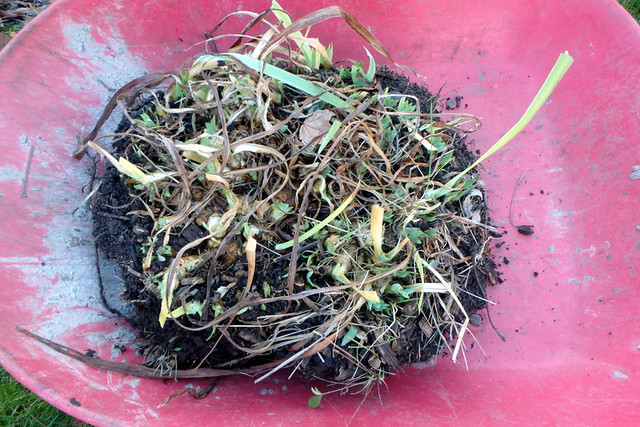
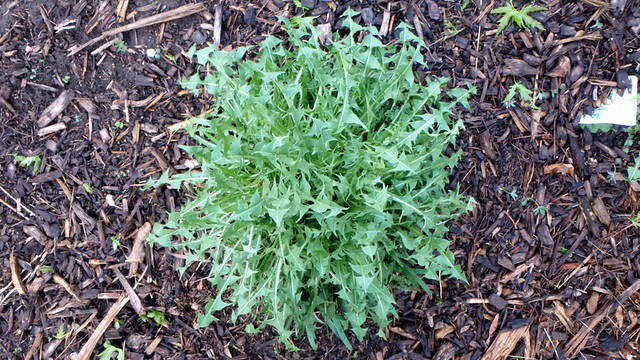
The most satisfying move: removing a giant dandelion that had been growing for three summers. It started out as a nuisance right next to a pretty allium two years ago. The dandelion’s leaves are barely visible in the bottom of this photo.
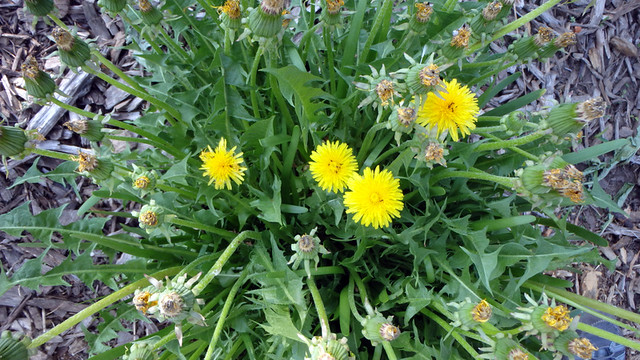
A year later it was intertwined with the allium, preventing us from easily removing it. The number of flowers was impressive. We always meant to separate the two plants, either in the spring or fall, but didn’t get around to it.
By this year, the dandelion was so big that it choked the allium.
This fall it was finally time. We were able to dig way down to the bottom (hopefully) of the root. Now the allium can come back.
Monarch season is long over in the north and we’re hearing reports of butterflies that have arrived in Mexico. It’s hard to believe that the three we released in September may be 2,000 miles away now! Here’s one last monarch post of 2015 to review our first season of raising.
I was an observer during the first generation of the season. During the second generation, we raised and released nine butterflies. During the migration generation, we raised four butterflies and released three (the fourth couldn’t fly).
I recorded 72 videos and took more than 900 photos, though I didn’t save nearly that many.
Why so few during the migration generation? I’m guessing it is because we had mostly common milkweed. By the time eggs were laid for the migration season, the common milkweed was not in great shape. I was imagining the female butterflies – who were still visiting the yard – saying, “Ew! I’m not laying my eggs on that disgusting leaf.” It’s a good reminder to diversify the plants to support a full season of insects. I’ve already planted swamp milkweed seeds and will look for more milkweed options next spring.
There was one pair of caterpillars that were always fighting for position. Even when they had climbed to the top of the cage, each was still trying to stake her claim. I felt like I was separating squabbling siblings more than once – “Just mind your own business. Move away so she doesn’t bother you.” – until I realized that I should leave them alone and let them figure it out.
Every day I brought in new milkweed leaves, ripping off bad spots. Many times late at night, I realized that I didn’t have enough and went back out into the yard with a flashlight to harvest more and save them in the fridge, just in case.
I never understood why they would always finish a wilted old leaf first, even when there was a new, fresh leaf available.
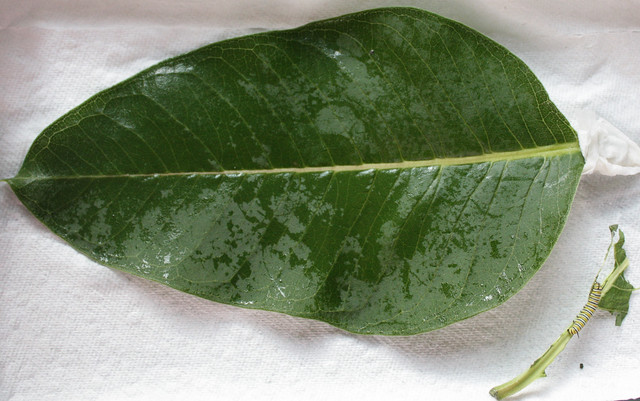
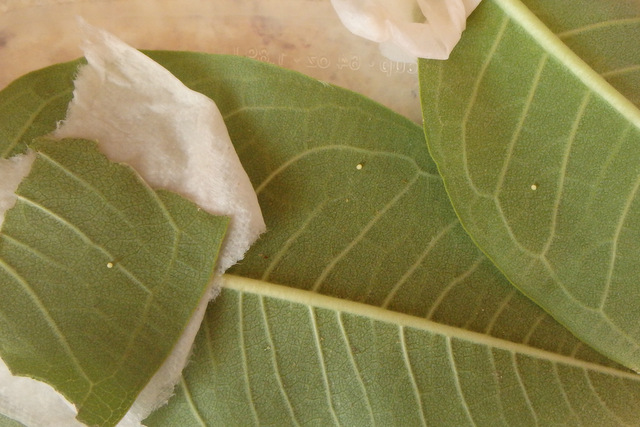
There were two “oops” caterpillars – two leaves I brought in for food had eggs I hadn’t noticed; one even got washed before I found it.
Right after molting, with no face…
…because the head capsule pops off during molting:
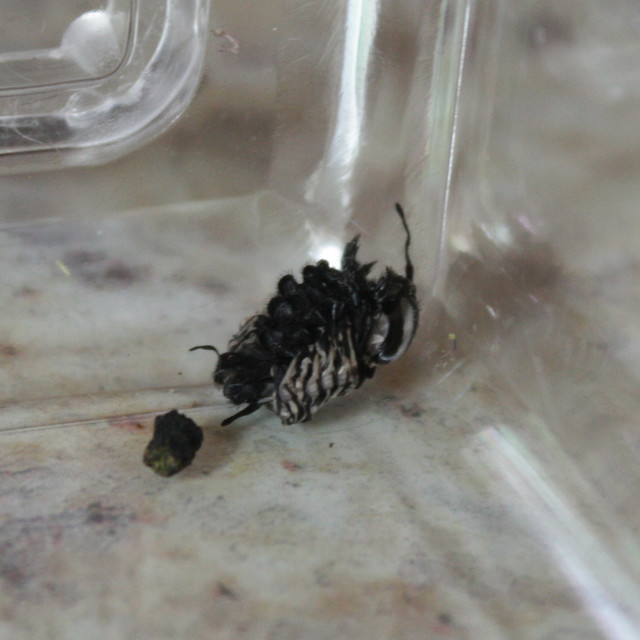
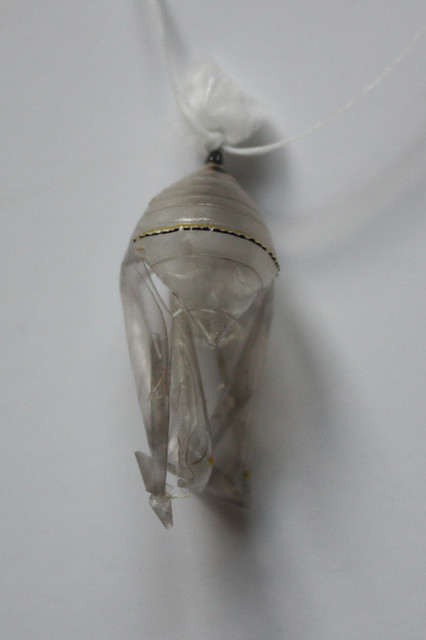
The fascinatingly creepy skin that’s left over after pupation:
Once the skin didn’t detach when the chrysalis was formed, but it turned out fine.
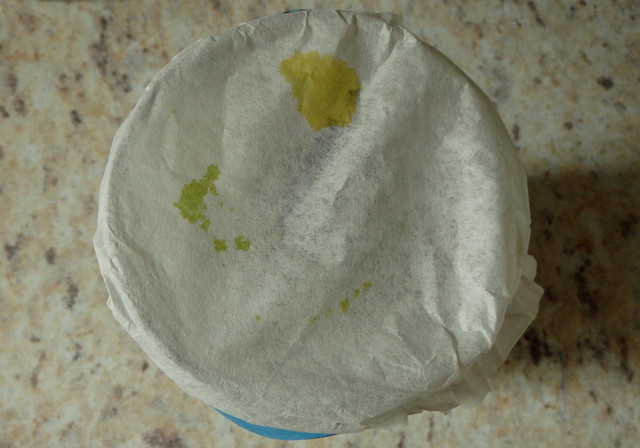
A bigger concern: one caterpillar started discharging a yellow-green liquid the day before she pupated. I isolated her because I was worried about a disease that could spread to another caterpillar, or perhaps the caterpillar had been infected by a tachinid fly that would emerge from the chrysalis (and kill it) and make a mess. But the butterfly was normal.
When a caterpillar is ready to pupate, it gets into position quickly; I only caught one caterpillar starting to make the long journey up to the top of the cage.
The caterpillars always seemed so surprised to find themselves at the top of the cage. “Wait, what is this green thing?”
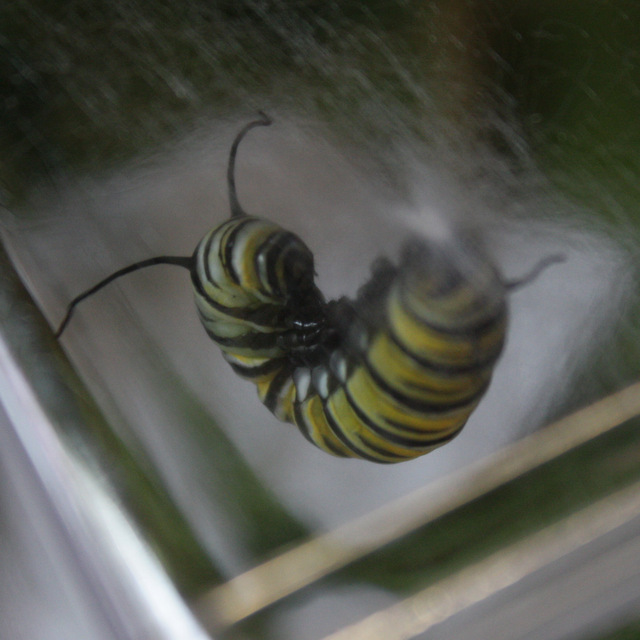
They go through an elaborate process to spin a web during molting and before pupation.
And another long process to create the silk “button” that will hold the chrysalis.
I’m always surprised by how much I miss the caterpillars when they chrysalis-ize. Things are suddenly really quiet, once a chrysalis forms.
When the first butterfly was ready to emerge from her chrysalis, I was worried she would fall, so I set up lots of towels for cushion. But she didn’t fall, and neither did any other. In fact, one hung from the empty chrysalis all day, then all night, and into the next morning, when I opened the cage to let her out.
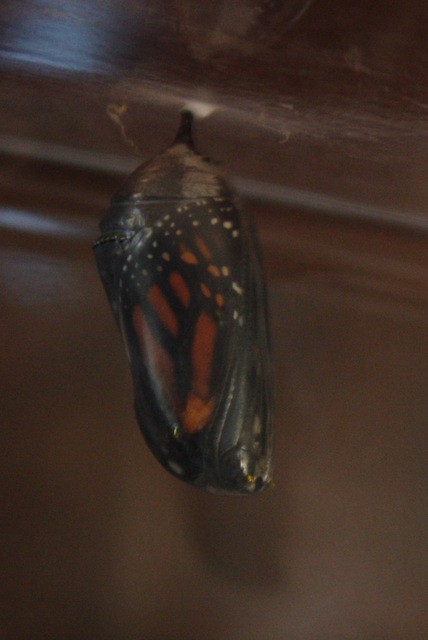
Right before the butterfly emerges, the chrysalis looks a little like Darth Vader.
It’s amusing how tiny and wrinkly the butterflies are when they first emerge. But it doesn’t take long for their wings to flatten.
They hold still for several hours while their wings dry.
One was so excited to leave that she tried to crawl through the towel that was draped over the top of the cage. I didn’t see her at first and was worried she had escaped.
But NONE of the butterflies escaped in the house!
All but one wanted help getting out of the cage. It’s a fun and funny feeling to have a butterfly crawl onto my hand.
All of them flew off into a tree immediately after they were released.
My favorite memory of the 2015 season: the sound of caterpillars chewing milkweed leaves.
Will we do it again next year? I’m not sure. It’s a lot of work – not so much on any one day, but over the couple of weeks during the caterpillar stage. It’s not possible to take a vacation while there are caterpillars. And some people advise against mass-rearing (although our “operation” could hardly be called “mass”), which makes me wonder whether we should raise any indoors.
It was a fun and educational experience, and I’m sure that I’ll want to do it again. It’s hard to see caterpillars in the yard and leave them, because I want to keep all of them safe until they turn into butterflies.
October is lingering into November. The temperature today was above 70, and the trees that still have leaves are gorgeous colors. Most of our garden is done for the year, but there are some signs of life.
Hollyhocks: one blooming, one budding
Native black-eyed susan
A couple yellow coneflower blooms
My best guess for this one is false aster. It’s been a cloud of white for weeks and shows no sign of stopping.
Ornamental kale – the only thing left in the pots of annuals
Reblooming rudbeckia – not as pretty as it was earlier this season, but spunky
One lonely dandelion
Lots and lots of calendula
The calendula is getting a head start on next year, too.
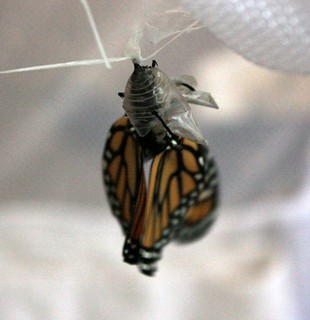
This was our first year of raising monarchs. Most of the time, when a butterfly emerged from its chrysalis, the big event happened before I woke up. So when it was time for the 12th birth, the day after Labor Day, I didn’t even try to wake up early to catch it. But when I checked on her, I noticed a that not only had she emerged, there was major problem: she was stuck in the chrysalis.
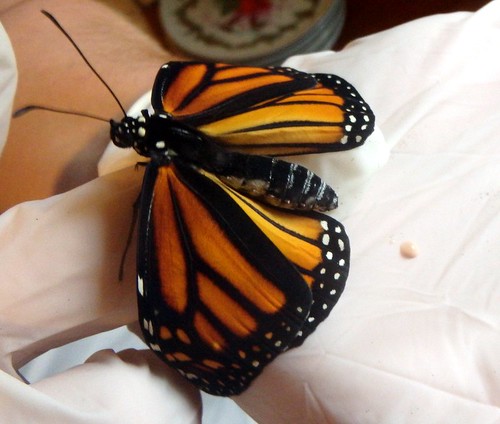
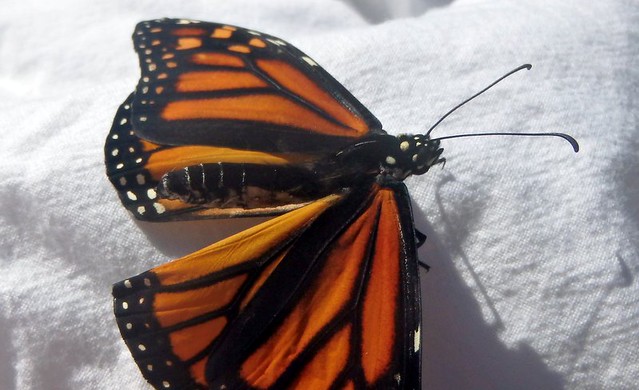
Her head and wings were out, but her abdomen was stuck to the very top of the chrysalis. It was obvious that she had been struggling to free herself for some time.
Best practices say that you should not help a monarch who is stuck. If this problem occurs, it is because something is wrong and the monarch isn’t healthy enough to live. But how in the world could I not help?! It was terrible to watch her frantic struggling. And I’m already helping by raising monarchs indoors, away from predators. Of course I felt like I had to help her.
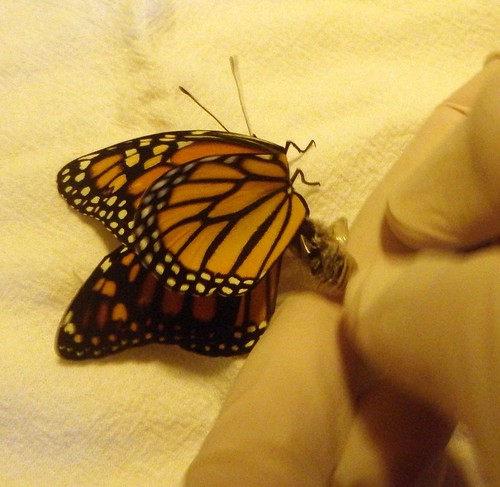
Luckily, my husband was at home that morning to assist. I cut down the chrysalis, and we gently laid her on a towel. It didn’t take much to pull the chrysalis off.
Her wings were limp, which I thought meant she might be new enough that she still had time to finish drying. I struggled to get her back into the cage because she was desperate to climb up my hands rather than be set down. She knew she needed to be able to hang to let her wings dry.
Unfortunately, when I got home from work that night, her wings still weren’t straight. I thought she flew a tiny bit but then realized it was more of a jump with a flutter. I had already decided to keep her inside overnight, and in the morning, not much had changed.
So what to do? It was the migration season, and she couldn’t fly. She needed to get to Mexico, or she would freeze or be eaten. Would it be more humane to euthanize her? Or should I keep her inside as long as she could survive?
There’s not a lot of advice for a situation like this. The only thing I could find was along these lines: “If the butterfly can’t fly, you should feed the butterfly sugar-water or rotten fruit.” Well, of course we should feed her. But then what? Do we keep her for the nine months that the migration generation lives? And even then, if she can’t fly, we wouldn’t be able to let her out even when the others returned to Minnesota in the spring. This was pretty stressful.
I mashed up an old banana and somehow managed to set her down near – or more accurately, in – it. By the time I had a chance to wonder whether she’d know what to do, I noticed her proboscis was already in the banana.
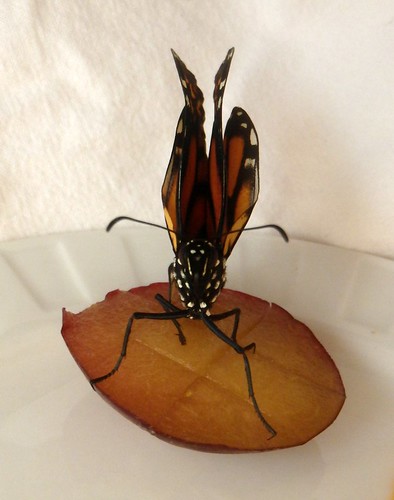
Later she was standing on top of a slice of plum, so I was assured she could move around on her own (even with fruit-covered feet). But it was obvious that her wings weren’t correct.
With the lack of a better option, we kept feeding her as the days passed. When I had first told people weeks earlier that I was raising monarchs, several people asked me if I planned to keep them. I thought they were crazy. The whole point is to raise healthy butterflies so they can be released. And now we were keeping one as a pet.
I took her outside when I released a healthy monarch. She seemed to enjoy sitting in the sun and made a couple attempts at flying.
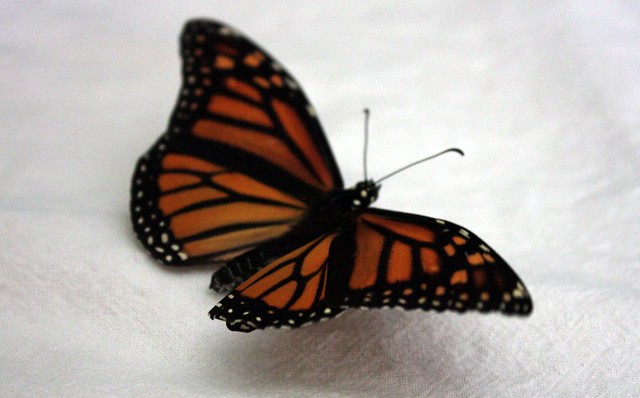
Five days after she emerged, she was very active. For an entire hour, she sat near the mashed bananas: drink, drink, drink, rest. Repeat. It even seemed like she was doing exercises, waving her wings and lifting her abdomen. And then she was trying very hard to fly. It didn’t work so well when she was on a flat surface, but if I picked her up, she could jump and fly away – except I eventually realized that she wasn’t so much flying as she was gliding; her path was always gently to the floor.
The following night she was even more spunky. She wouldn’t sit still anymore, walking all over the table and gliding over to the window and climbing the curtains.
Many times I picked her up and she jumped off my finger. She seemed determined to fly, and she seemed mad that it wasn’t working.
It seemed that she got discouraged after this. The next night, she would barely eat and only briefly tried to fly.
The next morning she was listless on the floor of the cage, one of her legs already folded up. It was time to help her go. Fortunately Bill was home to help me. We put a tissue in a jar to give her a soft spot to rest, and then placed a cotton ball soaked in nail-polish remover in the jar and sealed the cover. Almost immediately, she was gone.
I never intended to have a butterfly as a pet, but this one stole our hearts. I’m sad that something was wrong to prevent her from flying, and that we couldn’t fix her. Though if we hadn’t helped her out of the chrysalis, she would have died anyway. We did the best we could to help her.
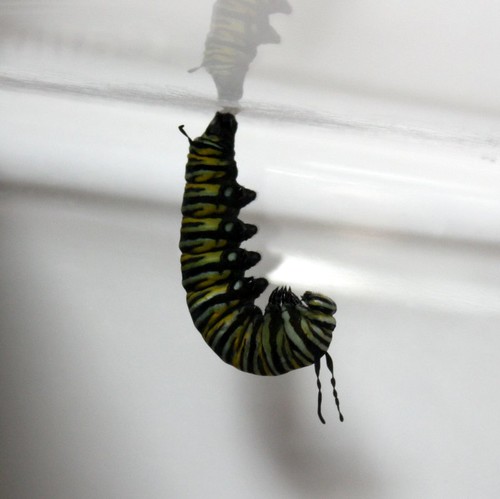
So what went wrong? Everything seemed normal when she was a caterpillar. The one thing I noticed was that it seemed to take her a really long time to get into the J position: she was at the top of the cage for a whole day before making the silk pad and falling back into the J.
But I watched her transform, and that process seemed fine.
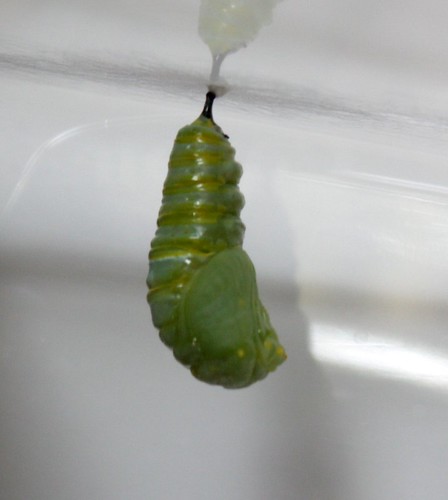
She’s the chrysalis in this photo:
But of course, she ended up stuck in the chrysalis. Also, her abdomen had irregular white marks instead of the usual defined lines.
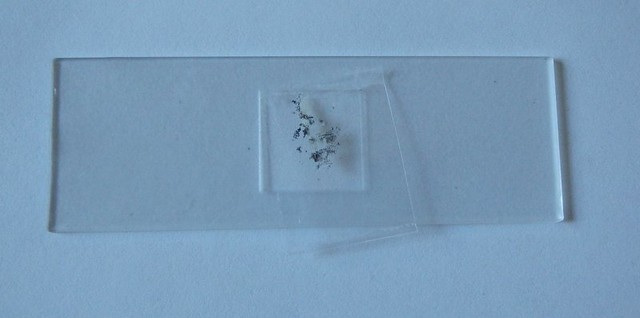
Because of those two things, I thought it might be OE, a parasite that lives inside monarchs and related butterflies. We collected a sample of her scales and used our microscope but couldn’t find anything. But since it’s a very cheap model and we weren’t sure it was powerful enough to see tiny OE spores, we sent it for testing.
Edith at Shady Oak Butterfly Farm didn’t find even one OE spore, proving that tests are needed to determine OE, not just observation. Here’s what she told me via email: “The problem is that the spotlight is so bright on OE that other diseases are openly doing their nasty work and no one blames them. They treat for OE and sometimes OE treatments won’t take care of the other diseases. … It reminds me of magicians imitating pick pockets. We are so busy looking at their right hands with the flashy tricks that we don’t see their left hands picking the subject’s pockets, right there in plain view.”
Another parasite, or a virus or disease, could have been the culprit. A younger butterfly – which had been raised in the same container as this one – was fine, though, which makes me think it wasn’t a contagious problem. Still, it’s a good reminder for next year that we will need to thoroughly clean the caterpillars’ cages daily (which we did this year anyway) and bleach them between generations (likewise) to try to prevent issues.
This post is now many years old, and I have closed the comments. I am not a butterfly expert, so I cannot provide advice to people who have butterflies that can’t fly. In fact, after two summers of raising a handful of caterpillars, I no longer do this. It’s a lot of work, but more importantly, research published in recent years shows that monarchs raised in captivity have less success in migration than wild monarchs. Learn more from Xerces Society: why captive raising isn’t the way to help monarchs.






















 crystallofolia